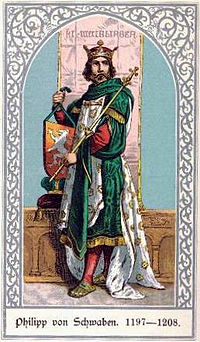
Philip of Swabia ( German: Philipp von Schwaben ; August 1177 - June 21, 1208 , Bamberg ) - Bishop of Wurzburg ( 1190 - 1191 ), Margrave of Tuscany ( 1195 - 1197 ), Duke of Swabia ( 1196 - 1208 ), King of Germany ( 1198 - 1208 ) , the youngest son of the Holy Roman Emperor Frederick I Barbarossa and the Palatinate of Burgundy Beatrice I of Burgundy . A well-educated and respected ruler, he spent 10 years of his life fighting for the crown of the Holy Roman Empire , but was killed by his daughter's rejected bridegroom.
| Philip of Swabian | |||||||
|---|---|---|---|---|---|---|---|
| Philipp von schwaben | |||||||
 | |||||||
| Predecessor | Gottfried von Spitsenberg | ||||||
| Successor | Henry III von Berg | ||||||
| |||||||
| Predecessor | Christian di Magonza | ||||||
| Successor | title abolished | ||||||
| |||||||
| Predecessor | Conrad II | ||||||
| Successor | Frederick VII | ||||||
| |||||||
| Coronation | September 6, 1198 , Mainz re-coronation: January 6, 1205 , Aachen | ||||||
| Together with | Otto IV of Braunschweig ( June 9, 1198 - June 21, 1208 ) | ||||||
| Predecessor | Henry VI | ||||||
| Successor | Otto IV Braunschweig | ||||||
| Birth | 1177 | ||||||
| Death | June 21, 1208 Bamberg , Germany | ||||||
| Burial place | June 22, 1208 , Bamberg Cathedral . On Christmas Day 1213, he was reburied in Speyer Cathedral . | ||||||
| Kind | Hohenstaufen | ||||||
| Father | Frederick I Barbarossa | ||||||
| Mother | Beatrice I of Burgundy | ||||||
| Spouse | Irina Angelina | ||||||
| Children | sons: Raynald, Friedrich daughters: Beatrice the Elder , Kunigund , Maria , Elizabeth, Beatrice the Younger | ||||||
| Religion | |||||||
The early years
Emperor Frederick I Barbarossa from childhood prepared Philip, the youngest of his sons, for a spiritual career, so he received a very good education for that time. In 1189, Philip was appointed probst of the church of St. Mary in Aachen , and in 1190 he was elected bishop of Wurzburg , but was not ordained.
In 1191, during the Third Crusade, one of the elder brothers of Philip, the Duke of Swabia, Frederick VI , died, and even earlier - his father drowned in 1190 , after which the imperial throne went to the eldest of the brothers Henry VI .
Frederick of Swabian did not have children, so Henry VI was handed over to Swabia by his second brother Conrad II , before that - to the Duke of Rothenburg . Another brother, Otton , ruled the Burgundian Palatinate , where he got stuck in the fight against the nobility, showing himself an inept ruler. Given that none of the older brothers had sons, this opened up good prospects for Philip.

In the winter of 1191/1192, Philip renounced spiritual dignity and abandoned the Würzburg diocese, where Henry III of Berg was ordained bishop instead. Emperor Henry went to meet him and in 1193 Philip was allowed to become a layman. However, in 1194, the son of Frederick was born to Henry, which removed Philip from the throne.
In 1195, Emperor Heinrich handed over to Philip Flax the Tuscan margrave , which was of strategic importance to the empire, because through it lay a road to Rome and Southern Italy, which was part of the Sicilian kingdom , which Henry possessed in 1194 . And after the death of Conrad II of Swabia in 1196, Philip received his possessions - the duchy of Swabia.
On May 25, 1197, Philip married Irina Angelina , daughter of the Emperor of Byzantium, Isaac II Angel , widow of the Sicilian prince Roger V , Duke of Apulia , with whom he was engaged to on April 2/3, 1195 . Shortly afterwards, on September 28, 1197, Emperor Henry unexpectedly died. In the last years of his life, he tried to make the imperial crown hereditary, which met resistance from German feudal lords and clergy. Heinrich's heir, Frederick, was only 3 years old. His mother, Queen Constance , in order to provide her son with a Sicilian crown, drove out all the German associates of her husband. As a result, the Sicilian kingdom , whose king was crowned four-year-old Frederick on September 3, 1198, was again isolated from the empire.
Double elections of the German king
At the time of his brother's death, Philip was in Italy, about to pick up his son Heinrich Friedrich and take him to Germany. Upon learning of the incident, he was forced to leave his nephew in Sicily, and he himself with great difficulty was able to get to Germany. There he quickly realized that it would be difficult for him to defend his nephew's rights. Supporters of the Hohenstaufen persuaded him to accept the crown himself. March 6, 1198 in Ichtershausen , and then on March 8 at the congress of the nobility in Mühlhausen, Philip was elected king of Germany ( Roman king ). On September 6, he was crowned in Mainz by the Archbishop of Tarentez Emo .
However, by that time, Philip had a rival. Opponents of Hohenstaufen, led by the Archbishop of Cologne Adolf Altensky, accused Philip of violating the oath to his nephew and nominating his candidate. It turned out to be the representative of the Welfare dynasty , Otton of Braunschweig , the youngest son of Heinrich Leo , who was deprived of most of his possessions by Emperor Frederick. Otton's mother was the English Princess Matilda , and he himself was raised at the English court, where he lived from the age of eight. His uncle, King of England Richard I of Lionheart , transferred Otton in flax possession to the county of Poitiers in 1196 .
On June 9, in Cologne, opponents of the Hohenstaufen chose Otto as the king of Germany, and on July 12, Archbishop Adolf crowned him in Aachen . Thus, in Germany there were simultaneously 2 rulers. Philip was crowned with genuine royal regalia, but in the “wrong place” (Mainz instead of Aachen) and the “wrong” archbishop (Taranteza, not Cologne), but the coronation by the “right” archbishop in Aachen of Otto Braunschweig did not use genuine regalia. Otton was supported by his uncle Richard of England, while Philip turned for support to the king of France, Philip II Augustus , who were at enmity with England.
Innocent Intervention III
In this situation, the position of the pope grew, which in 1198 became Innocent III . He decided to take advantage of the circumstances in order to strengthen the position of the papal curia in the empire.
This was facilitated by the fact that the Queen of Sicily, who died in the same year 1198, appointed Constantine the father of Innocent, guardian of her son Frederick, recognizing him, in addition, as overlord of the Sicilian kingdom. Otton of Braunschweig persistently sought support in Innocent, but he did not intervene in the affairs of the kingdom, in which a civil war broke out between Philip and Otton.
Archbishop of Mainz , Conrad I , the Chancellor of the Empire, who had returned from the Crusade in the meantime, tried to create a third party that defended the interests of Frederick of Sicily, but was not successful.
In 1199, King Richard of England died, as a result, the advantage was on the side of Philip. However, Pope Innocent intervened, who unexpectedly sided with the Welfish party. On March 1, 1201, he recognized the right to the throne after Otto, and in June of that year he issued the Nays concordat , in which he stipulated that he took possession of possessions in Northern Italy. As a result, Otton agreed to cede pope to the Ravenna Exarchate , Pentapolis , Ancon and Tuscan brands, as well as the Duchy of Spoleto . Then the king of Denmark occupied Holstein . But Pope excommunicated Philip and his supporters from the church, which, however, had no consequences.
Fighting Otto IV
Until 1203, Otton owned the advantage. However, by 1204, his position had weakened.
In the same year, many feudal lords passed from Otto to the side of Philip of Swabia, including Otton's brother, the Palatine of the Rhine, Henry V , the Duke of Brabant, Henry I , the Landgrave of Thuringia , the Czech King Przemysl Ottokar I and even the Archbishop of Cologne, Adolf Altensky, who January 6, 1205 years in Aachen re-crowned Philip of Swabia.
In these circumstances, Pope Innocent began negotiations with Philip, from whom in 1207 the excommunication at the Reichstag in Worms was lifted. Under pressure from the clergy, Philip and Otton met at a convention in Quedlinburg , where Philip offered his rival, in exchange for giving up the crown, the hand of one of his daughters and Swabia. However, Otton indignantly rejected this proposal.
As a result, the struggle resumed, but the advantage was on the side of Philip, who gathered a large army. In addition, Philip managed to pull his father to his side, for which he offered the hand of his second daughter to the brother Innocent, Count Ricardo, in response, the pope had to give up the rights to Tuscany, Spoleto and Ancona mark, which were to go to Ricardo as a dowry to his daughter Philip.
But on June 21, 1208, at the wedding of Philip's niece in Bamberg, the palatine of Bavaria, Otton VIII von Wittelsbach, stabbed King Philip. The reason for this was that Philip promised Otton the hand of his daughter, but he did not keep the promise.
Philip did not leave sons, only daughters. In order to avoid anarchy, the party of Hohenstaufen recognized Otton of Braunschweig as king of Germany, who married Beatrice , Philip's eldest daughter. Palatine Otton, the killer of Philip, was beheaded in 1209 . Philip's body was buried on June 22, 1208 in the Bamberg Cathedral , but on Christmas Day 1213 he was reburied in the Speyer Cathedral .
Marriage and children
- Wife: (from May 25, 1197 , Bari ?) Maria (Irina) Angelina ( 1181 - August 27, 1208 ), daughter of the Emperor of Byzantium, Isaac II Angel , widow of Roger , Duke of Puglia . Children:
- Beatrice the Elder ( 1198 - August 11, 1212 ); husband: (from July 22, 1212 ) Otto IV of Braunschweig (c. 1175/1176 - May 19, 1218 ), king of Germany from 1198 , emperor of the Holy Roman Empire 1209 - 1215 ;
- Kunigunda ( 1200 - September 13, 1248 ); husband: from 1228, Vaclav I ( 1205 - September 23, 1253 ), king of the Czech Republic from 1230 ;
- Maria ( March / May 1201 - until 1235 ); husband: (from until August 22, 1215 ) Henry II ( 1207 - February 1, 1248 ), Duke of Brabant from 1235 ;
- Elizabeth ( March / May 1203 - November 5, 1235 ); husband: (from November 30, 1219 ) Fernando III Holy ( 1199 - May 30, 1252 ), king of Castile from 1217 , king of Leon from 1230 ;
- Raynald (d. In the young.);
- Son (Frederick?) ( 1206 - in the young.);
- Beatrice the Younger (born and died on August 20/27 , 1208 ).
Notes
- ↑ German National Library , Berlin State Library , Bavarian State Library , etc. Record # 118593854 // General regulatory control (GND) - 2012—2016.
Literature
- Bulst Tile Maria Louise, Jordan Karl, Fleckenstein Joseph. The Holy Roman Empire: the era of formation / Per. with him. Drobinskaya K. L., Neborskaya L. N. edited by I. Ermachenko - St. Petersburg. : Eurasia, 2008 .-- 480 p. - 1000 copies. - ISBN 978-5-8071-0310-9 .
- Jaeger O. Philip of Swabian and Otton IV // Middle Ages. - Edition corrected and supplemented. - SPb. : “Special Literature”, 1997. - T. 2. - S. 340—343. - (World History in four volumes). - 10,000 copies. - ISBN 5—87685-085-3.
- Andreas Bihrer. König Philipp von Schwaben - Bamberg, 21. Juni 1208 (German) // Michael Sommer (Hrsg.) Politische Morde. Vom Altertum bis zur Gegenwart. - Darm. , 2005 .-- P. 117-126.
- Peter Csendes. Philipp von Schwaben (Gestalten des Mittelalters und der Renaissance). - Darm. , 2003. - ISBN 3-89678-458-7 .
- Joachim Heinzle. Philippe - des rîhes krône - der weise. Krönung und Krone in Walthers Sprüchen für Philipp von Schwaben (German) // Thomas Bein (Hrsg.) Walther von der Vogelweide. Textkritik und Edition. - B. , 1999. - P. 225—237.
- Bernd Ulrich Hucker. Der Königsmord von 1208 - Privatrache oder Staatsstreich? // Die Andechs-Meranier in Franken. Europäisches Fürstentum im Mittelalter. - Mainz, 1998 .-- S. 111-128 .
- Bernd Ulrich Hucker. Philipp von Schwaben // Neue Deutsche Biographie (NDB). Band 20. - B .: Duncker & Humblot, 2001 .-- P. 370-372.
- Hans Martin Schaller. Der deutsche Thronstreit und Europa 1198–1218. Philipp von Schwaben, Otto IV., Friedrich II // Mario Kramp (Hrsg.) Krönungen. Könige in Aachen. Geschichte und Mythos. - Mainz, 2000. - P. 398-406.
- Bernd Schütte. König Philipp von Schwaben: Itinerar - Urkundenvergabe - Hof. - Hannover, 2002. - ISBN 3-7752-5751-9 .
- Christoph Waldecker. Philipp von Schwaben // Biographisch-Bibliographisches Kirchenlexikon ( BBKL ). Band 25. - Nordhausen, 2005 .-- P. 1070-1095. - ISBN 3-88309-332-7 .
- Alfred Winkelmann. Philipp von Schwaben // Allgemeine Deutsche Biographie (ADB). Band 25. - Lpz. : Duncker & Humblot, 1887. - P. 742-754.
- Eduard Winkelmann. Philipp von Schwaben und Otto IV. von Braunschweig, 1.Bd., König Philipp von Schwaben, 1197–1208. - Lpz .. - 1873. , Neudruck: Darm. , 1963.
- Egon Boshof. Innozenz III. und der deutsche Thronstreit, Papst Innozenz III. Weichensteller der Geschichte Europas / Hrsg. von Thomas Frenz. - Stuttg. , 2000. - P. 51-67.
- Klaus von Eickels. Otto IV. (1198-1218) und Philipp (1198-1208) // Hrsg. von Bernd Schneidmüller - Stefan Weinfurter. Die deutschen Herrscher des Mittelalters. Historische Portraits von Heinrich I. bis Maximilian I .. - Münch. , 2003 .-- P. 272-292.
Links
- PHILIPP von Schwaben, Deutscher König (German) . Mittelalterliche Genealogie im Deutschen Reich bis zum Ende der Staufer. Date of treatment December 17, 2011. Archived on April 20, 2012.
- KINGS of GERMANY 1138-1254, HOHENSTAUFEN . Foundation for Medieval Genealogy . Date of treatment December 17, 2011. Archived March 25, 2012.