Empire ( French style Empire - "imperial style") - the style of late (high) classicism in architecture and applied art. It arose in France during the reign of Emperor Napoleon I ; developed during the first three decades of the 19th century; replaced by the course of historicism .
| Empire | |
|---|---|
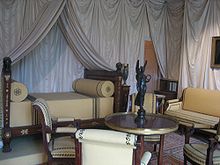
 Napoleon's bedroom in the Greater Trianon | |
| Concept | theatricality of design |
| A country |  France France |
| Established | early 19th century |
| The most important buildings | Kazan Cathedral (St. Petersburg) , Fontainebleau Palace , Nelson's Column in London |
Content
History
Origin
Empire style is the final stage of classicism, arose in the first third of the XIX century . In France, the era of Napoleon Bonaparte, there was a degeneration of classicism in the upper class, the official imperial style, the essence of which is reflected in its name (from the French empire - "empire"). The style gained distribution in many European countries and was actively developed throughout the first three decades of the 19th century .
In imperial France, the empire was distinguished by the solemnity and ceremoniality of memorial architecture and palace interiors created by the court architects of Napoleon, Charles Persieux and Pierre Fontin [1] .
In Russia
In the Russian Empire, this style appeared under Alexander I. The invitation of foreign architects to Russia was a frequent occurrence, since among the titled persons it was fashionable, and at the beginning of the 19th century there was a fascination with French culture in Russia. For the construction of St. Isaac’s Cathedral, Alexander I invited the novice French architect Henri Louis Auguste Ricard de Montferrand , who later became one of the founders of the “Russian Empire”.
Many researchers follow I.E. Grabar . and G.K. Lukomsky distinguish early Alexandrian classicism with a focus on the architectural monuments of Ancient Greece of the Doric style and the subsequent Russian Empire, the architects of which, as in Napoleonic France, were inspired by the monuments of imperial Rome in a special historical and regional style. [2] Accordingly, the full-fledged development of the Empire refers to the "post-war era" (after the victory of Russia in the Patriotic War of 1812, which gave a new impetus to the development of style) and to the period of the reign of Emperor Nicholas I. Hence the term "Nikolaev Empire". The Russian Empire received a division into Moscow and St. Petersburg, and such a division was determined not so much by the territorial attribute as by the degree of separation from the classicism of the previous era - Moscow was more connected with national traditions. [3] . The architect Karl Rossi became the most famous representative of the Petersburg Empire style, among other representatives of this style it is customary to call architects Andreyan Zakharov , Andrei Voronikhin , Osip Bove , Domenico Zhilyardi , Vasily Stasov , sculptors Ivan Martos , Theodosius Shchedrin [1] [4] . In Russia, the empire dominated in architecture until 1830-1840, the beginning of the period of historicism.
The revival of the Empire in degenerated forms took place in Russia in Soviet times, from the mid-1930s to the mid-1950s. This direction of the empire is also known as the " Stalinist empire " [5] .
Features
Empire refers to the so-called "royal styles", which can be characterized by theatricality in the design of architectural buildings and interior interiors. A feature of architectural empire is the obligatory presence of columns , pilasters , stucco moldings and other classical elements, as well as motifs that reproduce almost without changes antique sculptures like griffins , sphinxes , lion paws and similar sculptural structures. These elements are arranged in the Empire style, in compliance with equilibrium and symmetry. The artistic design of the style, with its massive lapidary and monumental forms, as well as rich decoration, the content of elements of military symbolism, the direct influence of art forms, especially the Roman Empire , as well as Ancient Greece and Hellenism , was designed to emphasize and embody the ideas of the power of the state and the presence of a strong army [1] [5] .
Empire fashion appreciated an elongated silhouette , created with an eye to ancient ash and chitons . Dresses were sewn with a high waist, under the chest they were intercepted by a belt, and a horsehair roller was inserted behind. The neck and arms were left open. The dresses underneath were embroidered with gold and silver thread, green palm leaves. The bottom edge was finished with chenille, sequins and sparkles. If the dress was elegant, intended for visits and dances, then he often had short sleeves with puffs. They put on shirts or bodysuits under tunic dresses. The female body was clearly visible. Sometimes even dresses made of delicate materials were wetted with water so that they would stick to the body [6] . Necklines were also as open as possible.
Vendome Column , Paris
Arch Carrusel , Paris
Kazan Cathedral (St. Petersburg)
Triumphal Gate (Moscow)
Nelson's Column , London
Throne of Napoleon
Armchair from the Louvre
Desk clock
Decorating the Fontainebleau Palace
Egyptian service of Vivan Denon
Notes
- ↑ 1 2 3 Empire . Mega-Encyclopedia of Cyril and Methodius . Date of treatment May 25, 2012. Archived June 30, 2012.
- ↑ V. G. Vlasov . Alexander classicism // Vlasov V.G. New encyclopedic dictionary of fine art. In 10 t. - St. Petersburg: ABC-Classic. T. I, 2004.S. 165-172
- ↑ V. G. Vlasov . Russian, or Petersburg, Empire // Vlasov V. G. New Encyclopedic Dictionary of Fine Arts. In 10 t. - St. Petersburg: ABC-Classic. T. VIII, 2008.S. 328-339
- ↑ Arslanov R.A., Kerov V.V. Topic 36. Culture of Russia in the first half of the XIX century. // The history of Russia from ancient times to the end of the XX century . - 2000.
- ↑ 1 2 Ignatova Anna Mikhailovna. "Ethnic Empire" - a new stage in evolution, style, architecture, materials and technology // Architecton: University News. - 2011, June. - Vol. 34 . - ISSN 1990-4126 . Archived July 14, 2014.
- ↑ “They Defined Fashion” - Dance Studio “Medival” (Inaccessible link) . Date of treatment May 21, 2016. Archived June 10, 2016.
Literature
- Empire // Great Soviet Encyclopedia : [in 30 vol.] / Ch. ed. A.M. Prokhorov . - 3rd ed. - M .: Soviet Encyclopedia, 1969-1978.
- Alexander Spelts . Ornaments of Empire. - 1924. Illustrations
- Bourgeois E. Le style Empire, ses origines et ses caractères. P-., 1930.
- Nekrasov A.I. Russian Empire. - M., 1935.
- Grabar I.E. Petersburg architecture in the 18th and 19th centuries .-- St. Petersburg: Lenizdat, 1994 .-- 384 p.
- Vlasov V.G. Empire, or "Empire style" // Vlasov V. G. New encyclopedic dictionary of fine art. In 10 t. - St. Petersburg: ABC-Classic. T. I, 2004.S. 219-229.
Links
- Definition of “ empire ” in Wiktionary