Inguinal granuloma ( Latin granuloma inguinale ) is an infectious disease caused by bacteria of the species Klebsiella granulomatis (formerly Calymmatobacterium granulomatis) and characterized by . In many regions it has the status of endemic disease .
| Inguinal granuloma | |
|---|---|
 | |
| ICD-10 | A 58 |
| ICD-10-KM | |
| ICD-9 | 099.2 |
| ICD-9-KM | |
| Diseasesdb | 3888 |
| Medlineplus | 000636 |
| eMedicine | derm / 172 |
| Mesh | D006100 |
In many countries, this disease is not treated due to poor-quality and advanced medicine. In addition, inguinal granuloma may be mistaken for syphilis [3] . If left untreated, the ulcers ultimately destroy internal and external tissues, causing extensive leakage of mucus and blood from the blood vessels . A destructive nature increases the risk of superinfection with other pathogenic microorganisms.
Symptoms
10-40 days after contact with bacteria, small, painless nodules appear. Later, the nodules burst, creating open and fleshy foci. During this period, the infection begins to spread, mutilating the tissue. If you do not start treatment, then the tissue will be destroyed. In most cases, lesions are located on the trunk of the male penis , labia or in the anus . In rare cases, a woman's vagina or cervix may be affected. At least one case in India has led to partial auto- amputation of the penis. Patient tested positive for HIV- 2. The disease progressed over six years [4] .
Infection Mechanism
Microbes spread from one person to another through contact with open sores.
Diagnostics
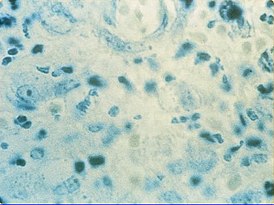
The diagnosis is based on the patient’s sexual history and physical examination: the doctor painlessly reveals a red ulcer with a characteristic folded edge of the granulation tissue . Unlike syphilitic ulcers, inguinal lymphadenopathy is usually mild or absent. A tissue biopsy and Romanowsky-Wright dye are used to assist in the diagnosis. The presence of granuloma bodies confirms the diagnosis; typically rod-shaped, oval bodies [5] .
When Romanovsky-Wright dye is added, the bodies turn dark purple. They were first discovered by [6] .
Classification
The first known name for the disease dates from 1882: serpiginous ulcer . The official clinical designation is “Inguinal granuloma,” however, donovanosis (donovanosis) can sometimes occur [7] [8] . Granuloma is a type of nodular inflammatory reaction that most often refers to the inguinal region [9] [10] .
Prevention
The disease is very effectively treated with antibiotics , so developed countries have a low incidence of donovanosis; About 100 cases every year in the USA . Dramatically increase the risk of infection can have sexual contact with people in endemic areas. Before starting a sexual relationship, it is recommended that you check for sexually transmitted diseases.
Notes
- ↑ Disease Ontology release 2019-05-13 - 2019-05-13 - 2019.
- ↑ Monarch Disease Ontology release 2018-06-29sonu - 2018-06-29 - 2018.
- ↑ Murray, Patrick R. Medical Microbiology. - 5th. - Philadelphia: Elsevier Mosby, 2005 .-- P. 336. - ISBN 0-323-03303-2 .
- ↑ Chandra Gupta TS, Rayudu T., Murthy SV Donovanosis with auto-amputation of penis in a HIV-2 infected person (Eng.) // Indian Journal of Dermatology, Venereology and Leprology : journal. - 2008 .-- Vol. 74 , no. 5 . - P. 490-492 . - DOI : 10.4103 / 0378-6323.44308 . - PMID 19052412 .
- ↑ thefreedictionary.com> Donovan bodies Retrieved on Nov 29, 2009
- ↑ Donovan, C. Ulcerating Granuloma of the Pudenda ( Neopr .) // Indian Medical Gazette . - 1905. - T. 40 . - S. 414 .
- ↑ Rashid RM, Janjua SA, Khachemoune A. Granuloma inguinale: a case report (English) // Dermatology Online Journal . - 2006. - Vol. 12 , no. 7 . - P. 14 . - PMID 17459300 .
- ↑ McLeod K. Precis of operations performed in the wards of the first surgeon, Medical College Hospital, during the year 1881 (Eng.) // Indian Medical Gazette : journal. - 1882. - Vol. 11 . - P. 113 .
- ↑ " granuloma inguinale " at Dorland's Medical Dictionary
- ↑ O'Farrell N. Donovanosis (Eng.) // Sexually Transmitted Infections . - 2002 .-- December ( vol. 78 , no. 6 ). - P. 452–457 . - DOI : 10.1136 / sti.78.6.452 . - PMID 12473810 .