Clever Geek Handbook
📜 ⬆️ ⬇️

Robinieae

Robinieae (lat.) Is a tribe of flowering plants belonging to the subfamily of the bean moth family.

Robinieae
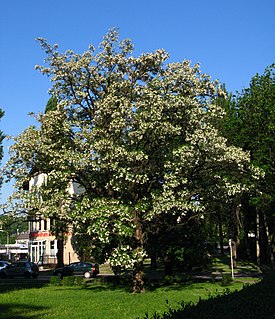
Robinia pseudoacacia Bielsko-Biała.JPG
Robinia pseudoacacia -
type species type genus .
General view of a flowering plant.
Scientific classification
Domain:Eukaryotes
Kingdom:Plants
Kingdom :Green plants
Department:Flowering
Grade:Dicotyledonous [1]
Order :Rosanae
Order:Legumes
Family:Legumes
Subfamily :Moth
Tribe :Robinieae
International scientific name

Robinieae Spenn. , 1829

Type genus
Robinia L. - Robinia

Description

Includes trees , shrubs, and herbaceous plants . Leaves are usually complex, less often simple ( Poissonia ), venation is reticulate. The leaf location is often the opposite. Stipules are sometimes transformed into thorns ( Robinia , Peteria ). The flowers are collected in racemose inflorescences , located, as a rule, in the axils of the leaves, less often, at the apex of the shoot ( Peteria ). Bracts are small, falling off in most species. 10 stamens , nine of which grow together3/four {\ displaystyle {} ^ {3} / {} _ {4}} {\displaystyle {}^{3}/{}_{4}} lengths. The ovary of the pestle is located on the stem. The column is bare. Seeds are ovoid or oblong-kidney-shaped [2] . In many representatives of the tribe, the seeds contain the non-proteinogenic amino acid Canavanin . It is believed that this amino acid performs the function of protecting seeds from being eaten by phytophages [3] .

Systematics

The tribe includes 11 genera [4] :

  • Coursetia DC.
  • Genistidium IMJohnst.
  • Gliricidia kunth
  • Hebestigma Urb.
  • Lennea Klotzsch
  • Olneya A.Gray
  • Peteria A.Gray
  • Poissonia Baill.
  • Poitea Vent.
  • Robinia L. - Robinia
  • Sphinctospermum rose

According to molecular genetic data, the closest tribes are Loteae and Coronilleae . Fossil representatives were found in deposits of the Late Eocene and Pliocene in Europe and North America [5] .

Distribution

Distributed mainly in the tropical regions of the Arctic and Neotropics [2] [6] . The distribution of the genera Poitea and Hebestigma is limited to the Antilles [7] .
Notes

  1. ↑ For the conventionality of specifying the class of dicotyledons as a superior taxon for the plant group described in this article, see the APG Systems section of the Dicotyledonous article .
  2. ↑ 1 2 Yakovlev G.P. Legumes of the globe / Editor-in-chief Yu. L. Menitsky. - L .: Nauka, 1991 .-- S. 96-98. - 144 p. - ISBN 5-02-026649-3 .
  3. ↑ Lavin M. The Occurrence of Canavanine in Seeds of the Tribe Robinieae (Eng.) // Biochemical Systematics and Ecology: journal. - 1986. - Vol. 14 , no. 1 . - P. 71-73 . - ISSN 03051978 .
  4. ↑ According to the GRIN website (see plant card).
  5. ↑ Lavin M., Wojciechowski MF, Gasson P., Hughes C. & Wheeler E. Phylogeny of Robinioid Legumes (Fabaceae) Revisited: Coursetia and Gliricidia Recircumscribed, and a Biogeographical Appraisal of the Caribbean Endemics // Systematic Botany: journal. - 2003. - Vol. 28 , no. 2 . - P. 387–409 .
  6. ↑ de Stefano RD, Fernández-Concha GC, Can-Itza LL, Lavin M. The Morphological and Phylogenetic Distinctions of Coursetia greenmanii (Leguminosae): Taxonomic and Ecological Implications (English) // Systematic Botany: journal. - 2010 .-- Vol. 35 , no. 2 . - P. 289-295 . - ISSN 0363-6445 .
  7. ↑ Lavin M. Biogeography and Systematics of Poitea (Leguminosae): Inferences from Morphological and Molecular Data (Eng.) // Systematic Botany Monographs. - 1993 .-- 18 January ( vol. 37 ). - P. 1–87 . - ISSN 0737-8211 .
Source - https://ru.wikipedia.org/w/index.php?title=Robinieae&oldid=97324621


More articles:

  • X (manga)
  • Dzodze, Kochi
  • Vishnevsky Village Council (Kupyansky District)
  • Erhanger (Duke of Swabia)
  • Kenneth Avenue
  • Osinovsky Village Council (Kupyansky District)
  • Smorodkovsky Village Council of Kharkiv Region
  • Copenhagen Alliance Treaty
  • Christopher's Bramey
  • Full factorial experiment

All articles

Clever Geek | 2019