Charlotte Brontë ( English Charlotte Brontë ; April 21, 1816 , Thornton , Great Britain - March 31, 1855 , Hoert , Great Britain ), pseudonym Carrer Bell ( Currer Bell ) - English poetess and novelist.
| Charlotte Bronte | |
|---|---|
| English Charlotte brontë | |
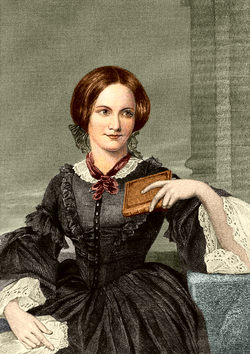 portrait of 1873 | |
| Aliases | Carrer Bell |
| Date of Birth | April 21, 1816 |
| Place of Birth | Thornton , UK |
| Date of death | March 31, 1855 (38 years old) |
| Place of death | Hoert , UK |
| Citizenship (citizenship) | |
| Occupation | poet , novelist |
| Genre | |
| Language of Works | English |
| Autograph | |
Biography
Charlotte Bronte was born April 21, 1816 in West Yorkshire and was the third child (and there were six of them - Mary, Elizabeth, Charlotte, Patrick Brenwell, Emily and Anne ) in the family of the Church of England Anglican clergyman Patrick Bronte (originally from Ireland) and his wife Maria, nee Brenwell.
In 1820, the family moved to Hoert , where Patrick was appointed vicar .
Charlotte's mother died of uterine cancer on September 15, 1821, leaving five daughters and a son to raise her husband Patrick.
Education
Cowan Bridge
In August 1824, his father sent Charlotte to the Cowan Bridge School for the daughters of the clergy (her two older sisters, Maria and Elizabeth, were sent there in July 1824, and the youngest, Emily, in November). When entering the school magazine, the following record was made about the knowledge of eight-year-old Charlotte:
 | Charlotte Bronte. Received August 10, 1824. Writes inaudible. He thinks a little, he sews carefully. He does not know anything about grammar, geography, history or etiquette. In general, smarter than his age, but does not know anything systematically. Left school on June 1, 1825. The governess [1] . |
The Cowan Bridge School served as the prototype of the Lovood boarding school in Jane Eyre . Poor conditions undermined the already poor health of Mary (born in 1814) and Elizabeth (born 1815) of Bronte. In February 1825, Mr. Bronte took Mary, a tuberculosis patient, from school; in May of that year, a second sister, Elizabeth, was sent home, completely ill from consumption. Shortly after returning to Hoert, the Charlotte sisters died. Mr. Bronte immediately took the two youngest girls home (June 1, 1825).
Charlotte’s pastoral homes and other surviving children: Branwell , Emily, and Anne set about writing a chronicle of the lives and struggles of the inhabitants of their imaginary kingdoms. Charlotte and Branwell wrote Byronic stories about the fictional English colonies in Africa, the center of which was the magnificent capital - Glass City (Glass Town, later Verdopolis), and Emily and Anne wrote books and poems about Gondal . Their complex and intricate sagas, rooted in the childhood and early youth of writers, determined their literary vocation.
Row Head
In 1831-1832, Charlotte continued her education at the Row Head School (Mirfield), which was headed by Miss Wooler. Charlotte maintained a good relationship with Margaret Wooler until the end of her life, although there was friction between them.
In the Row Head, Charlotte met her peers Ellen Nassi and Mary Taylor, with whom she made friends and corresponded further.
After graduating, in 1835-1838, Charlotte worked as a teacher in the Row Head. By decision of the family, Charlotte brought Emily to school with her: she paid for the education of her younger sister from her salary. However, Emily’s inability to live in a new place among strangers changed their original plans: Emily had to be sent home, and Anne took her place.
In 1838, Charlotte and Ann left Miss Wooler on the pretext that moving the school to Dewsbury Moore had a bad effect on their health. Dewsbury Moore was indeed a rather unhealthy area, but the main reason for Charlotte's departure was obviously tiredness from her unloved work and inability to write (works of 1835-1838 were created in snatches during the short weeks of school holidays).
Literary Ambition
Correspondence with Robert Southey
Having started writing early, Charlotte also early recognized her calling and talent. The first attempt by a future writer known to us to enter the literary world dates back to 1836. On December 29, Charlotte sent a letter and poems to the famous poet Robert Southey , asking him to express his opinion. This letter did not reach us, and therefore it is not known which particular poems Sauti read [* 1] . However, it is clear that Charlotte expressed her ardent desire to become a famous poetess in a very exalted style. In a response letter, Sauti cited some passages of his correspondent, allowing to get an idea of the rest of the content:
| What I am, you could learn from those of my published works that fell into your hands; but you live in a world of visions and seem to imagine that this is the same with me when you ask me to "descend from the throne of light and glory." If you knew me, a small personal acquaintance would moderate your enthusiasm. You, who so ardently want to “become famous throughout the ages” as a poetess, could to some extent cool your ardor by seeing the poet on the slope of his life and noting the effect that age has on our hopes and inspiration [2] . |
Southey found that Miss Bronte undoubtedly possessed — and not insignificantly — a poetic gift, but found it necessary to warn her correspondent that the exalted state into which poetry apparently plunges her is harmful to her mental health, to prevent her from further happiness and make her unsuitable for performing traditional female duties, which, according to the elderly poet, should be more important for a woman than any creativity.
Charlott's letter had a beneficial effect on Charlotte. Although her apparent exaltation was not connected with creativity, but with the inability to engage in creativity (at this time she teaches in the Row Head and is busy full time teaching the students and looking after them), nevertheless, she was well aware that the words the wisdom of the era. She took the advice to write poetry only for their own sake, although in practice this was expressed in the fact that she belittled the significance of her poetry. Her second letter of thanks made a most favorable impression on Robert Southey.
Charlotte probably never found out that Sauti was partly influenced by one extraneous circumstance. A little later Charlotte, her brother, Branwell, also sent a letter and poems to William Wordsworth (it is possible that the brother and sister conceived these addresses together). Wordsworth didn’t like the letter from Branwell, and he reacted to Southey in the most negative way. Southey wrote about this to Carolina Bowles:
| I sent a dose of chilling warning to the poor girl whose eccentric letter overtook me in Buckland. The dose was well received, and she thanked me for her. (...) Almost at the same time as she wrote to me, her brother wrote to Wordsworth, who was disgusted by his letter, because it contained rude flattery for himself and abusive abuse of other poets, including me [* 2] . I think well of my sister thanks to her second letter, and perhaps she will sympathetically remember me all her life [3] . |
Hartley Coleridge Letter
Charlotte learned three lessons from talking to Robert Sauti: firstly, she decides to leave poetry and turn to prose, secondly, she plans to abandon romanticism in favor of realism, and thirdly, she decides to use a pseudonym from now on so that attitude to a woman, nor traditional beliefs did not interfere with the assessment of her works.
In 1840, she sends the first chapters of her Ashworth novel to Hartley Coleridge (son of a famous poet) [* 3] . Coleridge obviously made a number of comments, the essence of which was that the novel would not be accepted by the publishers. Charlotte's appeal was apparently prompted by the advice of her brother, Branwell, who had seen Coleridge about his translations of Horace's Od.
Hartley Coleridge’s letter to Charlotte did not survive. Her response letter exists in two copies: a draft and a sent clean copy.
First publications
According to Charlotte, it is known that even before the publication of the collection of poems by Carrera, Ellis and Acton Bellov, a translation of French poetry was published in some magazine [4] . However, as the writer noted, he published anonymously. Since Charlotte did not indicate where and when exactly her translation appeared, it was not possible to establish the date of her first publication.
Work governess. School Project
In June 1839, Charlotte received her first position as a governess in the Sidgwick family (from where she quickly left due to mistreatment) [* 4] , and in 1841, the second, in the family of Mr. and Mrs. White.
In the same year, Aunt Charlotte, Miss Elizabeth Branwell, agreed to provide money to her nieces so that they could establish their own school. However, Charlotte suddenly changed plans, deciding to preliminarily improve in French. To this end, she intended to go to one of the Belgian boarding schools. Since the borrowed aunts had only enough money for one semester, Charlotte planned to find work abroad. In November 1841, she wrote to Emily:
| Before our six months in Brussels end, you and I will have to find a job abroad. I do not intend to return home until the twelve months have elapsed [5] . |
Brussels
In 1842, Charlotte and Emily went to Brussels to enroll in a boarding school run by Konstantin Ezhe (1809–1896) and his wife Claire-Zoe Ezhe (1814–1891). After studying for one semester, the girls received an offer to stay there to work, paying with their labor the opportunity to continue their education. Charlotte wrote to Ellen Nassi:
| I can’t say for sure whether I will return home in September or not. Madame Ege made an offer to me and Emily to stay for another six months, meaning to dismiss the English teacher and take me in this capacity, as well as to hire Emily for some part of the day to learn music from several students. For this work, we are invited to continue our studies in French and German, to rest, etc., without paying for it; however, no salary was offered to us [6] . |
The stay of the sisters in the hostel ended in October 1842, when their aunt, Elizabeth Brenwell, who took care of the girls after the death of her mother, died.
In January 1843, Charlotte returned to Brussels to teach English. However, now her time at school was not happy: the girl was lonely, homesick and, obviously, felt that her studies with literature with Monsieur Ege would not help her start a literary career. The feeling of time running out and the fear of wasting one’s abilities in the near future will become a constant leitmotif of Charlotte’s letters. She was probably scared by the example of her brother, whose once brilliant prospects had steadily melted away.
Mary Taylor, recalling the Brussels meetings with her old school friend and her subsequent letters, repeated the words often found in the letters of Charlotte herself:
| She said: “My youth is leaving; I’ll never do anything better than what I’ve already done, but I haven’t done anything yet. ” In such cases, she seems to have believed that human beings are doomed, under the pressure of worldly interests, to lose one ability after another, one feeling after another, “until they completely die. I hope that by the time I am dead, I will already be in the grave. " (...) When she got used to Brussels people and manners, her life became monotonous, and she fell into the same state of hopelessness as Miss Wooler, although to a lesser extent. I wrote to her, prompting her to go home or somewhere else [7] [* 5] . |
Finally, in December 1843, Charlotte decided to return to Hoert, despite the fact that she did not see at home any literary opportunities for herself.
Charlotte’s Brussels experience is reflected in the novels “The Teacher ” and “Willett” (“The Town ”).
School Project
Returning home on January 1, 1844, Charlotte again decides to take up the project of founding her own school in order to provide herself and her sisters with earnings. However, the circumstances prevailing in 1844 were less favorable for such plans than was the case in 1841.
Charlotte's aunt, Mrs. Branwell, is dead; Mr. Bronte’s health and vision were weakened. The Bronte sisters were no longer able to leave Hoert to rent a school building in a more attractive area. Charlotte decides to found a boarding house directly at Hoert Pastoral; but their family home, located in a rather wild wilderness cemetery, scared away the parents of potential students, despite Charlotte’s cash discounts.
Beginning of a Literary Career
In May 1846, Charlotte, Emily and Anne published at their own expense a joint poetry collection under the pseudonyms Carrer, Ellis and Acton Bell. Despite the fact that only two copies of the collection were sold, the sisters continued to write, bearing in mind the subsequent publication. In the summer of 1846, Charlotte began searching for publishers for the novels by Carrera, Ellis, and Acton Bell: these were Teacher, Wuthering Heights , and Agnes Gray , respectively.
Having published the first book on family funds, Charlotte later did not want to spend money on publishing, but, on the contrary, get the opportunity to earn literary work. However, her younger sisters were ready to take a chance again. Therefore, Emily and Ann accepted the offer of London-based publisher Thomas Newby, who requested £ 50 for the publication of Wuthering Heights and Agnes Gray as a guarantee, promising to return the money if he could sell 250 copies out of 350 (circulation of books). Newby did not return the money, despite the fact that the entire print run [* 6] was sold out in the wake of the success of Charlotte’s Jane Eyre novel in late 1847 [* 7] .
Charlotte herself declined Newby's offer. She continued correspondence with London firms, trying to interest them in her novel " Teacher ." All publishers rejected it, however, the literary consultant of Smith, Elder & Company sent a letter to Carrer Bell, in which he sympathetically explained the reasons for the refusal: the novel lacked the fascination that would allow the book to sell well. In the same month (August 1847), Charlotte sent the manuscript “Jane Air” to Smith, Elder and Company. The novel was adopted and printed in record time.
The death of Brenwell, Emily and Anne Bronte
Along with the literary success in the Bronte family, trouble came. Charlotte's brother and only son in the Brenwell family died in September 1848 from chronic bronchitis or tuberculosis . The heavy condition of his brother was aggravated by drunkenness, as well as drug addiction (Brenwell took opium ). Emily and Ann died of pulmonary tuberculosis in December 1848 and May 1849, respectively.
Now Charlotte and her father were left alone. Between 1848 and 1854 Charlotte led an active literary life. She became close to Harriet Martino , Elizabeth Gaskell , William Thackeray and George Henry Lewis .
Bronte's book spawned the feminist movement in literature. The main character of the novel, Jane Eyre , is as strong a girl as the author. However, Charlotte tried not to leave Hoarth for more than a few weeks, because she did not want to leave her aging father.
Marriage. Death
Throughout her life, Charlotte repeatedly refused marriage, sometimes taking marriage proposals seriously, sometimes treating them with humor. However, she preferred to accept the offer of her father's assistant, priest Arthur Bell Nicholls .
Charlotte met her future husband in the spring of 1844 when Arthur Bell Nicholls arrived in Hoert. Charlotte’s first impression of her father’s assistant was by no means flattering. She wrote to Ellen Nassi in October 1844:
| Mr. Nicholls has just returned; even for the sake of saving my life, I cannot consider in it those interesting rudiments of goodness that you have discovered; I am mainly always struck by the narrowness of his thinking [10] . |
Similar reviews are found in Charlotte's letters in later years, but they disappear over time.
Charlotte married in June 1854. In January 1855, her health condition deteriorated sharply. In February, the doctor who examined the writer came to the conclusion that the symptoms of malaise indicate the onset of pregnancy and are not life threatening.
Charlotte was tormented by constant nausea, lack of appetite, extreme weakness, which led to rapid exhaustion. However, according to Nicholls, it was only in the last week of March that it became clear that Charlotte was dying. The cause of death has not been established .
Charlotte died on March 31, 1855 at the age of 38. Tuberculosis appeared to be the cause of her death, however, as many Charlotte biographers have suggested, she could have died from dehydration and wasting caused by severe toxicosis . It can also be assumed that Charlotte died of typhus , which she could infect with the old servant Tabitha Aykroyd, who died shortly before Charlotte's death.
The writer was buried in the family crypt at St. Michael's Church, located in Hoert, West Yorkshire, England.
Early Creation
Charlotte Bronte began to write early: her first manuscript that came to us ( There was once a little girl ) dates from about 1826 (the author is 10 years old). In the years 1827-1829, the children of Bronte came up with several large and small games, which served as the basis for their further creativity. In a children's autobiographical note, History of the Year (March 12, 1829), Charlotte described the emergence of the game Young People, from which an “African” saga will develop in the coming years:
| Dad bought Leeds soldiers for Leanwell in Leeds. When dad returned home, it was night and we were in bed, so the next morning Branwell came up to our door with a box of soldiers. Emily and I jumped out of bed, I grabbed one and exclaimed: “This is the Duke of Wellington! May he be mine! ” When I said this, Emily also took one and said, let him be her. When Anne went downstairs and she took one [11] . |
Arthur Wellesley, Duke of Wellington , a famous commander, Irish by birth, was the hero of Charlotte. First, she made him the central character of her "African" saga. In the novel Twelve Adventurers (April 1829), a 13-year-old author describes the departure of the 74-gun ship Invincible, its wreck on the west coast of Africa, the founding of an English colony, and the help of powerful genies to create the magnificent Glass City:
One evening, when we all gathered in the House of Justice, Arthur Wellesley, then a simple trumpeter, suddenly exclaimed as we discussed our luck:
- (...) Wouldn’t it be better to immediately send to England to tell about the new world that we discovered and about its riches; and don’t you think that they will send us an army?
Francis Stewart rose immediately and said:
- Young man, think before you say it! How do we send to England? Who is hardy enough to cross the Atlantic again? Don't you remember the storm that brought us to the shores of Trinidad?
Arthur Wellesley replied:
- (...) I’m not so reckless as to suggest that we ourselves will be able to cross the ocean in the damaged and leaking vessel that we have, or that we will be able to build another in time (...). But in what short time we built the city where we are now! How long did it take to erect this magnificent Chamber in which we are now? Are these marble columns and this magnificent dome not built by superhuman strength? If you look at the city from this Gothic window and see the morning rays, the golden teeth of powerful towers and columns of magnificent palaces erected in a few months, can you doubt that magic was used to create them?
Here he stopped. We were all convinced that genies helped us build our city. He continued:
“Well, if the genies built our city, won't they help us call on our compatriots to protect what they built from enemy attacks?”
He broke off again as the roof shook and the chamber filled with smoke. Paul opened, and we heard a voice saying:
- When the sun appears in the east above the forests, all of you should be on the border of the dead desert, because if you do not come, I will split you up into atoms.
The appearance of the genies, of course, was due to the fact that the children of Bronte were read out by the tales of "A Thousand and One Nights."
Soon the sagical duke Wellington gave way to his sons: Arthur-Augustus-Adrian Wellesley, Marquis of Duero (later he would become Duke of Zamora and King of Angria) and his younger brother Lord Charles-Albert-Florian Wellsley (later Charles Townshend or Towns). С ним Шарлотта отчасти отождествляла себя, поскольку лорд Чарлз является одним из главных рассказчиков, от чьего лица она ведёт повествование.
Следует заметить, что некоторые произведения ювенилии не связаны с сагой (например, «Приключение в Ирландии» или «Приключения мсье Эдуарда де Крака»), однако со временем практически всё, что выходит из-под пера Шарлотты, оказывается частью её вымышленного африканского мира.
В 1830 году Шарлотта переименовывает Стеклянный Город в Вердополис. С этого момента английские колонии в Африке получают имя Вердополитанской Конфедерации (или Вердополитанского Союза). Конфедерация изначально объединяла четыре королевства: Веллингтонленд (впоследствии Сенегамбия), Пэррисленд (Эдвард Пэрри — имя солдатика Эмили), Россленд (по имени солдатика Энн) и Сничисленд. В 1834 году в ходе Завоевательной войны к ним было присоединено ещё одно королевство — Ангрия.
Ангрианская часть «африканской» саги (после «гласстаунской» и «вердополитанской») является самой последней и наиболее интересной. Её основной «нерв» образует противостояние двух главных героев саги: Артура Уэллсли, герцога Заморны, и Александра Перси, графа Нортангерленда. Изначально Александр Перси задумывался как ведущий отрицательный персонаж (в «гласстаунской» части он носит «говорящее» имя Плут (Rogue)), однако со временем оба героя утратили однозначность. Заморна, развивающийся по образцу байронического героя, быстро обзавёлся всеми пороками, свойственными этому типу; характер Александра Перси, со своей стороны, приобрёл трагические обертоны. Вдобавок Шарлотта и её брат решили породнить героев: Заморна женился вторым браком на дочери Александра Перси. Мэри-Генриетта Перси-Уэллсли таким образом становится разменной монетой в интригах её мужа и отца, которых тянет и отталкивает друг от друга. Противостояние Заморна-Нортангерленд выливается в гражданскую войну в Ангрии.
Поздняя ювенилия Шарлотты Бронте отмечена появлением нового типа героини. В детском и подростковом возрасте девочка ориентировалась на литературные романтические образцы, главным образом, на героинь Байрона и Вальтера Скотта. Однако в 1838—1839 годах Шарлотта создаёт оригинальный женский персонаж, высшей точкой развития которого станет характер Джейн Эйр. Прототипом Джейн в ювенилии является Элизабет Гастингс; её противостояние полковнику Уильяму Перси и любовь к нему образуют первый очерк будущего романа, который прославил Шарлотту Бронте.
До нас дошли практически все ранние произведения Шарлотты Бронте. Поскольку изначально они сочинялись от лица деревянных солдатиков, рукописи написаны чрезвычайно мелким почерком печатными буквами (дети имитировали книги). Благодаря усилиям учёных, трудившихся над расшифровкой бронтенианы, в XX веке разными фрагментами было издано практически всё наследие Шарлотты Бронте. Однако научное издание потребовало больше времени. В настоящее время оно близко к завершению [12] .
Детские и юношеские произведения ( Ювенилия )
Приводимый ниже список ювенилии Шарлотты Бронте является неполным (полный список слишком обширен).
Названия, записанные в квадратных скобках, даны исследователями.
- Две романтические повести: «Двенадцать искателей приключений» и «Приключение в Ирландии» (1829) Последнее произведение, в действительности, не повесть, а рассказ.
- Журнал «Молодых Людей» (1829—1830)
- Поиски счастья (1829)
- Характеры выдающихся людей нашего времени (1829)
- Рассказы об островитянах. В 4 томах (1829—1830)
- Вечерняя прогулка, стихотворение маркиза Дуэро (1830)
- Перевод английскими стихами Первой книги «Генриады» Вольтера (1830)
- Альбион и Марина (1830) . Первая «любовная» повесть Шарлотты, написанная под влиянием Байрона; характер Марины соответствует характеру Гайдэ из поэмы «Дон Жуан». Повесть Шарлотты носит несколько мистический характер.
- Приключения Эрнеста Алемберта. Сказка (1830)
- Фиалка и другие стихи маркиза Дуэро (1830)
- Свадьба (1832) (стихотворение и повесть)
- Артуриана, или Обрезки и остатки (1833)
- Кое-что об Артуре (1833)
- Две повести: «Тайна» и «Лили Харт» (1833)
- Визиты в Вердополисе (1833)
- Зелёный карлик (1833)
- Найдёныш (1833)
- Ричард Львиное Сердце и Блондель (1833) , стихотворение
- Лист из неоткрытого тома (1834)
- «Заклинание» и «Светская жизнь в Вердополисе» (1834)
- Книга-свалка (1834)
- Блюда на закуску (1834)
- Моя Ангрия и ангрианцы (1834)
- «Мы сеть соткали в детстве» [Ретроспектива] (1835) , одно из самых известных стихотворений Шарлотты Бронте
- Текущие события (1836)
- [Изгнание Заморны] (1836) , поэма в двух песнях
- [Возвращение Заморны] (1836-7)
- [Джулия] (1837)
- [Лорд Дуэро] (1837)
- [Мина Лори] (1838)
- [Стэнклифф-Отель] (1838)
- [Герцог Заморна] (1838)
- [Капитан Генри Гастингс] (1839)
- [Кэролайн Вернон] (1839)
- Прощание с Ангрией (1839)
- Эшворт (1840) первый набросок романа для печати. Эшворт — своего рода псевдоним Александра Перси.
Некоторые популярные издания ювенилии Шарлотты Бронте
- « Легенды Ангрии » (1933, под редакцией Ф. Э. Рэтчфорд). В эту книгу вошли подростковый роман « Зелёный карлик », поэма «Изгнание Заморны», повесть «Мина Лори», юношеский роман «Кэролайн Вернон» и «Прощание с Ангрией» — прозаический фрагмент, жанр которого трудно определить.
- «Шарлотта Бронте. Пять маленьких романов» (1977, под редакцией У. Жерен). В эту книгу вошли повести «Текущие события», «Джулия» и «Мина Лори», а также юношеские романы «Капитан Генри Гастингс» и «Кэролайн Вернон».
- « Рассказы об Ангрии » (2006, под редакцией Хедер Глен). В эту книгу вошли повести «Мина Лори» и «Стэнклифф-Отель», небольшой роман в письмах «Герцог Заморна», романы «Генри Гастингс» и «Кэролайн Вернон», а также дневниковые фрагменты, которые Шарлотта Бронте написала, будучи учительницей в Роу-Хэде.
Зрелое творчество
Романы 1846—1853 годов
В 1846 году Шарлотта Бронте полностью закончила роман, специально написанный для печати, — «Учитель». Под псевдонимом Каррер Белл она предложила его нескольким издательствам. Все отвергли рукопись, однако литературный консультант фирмы «Смит, Элдер и компания», Уильям Уильямс, увидел потенциал начинающего автора и написал Карреру Беллу письмо, в котором объяснил, что книга должна быть привлекательной для публики и, соответственно, продаваемой. Через две-три недели после получения этого письма Шарлотта отправила фирме «Смит, Элдер и компания» рукопись романа «Джейн Эйр» (написан между августом 1846 и августом 1847).
В своей «Жизни Шарлотты Бронте» Э. Гаскелл так описала реакцию, которую вызвал новый роман:
| Когда рукопись «Джейн Эйр» дошла до будущих издателей этого замечательного романа, на долю одного джентльмена, связанного с фирмой, выпало прочитать его первым. Он был так сильно потрясён характером книги, что в очень эмоциональных выражениях высказал свои впечатления мистеру Смиту, которого, казалось, чрезвычайно позабавило это взволнованное восхищение. «Кажется, вы так очарованы, что я и не знаю, могу ли верить вам», – сказал он, смеясь. Но когда второй читатель, трезвомыслящий шотландец, не подвластный энтузиазму, вечером забрал рукопись домой и так глубоко заинтересовался рассказом, что просидел полночи, пока не дочитал его, любопытство мистера Смита было достаточно возбуждено, чтобы ему захотелось самому прочитать роман, и, как ни велики были похвалы, ему расточаемые, он нашёл, что они не грешили против истины [13] . |
Шарлотта отправила издателям роман «Джейн Эйр» 24 августа 1847 года , а 16 октября того же года книга была опубликована. Шарлотта была приятно поражена, когда получила свой гонорар. По современным меркам он был невелик: автору выплатили 500 фунтов [* 8] .
В 1848—1849 гг. Шарлотта Бронте написала второй из своих опубликованных романов — « Шерли ». Внешние обстоятельства её жизни, однако, не благоприятствовали творчеству: в начале 1848 года скандал, касающийся авторства романов её сестёр («Грозовой перевал» Эмили Бронте и обе книги Энн — «Агнес Грей» и « Незнакомка из Уайлдфелл-Холла » были приписаны Карреру Беллу), вынудил Шарлотту приехать в Лондон и раскрыть свой псевдоним. Во второй половине этого года умерли её брат Бренуэлл и сестра Эмили. Было также очевидно, что самая младшая сестра Шарлотты, Энн, долго не проживёт; и действительно, она скончалась в мае 1849 года. Через два месяца после этого, в августе, Шарлотта закончила «Шерли». 26 октября книга вышла из печати.
В 1850—1852 годах Шарлотта написала свою последнюю (и, возможно, лучшую) книгу — «Виллетт» (Название «Городок» является ошибочным, поскольку Виллетт — название столицы Лабаскура: топонимы не переводятся). Роман отличает очень тяжёлая атмосфера — следствие пережитого автором горя. Писательница ставит главную героиню в тупиковые ситуации: смерть близких, утрата друзей, тоска по разрушенному дому. Люси Сноу, по замыслу автора, с самого начала обречена на неудачи, беды и безысходное одиночество. Она — отверженная от земного счастья и может надеяться лишь на Царствие Небесное. В некотором смысле можно сказать, что Шарлотта выместила на своей героине собственную боль от потери семьи. Книгу отличает камерность и исключительная психологическая убедительность.
«Виллетт» вышел из печати 28 января 1853 года и стал последним произведением, которое Шарлотта успела закончить.
Незаконченные фрагменты
После смерти Шарлотты Бронте осталось несколько незаконченных рукописей. Одна из них, содержащая две главы под заголовком « Эмма », была опубликована вскоре после смерти автора (Клэр Бойлан закончила книгу в 2003 году, назвав её « Эмма Браун »).
Существует ещё два фрагмента: «Джон Генри» (около 1852) и «Вилли Эллин» (май-июнь 1853).
Value
Шарлотта Бронте является одной из талантливейших представительниц английского романтизма и реализма . Обладая крайне нервным и впечатлительным темпераментом, она в высокой степени владела тем, что Гёте называет секретом гения — способностью проникнуться индивидуальностью и субъективным настроением постороннего лица. При ограниченном круге наблюдений, она с поразительной яркостью и правдой изображала всё, что ей приходилось видеть и чувствовать. Если иногда чрезмерная яркость образов переходит в некоторую грубость красок, а излишний мелодраматизм в положениях и сентиментальное заключение ослабляют художественное впечатление, то полный жизненной правды реализм делает незаметными эти недостатки.
Посмертная биография Шарлотты Бронте, написанная Элизабет Гаскелл, — « Жизнь Шарлотты Бронте » — была опубликована первой среди многочисленных биографий писательницы. Книга Э. Гаскелл не всегда достоверна, однако её главный недостаток в том, что в ней практически полностью обойдено вниманием раннее литературное творчество Шарлотты Бронте.
В честь Шарлотты Бронте назван кратер на Меркурии .
Ш. Бронте изображена на британской почтовой марке 1980 года номиналом 12 пенсов [14] .
В 1997 году, к 150-летию выхода в свет романа Ш. Бронте «Джейн Эйр», королевская почта Великобритании выпустила почтовую марку достоинством в 1 ф.ст.
Романы
- Джейн Эйр , 1846-47, издан в 1847 г.
- Шерли , 1848-49, издан в 1849 г.
- Городок , 1850-52, издан в 1853 г.
- Учитель , 1845-46, издан в 1857 г.
- Эмма (Незавершённый; роман завершила, бережно относясь к наследию Шарлотты Бронте, писательница Констанс Сейвери , которая опубликовала роман « Эмма » под следующим соавторством: Шарлотта Бронте and Another Lady. Помимо этого, роман Шарлотты дописала ещё в одном варианте Клэр Бойлан , и назвала его « Эмма Браун »).
Poems
- « Стихотворения Каррера, Эллиса и Эктона Беллов » (1846)
- Полное собрание стихотворений Шарлотты Бронте (1971). Под редакцией К. К. Шортера и Ч. У. Хэтфилда.
- «Стихотворения Шарлотты Бронте» (под ред. Тома Уиннифрита, 1984)
Биографии
- « Жизнь Шарлотты Бронте » — Элизабет Гаскелл , 1857 год.
Notes
- Comments
- ↑ Если Шарлотта посылала самые недавние свои стихи, то Саути мог читать или стихотворение «Погружение», или поэму (возможно, отрывок из неё) ["Изгнание Заморны"] (название дано исследователями).
- ↑ Из справедливости к Бренуэллу Бронте следует сказать, что это не вполне правда. Единственным выражением, которое Вордсворт мог бы посчитать «бранью», является фраза Бренуэлла, что ни один из пишущих сейчас поэтов не стоит и шестипенсовика. Вполне вероятно, что Бренуэлл имел в виду молодых поэтов – своих сверстников.
- ↑ Этот незаконченный роман сейчас известен под названием «Эшворт».
- ↑ Кузен Сиджвиков, поэт и эссеист Артур К. Бенсон, впоследствии подготовит к печати томик стихотворений сестёр Бронте.
- ↑ Мэри Тейлор хотела, чтобы Шарлотта эмигрировала вместе с ней в Новую Зеландию
- ↑ Ньюби впоследствии признался Шарлотте, что напечатал всего 250 экземпляров [8] ).
- ↑ В 1854 году, через несколько лет после смерти Эмили и Энн Бронте , Шарлотте удалось получить с Ньюби 30 фунтов (возможно, благодаря помощи своих издателей) [9] .
- ↑ За эту сумму «Смит, Элдер и компания» приобрели право публиковать «Джейн Эйр» в трёхтомном формате (обычная книгоиздательская практика того времени). За дешёвые однотомные издания автору платили отдельно [9] .
- Sources
- ↑ Shorter, 1908 , Vol. 1, p. 69.
- ↑ The Letters of Charlotte Bronte , Vol. 1 (1829–1847), p. 166.
- ↑ Item, p. 171.
- ↑ Письмо к У. Уильямсу от 15 декабря 1847 г.
- ↑ Shorter, 1908 , Vol. 1, p. 224.
- ↑ Shorter, 1908 , Vol. 1, p. 239.
- ↑ Shorter, 1908 , Vol. 1, p. 247–248.
- ↑ The Letters of Charlotte Bronte , Vol. 2 (1848–1851), p. 465.
- ↑ 1 2 The Letters of Charlotte Bronte , Vol. 2 (1848–1851), p. 29.
- ↑ Shorter, 1908 , Vol. 1, p. 285.
- ↑ The Brontës. Tales of Glass Town, Angria and Gondal. Selected Early Writings. Oxford, 2010, p. 3-4.
- ↑ An edition of the early writings of Charlotte Brontë (ed. by Christine Anne Alexander). V. 1-2, 1987—1992. 2 том содержит две книги. 3 том готовится к изданию.
- ↑ Gaskell, 1857 , Vol. 2, p. 29.
- ↑ Literature on Stamps (англ.) (недоступная ссылка) . readliterature.com. Дата обращения 14 июля 2015. Архивировано 4 марта 2016 года.
Literature
- Бронте Шарлотта // Энциклопедический словарь Брокгауза и Ефрона : в 86 т. (82 т. и 4 доп.). - SPb. , 1890-1907.
- Gaskell E. The Life of Charlotte Brontë. — 1857. — Vol. 1–2.
- Charlotte Brontë and her Circle . — 1896.
- Shorter CK The Brontës: Life and Letters . — London, 1908. — Vol. 1–2.
- Fannie E. Ratchford, The Brontës' Web of Childhood , 1941
- Winifred Gérin, Charlotte Brontë. The Evolution of Genius , 1967
- Tom Winnifrith, The Brontës , 1977
- Juliet Barker, The Brontës , 1995
- The Letters of Charlotte Bronte: with a Selection of Letters by Family and Friends. - Vol. 1–2.
- The Letters of Charlotte Brontë , ed. by Margaret Smith, 3 vols, 1995
- The Cambridge Companion to the Brontës , ed. by Heather Glen, 2003
- A Brontë Family Chronology , Edward Chitham, 2003
- The Oxford Companion to the Brontës , ed. by Christine Alexander & Margaret Smith, 2006
Links
- Бронте, Шарлотта в библиотеке Максима Мошкова
- Хронология жизни Шарлотты Бронте . brontesisters.ru. Дата обращения 30 июня 2013. Архивировано 2 июля 2013 года.
- Стихотворения Шарлотты Бронте . brontesisters.ru. Дата обращения 30 июня 2013. Архивировано 2 июля 2013 года.
- Korovina E. Country Bronte . Heir, No. 41 . naslednick.ru (2011). - A story about the museum of the writer. Date of treatment June 29, 2013. Archived July 2, 2013.
- Makarenko S. "The inconspicuous fairy from the edge of the swamps . " litkonkurs.com (2006). - Essay on Charlotte Bronte. Date of treatment June 30, 2013. Archived July 2, 2013.