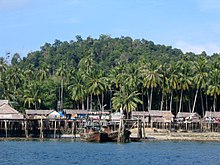


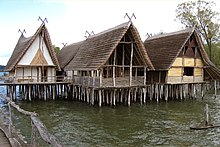
Pile dwellings - houses erected on stilts above the surface of the earth or above water.
History and Modernity
Herodotus described the people of the peons who lived on Lake Prazia , in Thrace , whose dwellings are arranged on stilts, on a high platform that communicates with narrow bridges to the shore.
In the winter of 1854, due to the unusually low standing of water in Lake Zurich , piles were found in it in some places, and previously, however, were known to local fishermen. The coastal residents decided to take advantage of this circumstance in order to win over land from the lake, capturing the space occupied by the piles and separating it with a dam. During these works, digging among the remains of piles, they began to find stoned stones, bones, shards. This drew the attention of local archaeologists (especially Keller), who undertook a thorough search here, as a result of which many remains of everyday life of the Stone Age were found. Subsequently, intensified searches in this direction led to the discovery of similar pile structures in other lakes in Switzerland .
In the Neolithic and early Bronze Age, pile dwellings were widespread in the Alps and on the Padan Plain ( Terramar culture). The remains of pile dwellings were discovered by archaeologists also in the Ljubljana swamps in Slovenia , on the lakes Mondze and Attersee in Upper Austria . Previously, archaeologists assumed that the pile dwellings of the Neolithic and Copper age were artificial islands, like Scottish cranes , but modern studies show that most of these dwellings were located on the shores of lakes, which appeared under water much later. The reconstructed pile dwellings are presented in open-air museums in Unteruldingen and in Zurich . In Neolithic Scandinavia, there was only one example of a pile village, which served as a cult center - Alvastra in Sweden .
Today pile houses are widespread in some places in the north of Brazil , in Southeast Asia , in Papua New Guinea and in West Africa . In the Alps, similar buildings, known as raccard , are still used as barns . Such barns are also used in West Africa, in particular, in several regions of Mali and Guinea , inhabited by native speakers of the Mandinka language.
Pile houses are also common in the Western Hemisphere , where they arose independently of the influence of the Old World and were common in a number of pre-Columbian cultures . In particular, such houses are common in the valleys of tropical rivers in South America ( palafito ), in particular, the Amazon and Orinoco with tributaries. Pile houses were so widespread along the shores of Lake Maracaibo that Amerigo Vespucci gave the area the name Venezuela (lit. “little Venice ”). As hurricanes began to pose a danger of flooding for the Gulf of Mexico, more and more ordinary houses began to be rebuilt in the form of pile houses [1] .
As a rule, pile houses were built to protect against floods , but sometimes also as warehouses that are difficult to access for small pests [2] . Examples of such buildings in Russia are storehouses . In Spain, peculiar barrels of orreo are common - buildings on piles protected from rodents by horizontal stone slabs between each pile and floor. Moreover, before in Asturias , according to Nikolai Vavilov , who visited it in 1927, this type of construction (he called them "palafitic") was predominant and was used not only as barns, but also as living quarters [3] .
Notes
- ↑ Fortified Home Design Pioneered on the Texas Gulf Coast> Texas Gulf Coast Real Estate> Texas Coast Real Estate News
- ↑ Cambodian Heritage Camp yearbook (link not available)
- ↑ Vavilov N.I. / A.N. Krasnov . Five Continents / Under the Tropics of Asia. - 2nd ed. - M .: Thought , 1987 .-- 348 p. - 150,000 copies.
Links
- Pile constructions // Brockhaus and Efron Encyclopedic Dictionary : 86 tons (82 tons and 4 additional). - SPb. , 1890-1907.