Mariam ( Hebrew מִרְיָם , Miriam ; in the Septuagint Μαριάμ, in Vulgate Maria), the daughter of Amram and Jochebed is Miriam the prophetess, elder sister of Aaron and Moses ( Exodus 15:20 ).
| Miriam | |
|---|---|
| Date of Birth | |
| Place of Birth | Ancient Egypt |
| Date of death | |
| A place of death | |
| Occupation | |
| Father | |
| Mother | |
Content
- 1 Bible
- 2 In Jewish traditions
- 3 notes
- 4 References
Bible
For the first time Miriam is mentioned in the story of the early childhood of Moses. When his mother, by virtue of the cruel order of the pharaoh, could not keep her three-month-old boy longer and was forced to leave him on the river, the eldest daughter Miriam from afar watched the baby who was lowered into the Nile in the basket, and when the basket with the child was pulled out of the water by her daughter Pharaoh, the sister of the saved Moses, invited the princess to bring for him a nurse from the Jews. She brought her mother, who was instructed to feed her own child ( Exodus 2: 1-9 ).
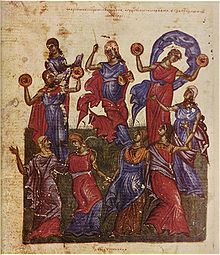
The Bible tells little about Miriam's life. After the miraculous passage of the Israelites through the Red Sea, the prophetess Miriam sang a hymn to the Lord at the head of the choir of women dancing and playing the timpani ( Exodus 15:20, 21 ). It is further stated that in punishment for the murmur of Miriam and Aaron about Moses marrying Ethiopian, Miriam was struck by leprosy and was forced to be isolated for seven days ( Num. 12 ).
Aaron, along with Mariam, questioned Moses' sole right of fellowship with God, and the Lord told the three of them to appear at the tabernacle . “The Lord came down in a pillar of cloud ”, accusing Aaron and Miriam of distrust of Moses “ and the anger of the Lord was kindled against them, and He departed. And the cloud departed from the tabernacle, and behold, Mariam was covered with leprosy, like snow. Aaron looked at Mariam, and, behold, she was in leprosy ”( Num. 12: 9 ).
Her prophetic gift, like that of Aaron, is placed below the prophetic gift of Moses ( Num. 12: 5-8 ). Nevertheless, she, along with Moses and Aaron, is considered the messenger of God to guide the Jews during their wanderings in the wilderness ( Micah 6: 4 ).
Miriam died on the 40th year after the Exodus from Egypt in the place of Kadesh , where she was buried ( Num. 20: 1 ).
In Jewish Traditions
Miriam was born at a time when the Egyptians harassed Jews with excessive taxes (cf. Exodus 1:14), so her name can also mean "bitter." [four]
She was also called “Pua” and, like her mother, was a midwife [5] , at the age of five she was already able to help the latter. [6]
Miriam had the courage to tell Pharaoh that he could be punished by God for his cruel treatment of Israel, thereby putting his life in great danger. [7]
When her father, Amram, moved away from her mother due to a cruel order to beat the babies, Miriam persuaded her father to return to her mother; [8] She sang and danced on her parents' second marriage day. [9] She predicted to her father that he would have a son who would free Israel from Egyptian slavery. When Moses was born, her father kissed his daughter, saying: "Your prophecy, my daughter, has come true." But then, when they had to throw the child into the river, the parents began to reproach her. Miriam went to the river (Exodus 2: 4) to see how her prophecy would come true. [10]
Miriam was also called by the names: Efrat, Khela, Naara, Azuva, Jeriot, Tsogar, Tseret, Ethnan and Aharhel [11] , who were given to her on various occasions: [12] Miriam was the wife of Kalev ben Yefune or ben Hetzron, who gave birth to a son Ora (Hura). [13] When she became ill (hence her name Hel), her husband abandoned her (hence the name Azuva); but after she recovered, she looked very young (hence the name Naara), and she returned to her husband's house. [fourteen]
Miriam was the progenitor of Veseleil (Betzalel), the builder of the Tabernacle , and King David .
When Miriam cursed her brother Moses, [15] she pursued only the good purpose of continuing the human race. [16] The Jews waited seven days because of Miriam while she was isolated, since she also remained because of Moses by the river (Exodus 2: 4).
Miriam is also considered the savior of Israel. [17] For the merits of Miriam, the Jews in the desert were accompanied by a wonderful source ( Miriam well ) from which water flowed continuously. With the death of Miriam, this source disappeared. [eighteen]
Miriam, like Moses and Aaron, died of a heavenly kiss, [19] since the angel of death did not have access to her; worms also cannot touch her body. [20] Haggadah says that Miriam, like Moses and Aaron, died for sin at the waters of Meribah. [21] However, according to the Bible and other agad, the Jews lacked water only after Miriam's death, when a wonderful well disappeared. [22]
In honor of Miriam, the asteroid (102) Miriam , discovered in 1868, is named.
Notes
- ↑ Kantor M. The Jewish Time Line Encyclopedia, New Updated Edition - 2004. - P. 25. - ISBN 978-0-87668-229-6
- ↑ Kantor M. The Jewish Time Line Encyclopedia, New Updated Edition - 2004. - P. 34. - ISBN 978-0-87668-229-6
- ↑ משה 1 // Book of Numbers
- ↑ Midrash Shemot Raba II, 11
- ↑ cf. Ref. 1:15
- ↑ Midrash Shemot Slave I, 17
- ↑ Midrash Shemot Slave I
- ↑ Midrash Shemot Slave I; Talmud , Sota 12a
- ↑ Midrash Shemot Slave I, 23; Talmud , Baba Batra 120a
- ↑ Midrash Shemot Slave I, 36; Talmud , Sota 12b — 13a
- ↑ cf. 1 pair 2: 18-21; 4: 5-8
- ↑ Midrash Shemot Slave I, 21; Talmud , Sota 11b — 12a
- ↑ cf. 1 pair 2: 18-21
- ↑ Midrash Shemot Slave I, 21
- ↑ cf. Chis. 12
- ↑ Midrash Dwarim Slave VI, 6
- ↑ Midrash Shemot Raba XXVI, 1
- ↑ Talmud , Taanit 9a
- ↑ Talmud , Moed Katan 23a
- ↑ Talmud , Baba Batra 17a
- ↑ cf. Chis. 20: 7-13
- ↑ Midrash Vayikra Raba XXXI, 5
Links
- Miriam - article from the Electronic Jewish Encyclopedia
- Jewish Encyclopedia , Ed. Islands for Scientific Jewish Ed. and Brockhaus-Efron. St. Petersburg: 1906-1913; reprint: M .: Terra, 1991. ISBN 5-85255-057-4 .