The siege of Constantinople in 1422 - an attempt by the Ottoman Empire to storm the Byzantine capital . Despite the fact that the Turks first used artillery [1] provided by German businessmen and mercenaries of the Sultan [2] , the siege was crowned with a moral victory for the besieged residents of Constantinople. Like the blockade of 1391 , the siege of 1422 coincided with the next plague epidemic in Constantinople, which, however, spread to the besieging Turks. As a result, they were forced to retreat [3] . However, the confrontation seriously weakened the city, which fell 31 years later (May 29, 1453). In parallel, on the western front, the Turkish sultan, seeking to punish the Palaeologus for trying to unleash insurrection in his state, began the siege of the harbor of Thessaloniki , the second most important city of the empire [4] . Despite the military support of the Venetians, who actually took upon themselves the defense of the city, Thessaloniki depopulated and on March 29, 1430 were finally subjugated by the Turks.
| Siege of Constantinople by the Turks | |||
|---|---|---|---|
| Main conflict: Turkish-Byzantine Wars | |||
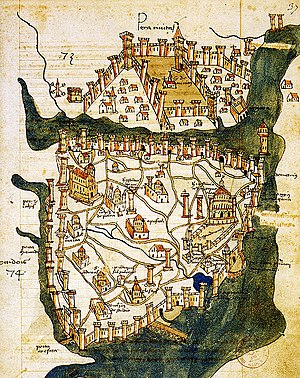 The oldest extant map of Constantinople, Cristoforo Buondelmonti , 1422. | |||
| date | 1422 | ||
| A place | Constantinople , Byzantium | ||
| Total | victory of the Byzantines | ||
| Opponents | |||
| |||
| Commanders | |||
| |||
| Forces of the parties | |||
| |||
Content
Prerequisites
In 1421, Murad II inherited the throne of the Ottoman Empire from his father Mehmed I. By this time, the emperor of Byzantium for a long time remained the ruler of only powerfully fortified Constantinople and a number of adjacent territories. [5] In 1422, Manuel II broke paralysis, and he had to transfer most of the official duties to his eldest son, John VIII . However, he did not have the experience and endurance of his father. He vehemently supported rival Murad II in the struggle for the imperial throne. Under these conditions, in the summer of the same year, Murad II decided on the siege of Constantinople, deciding to teach them an obedience lesson.
Siege
Murad II, who regarded the actions of John VIII as an uprising, sent troops who did not fully recover from the Battle of Angora to Constantinople. However, on June 15, 1422, the Turks laid siege to the capital of the Byzantine Empire. Ten-thousand cavalry blocked the roads at the approaches to the city. [6] On August 24, a 10-thousand army, equipped with various military vehicles, attempted to storm Constantinople. However, the attack was repulsed by the heroic efforts of the metropolitan population. The people took deliverance from the invaders as a manifestation of the patronage of the Mother of God , who is considered the protector of Constantinople. In this honor, the contemporary of events, John Kanan, composed “A story about the Constantinople War of 6930 [7] , when Amurrat Bey attacked a city with a strong army and nearly took possession of it, if the Most Pure Mother of God had not preserved it . ” Meanwhile, the Ottoman Empire experienced significant domestic problems, which led to the need to end the siege. Murad II was forced to pull troops to the south, where he successfully suppressed a number of uprisings in Anatolia. [eight]
Implications
Residents of the city successfully defended, including with the help of firearms, used here by French and Italian mercenaries since the 1380s. Up to a thousand Turks died during the siege. Losses of Constantinople were relatively small: about 30 residents were killed and about 100 wounded [2] . Nevertheless, according to the 1424 world concluded with the Turks, Emperor John VIII pledged to continue to pay a certain tribute to the Sultan and gave him some cities in Thrace . Thus, the surrounding area of Constantinople has become even smaller. Having lost large resources and weakened, the capital seemed to repeat the fate of Emperor Manuel II, who was paralyzed and died in 1425 . On the western front, the Turks continued the siege of Thessaloniki, finally conquering the city on April 29, 1430 .
Like the late Byzantium, the Ottoman state was technologically underdeveloped [2] . However, unlike the Greek, it possessed sufficient demographic and raw material resources to continue the purchase and the gradual introduction of the production of firearms in its army, which predetermined the success of the Ottomans in the future. The fall of Constantinople took place on May 29, 1453 . The son of Murad II Mehmed II captured the city and made it the capital of the Ottoman Empire . [eight]
See also
- Siege of Constantinople
Notes
- ↑ Byzantium in the XV century - "Chronos".
- ↑ 1 2 3 Mark C. Bartusis. The Late Byzantine Army: Arms and Society, 1204-1453 . - University of Pennsylvania Press, 2015-12-22. - 522 s. - ISBN 9781512821314 .
- ↑ (PDF) Epidemic waves of the Black Death in the Byzantine Empire (1347-1453 AD). (eng.) ResearchGate. The appeal date is December 1, 2018.
- ↑ John Julius Norwich, Byzantine: The Decline and Fall (Alfred A. Knopf Pub .: New York, 1998) p. 394
- ↑ Irmiyaeva T.Yu. The history of the Muslim world from the Caliphate to the Brilliant Porta . - Library Gummer.
- ↑ Istanbul and its conquest .
- ↑ See the Byzantine calendar .
- ↑ 1 2 Vasilyev A.A. "History of the Byzantine Empire . " Byzantium.ru.