Alan Garner ( born Alan Garner b. October 17, 1934 ) - English writer, best known for his fantasy novels for children and retellings of traditional English folk tales. His work is based on the landscapes, history and folklore of his native county of Cheshire in North-West England. Books are written in these places using the Cheshire dialect .
| Alan Garner | |
|---|---|
| Alan garner | |
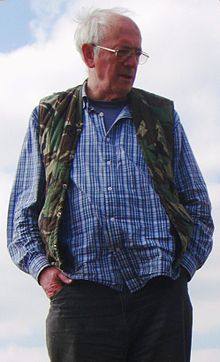 Alan Garner in 2011 | |
| Birth name | Alan Garner |
| Date of Birth | October 17, 1934 (84 years) |
| Place of Birth | Congleton , Cheshire , England , UK |
| Citizenship |  Great Britain Great Britain |
| Occupation | Writer , folklorist |
| Years of creativity | 1960 - our days |
| Direction | Fantasy |
| Genre | Children's literature , fantasy , folklore |
| Language of Works | English |
| Debut | "The Magic Stone of Brizingamen" |
| Awards |  |
Garner was born to a working class family in Congleton , Cheshire, and grew up near the neighboring village of Alderley Edge . He spent most of his youth in wooded places known as the Edge, where he developed an interest in local folklore. After graduating from high school in Manchester and then Oxford University , in 1957 he moved to the village of Blackden , where he bought and renovated a late medieval building known as Tod Hall. His first novel, The Magic Briezingamen Stone, was published in 1960 . This fantasy novel for all those who would be interested in reading it, written in Alderley Edge, contains elements of local folklore in its plot and images not of the main characters. Later, Garner wrote the sequel "The Moon on the Eve of Gomrat" ( 1963 ), but also one more - "Material". He created a number of other fantasy novels: "Elydor" ( 1965 ), "Owls on plates" ( 1967 ) "Red Displacement" ( 1973 ), before the sequel was published.
Despite the fact that Garner’s early works are often labeled as “children's literature,” Garner himself rejects such a description: in an interview he said that he “certainly never wrote for children” and that instead he wrote for himself.
Neil Philip, in his critical review of the works of Garner (1981), noted that until that moment everything that was from Alan Garner was for children, continuing to say that, perhaps, Garner is the case when the division into children's literature and adults is meaningless that his literature pleases readers regardless of age.
"I have as many as four cabinets of correspondence with readers, and after years the main idea is clear and unshakable. Up to eighteen readers read what I wrote with more enthusiasm, understanding and clarity of perception than adults. Adults bog down, claim that I am complicated, equable ... and sometimes I just want to embarrass. It’s not me, I’m just trying to find a simple, just told story. I didn’t decide consciously what I was writing for children, but I’m somehow connected with them ... "Alan Garner, 1989 .
Moving away from fantasy as a genre, Garner released The Stone Book ( 1979 ), a series of four short tales describing in detail one day in the life of four generations of his family. He also published a series of rewritten English folk tales in the cycles “Golden Tales” ( 1980 ), “The Book of British Tales by Alan Garner” ( 1984 ) and “Bag of Moonlight” ( 1986 ). In his subsequent novels, Strandloper ( 1996 ) and Thursbitch ( 2003 ), he continued to write stories revolving around Cheshire, but without the fantasy elements characteristic of his early works.
Content
Biography
Early years: 1934–1956
“I had to return [to family methods of doing business], using the skills my ancestors had been deprived of; but I had nothing that they would call worthwhile. My advantage was in the language, in the languages. One way or another, I had to use it. Writing was my manual art. But what did I know enough to write about it? I knew the land " - Alan Garner, 2010 [1] |
Garner was born in the front room of his grandmother's house in Congleton, Cheshire, October 17, 1934. [2] He grew up near Alderley Edge, a wealthy Cheshire village that actually became a suburb of Manchester . [2] Garner grew up in a “rural working-class family,” [3] His origins are related to Alderley Edge from at least the 16th century, traced from Alan in reverse chronology to the death of William Garner in 1592 . [4] The Garner family conveyed “true oral tradition” by teaching their children tales of Edge, including, for example, the story of the king and his army of knights who sleep under Edge guarded by a sorcerer. [3] And in the middle of the XIX century, great-great-great-great-grandfather of Alan Robert Garner carved the face of a bearded sorcerer on a stone rock near the source, known in local folklore as the Spring of the Sorcerer. [5] Living in this rural area, Robert Garner and his relatives were skilled craftsmen, who with each successive generation tried to "improve or do something different from the previous ones." [6]
Alan's grandfather, Joseph Garner, “could read, but did not, and therefore was practically illiterate,” but instead told his grandson various tales about Edge. [3] As Alan later noted, he eventually “was aware of [Edge's] magic” as a child who often played there with his friends. [7] The story of the king and sorcerer living under the hill played an important role in the life of young Alan, "deeply rooted in his psyche" and greatly affected his works. [3]
As a child, Garner faced several diseases that threatened his life. [2] However, he went to a local school, where he was rewarded for his high intelligence, but he was punished for his native Cheshire accent. [2] Later, he went to high school in Manchester [2] , and then began to study classical languages at Magdalen College, Oxford University . Garner became the first family member to graduate. He noted that this led to his exclusion from the "cultural background" and some division between him and his relatives, who "could not get along with me, and with whom I could not get along." [3]
The Magic Stone of Brizingamen and the Moon on the Eve of Gomrat: 1957–1964
In 1957, Garner acquired Todd Hall, a building from the late Middle Ages, in Blackden, seven miles from Alderley Edge. At the end of the 19th century, Hall was divided into two cottages for agricultural workers, but Garner received both for £ 670 and proceeded to convert them back to a solid house. [eight]
It was in Todd Hall that Garner began writing his first novel, which was to receive the title “Brizingamen’s Magic Stone: Alderley's Story”. Having formed on Alderley, she revolved around two children, Colin and Susan, who are sent to live in the district to the old nanny of their mother Bess and her husband Gauter Mossoku. Having tuned in to the study of Edge, they discover an evil tribe of “Swart-Alfar” who live in ruined mines and are going to capture them, until the magician Cadellin rescues them and finds out that the forces of darkness are pulled up to Edge in search of the royal “magic stone Brizingamen”. Engaged in creative work, Garner simultaneously tried to get a job as a teacher, but soon gave up, believing that he “could not write and teach; these forces were too similar. " Therefore, for four years he was a laborer, remaining unoccupied for most of this time. [3]
Garner sent the manuscript of his debut novel to the publishing company Collins, where it was picked up by the head of the company, William Collins, who was in search of new fantasy novels after the success of Lord of the Rings by J.R.R.Tolkin . [9] Garner, later becoming a friend of Collins, remarked that "Billy Collins saw the headline with funny words and decided to publish it." [9] Released in 1960, Brizingamen’s Magic Stone was “a resounding success ... both critically and commercially” and was later described as “a trick of the imagination, a novel that showed almost every subsequent writer what can be achieved with the help of the novel , released allegedly for children. [ten]
“When I was engaged in literary activity, which is partially intellectual in its function, but primarily intuitive and emotional in its performance, I turned to the exciting and supernatural that was in me - it was a legend about King Arthur Sleeping Under the Hill. She stood behind everything I had to quit in order to make sense of what I needed to quit. And so the first two of my books are not rich in descriptions - I was somewhat dumb in this area, but filled with images and landscapes, because I inherited landscapes along with the legend. ” - Alan Garner, 1989 [3] |
When Garner’s first book came out, he left his job and got the job of a freelance television reporter, living from “hungry” on a “meager” budget. [3] He also worked on the continuation of the “Brizingamen's Magic Stone”, which was called the “Moon on the Eve of Gomrath”.
The Moon on the Eve of Gomrath also revolves around the adventures of Colin and Susan, a possessed evil creature named Brollachan, who recently entered the world. With the help of the wizard Cadellin, Brollachana is banished, but Susan’s soul also leaves her body, going to another dimension, leading Colin, who is looking for a way to return her.
In a later interview in 1989, Garner admitted that he had left the opportunity for the third book about the adventures of Colin and Susan to appear, having conceived a trilogy, but he deliberately decided not to write it, but instead to move on to write something else. [3] However, “Boneland”, the end of the cycle, was nevertheless written and published in August 2012 . [eleven]
Elydor, Owls on Plates and Red Offset: 1964–1973
In “Elidor,” the scene of which is present-day Manchester, we are talking about four children who ended up in the Victorian church and found there a portal to the magical country of Elidor. There, King Malibron entrusts them to help save the four treasures stolen by the forces of evil that are trying to take control of Elydor. After successfully doing this, the children return home to Manchester, but evil forces pursue them in order to steal the victory.
The action "Owls on plates" takes place in Wales and is based on a plot from the medieval Welsh epic " Mabinogion ".
Stone Book Cycle and Fairy Tale Collections: 1974–1994
The Stone Book cycle ( 1976 - 1978 ) [12] is poetic in its style and influence. Garner pays special attention to the language and seeks to reproduce the modulations of the Cheshire dialect of English. He explains this by the feeling of rage experienced during the reading of the poem Sir Gawain and the Green Knight : his father would not need footnotes. This and other aspects of his work became the subject of a detailed analysis of Neil Phillips in “Beautiful Rage: A Critical Introduction to the Works of Alan Garner” (Collins Publishing House, 1981 ).
In a 1989 interview , Garner remarked that, despite the fact that the writing of The Stone Book was "exhausting," it became "the most worthy of everything he had written by that time." [3]
Strandloper, Thursbitch and Boneland: 1995 – present
In 1996, Garner’s novel Strandloper was released.
His collection of essays and public speeches, The Voice That Rumbles, contains many autobiographical materials (including a report on his life with bipolar disorder ), as well as critical reflections on folklore and language, literature and education, the nature of myth and time.
Garner’s next novel, “Thursbitch,” was released in 2003 .
Garner's latest novel, "Boneland", published in August 2012, completes the trilogy begun over fifty years ago with "The Brizingamen's Magic Stone."
Literary style
“I have as many as four cabinets of correspondence with readers, and after years the main idea is clear and unshakable. Readers before the age of eighteen read what I have written with more enthusiasm, understanding, and clarity of perception than adults. Adults get bogged down, claim that I am complex, capricious and obscurantist, and sometimes they just try to embarrass. It's not me; I'm just trying to find a simple, simply told story ... I did not consciously decide what I was writing for the children, but I somehow connected with them. I think this applies to my psychopathology, but I am not competent enough to determine this. ” - Alan Garner, 1989 [3] |
Despite the fact that Garner’s early works are often labeled as “children's literature,” Garner himself rejects such a description: in one of the interviews he said that he “certainly never wrote for children” and that instead he always wrote exclusively for himself. [3] Neil Philip, in his critical review of Garner’s work ( 1981 ), noted that up to this point “everything that Alan Garner released was released for children,” [13] but despite this continued to say that Garner was the case when the separation of children's and adult literature is meaningless, "and that his literature" like the type of people, regardless of their age. [14]
English writer and academician Charles Butler noted that Garner was attentive to "geological, archaeological and cultural history in his artistic design and combined his narrative with physical reality beyond the page." [15] It is interesting that Garner included the maps of Alderley Edge in the “Brizingamen's Magic Stone” and “The Moon on the Eve of Gomrat”. [16] Garner spent a lot of time exploring the places he dealt with in his books; in his article for The Times Literary Supplement in 1968, Garner noted that in preparation for writing Elydor:
I had to read many textbooks on physics, on Celtic symbolism, unicorns, medieval watermarks, megalithic archeology; study the works of Jung ; refresh Plato ; visit Avebury , Silbury Hill and St. Michael’s Cathedral in Coventry ; spend a lot of time with working groups on the demolition of slum sites; and also listen to Britten's entire War Requiem almost every day. [17]
Recognition and Legacy
Awards
- 1967 - Carnegie Medal
Television and radio adaptations
Bibliography
- 1960 - "The Magic Briezingamen Stone"
- 1963 - “The Moon on the Eve of Gomrat”
- 1965 - "Elidor"
- 1966 - English Holly from the Bongs: A Nativity Play
- 1967 - "The Old Man of Moe"
- 1967 - "Owls on the plates"
- 1969 - “The Goblin Book of Hamish Hamilton”
- 1973 - "Red Offset"
- 1974 - English Holly from the Bongs: A Nativity Opera
- 1975 - English The breadhorse
- 1975 - English The guizer
- 1976 - The Stone Book
- 1977 - “Granny Reardan”
- 1977 - "Day Fobbla"
- 1978 - "The Gate of Aymer"
- 1979 - English The stone book quartet
- 1980 - “Guy from Gad”
- 1980 - "Golden Tales"
- 1984 - “The Book of British Fairy Tales by Alan Garner”
- 1985 - The Potter Thompson
- 1986 - "Bag of Moonlight"
- 1992 - "Jack and the Beanstalk"
- 1993 - “Once”
- 1996 - English Strandloper
- 1997 - "Little Red Chicken"
- 1997 - “Thunder Voice”
- 1997 - English The Voice That Thunders (collection of essays and lectures)
- 1998 - "Gray Wolf, Prince Jack and the Fire Bird"
- 1998 - "The Well of the Wind"
- 2003 - English Thursbitch
- 2009 - “Freedom”
- 2011 - English Collected Folk Tales
- 2012 - English Boneland
Notes
- ↑ Garner 2010 . p. 08
- 2 1 2 3 4 5 Philip 1981 . p. eleven.
- ↑ 1 2 3 4 5 6 7 8 9 10 11 12 Thompson and Garner 1989 .
- ↑ Garner 2010 . p. 05
- ↑ Garner 2010 . pp. 08-09.
- ↑ Garner 2010 . p. 07
- ↑ Garner 2010 . p. 09
- ↑ Blackden Trust 2008 .
- ↑ 1 2 Lake 2010 . p. 317.
- ↑ Lake 2010 . pp. 316-317.
- ↑ Boneland by Alan Garner - review
- ↑ Stone Book series . The Internet Speculative Fiction Database. Retrieved 11 July 2012.
- ↑ Philip 1981 . p. 7
- ↑ Philips 1981 . p. eight.
- ↑ Butler 2009 . p. 146.
- ↑ Butler 2009 . pp. 146–147.
- ↑ Garner 1968 . p. 577.