
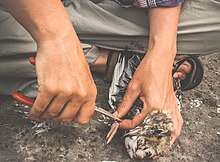
Bird ringing is a tagging method used in ornithology to study the biology of wild birds. Banding occurs by catching a bird and putting a number ring on its foot. Birds are ringed at the nesting site, on the flight path, during molting or on wintering. Most often, the rings are made of aluminum . Sometimes banding is used to highlight a specific individual, to observe the bird in nature. In such cases, a large ring with a number or with colored plastic inserts is put on the foot to easily track the bird with optical instruments. An analysis of received reports of ringed bird encounters allows us to judge the ways and timing of bird migration , their resettlement, changes in numbers, causes of death, and life expectancy. This is important for the harmonization of the rules for the protection of migratory birds in different countries, in the interests of the hunting economy, for studying the paths of birds carrying parasites and pathogens.
Content
- 1 History
- 2 Why do the birds ring
- 3 EURING
- 4 Literature
- 5 Links
History
Even in ancient times, people in various ways tried to label animals. Mostly tagged animals were poultry and hunting birds. The literature also contains information about ringing of herons , storks , swans , geese , pigeons and swallows in the Middle Ages. As a rule, information on such marking was necessary and therefore accessible to a narrow circle of people directly involved in the ringing process. In addition, at that time in the world there were no modern ways of exchanging information, which also did not allow widespread use of the banding method for studying wild birds.
Hans Christian Cornelius Mortensen, a teacher from Viborg, Denmark, was the first to systematically ring birds for scientific purposes. In 1899, he marked with aluminum rings with the original numbers and the address of 165 starlings in the hope that some of the birds would be discovered and the ring would return with information about the date and location of the find. The experiment was successful, and a year later its first results were published. The method proposed by Mortensen attracted the attention of scientists, and in many countries began to ring birds and organize ring centers. Since then, tens of millions of different birds have been ringed and tagged in the world.
Why birds ring
Banding, like any other method of individual tagging of birds, is a very important method for studying them, extremely widely used by scientists in different countries of the world. It is based on the ability to identify a bird thanks to the number on the ring or some other mark. Any registration of a ringed bird, for example, as a result of its repeated capture, simple observation, finding a ring or finding a dead bird, gives a lot of information about the life of this individual, especially about its movements. And knowledge of flight routes, stopping places during periods of migration, wintering allows you to plan and improve the protection of birds and their habitats both at the national and international levels.
Another part of the information obtained as a result of the return of the rings allows us to study important population indicators (e.g., survival, reproductive success, average life expectancy, mortality at different periods of the life cycle, etc.) and helps scientists shed light on the reasons for the change in population size.
EURING
Migratory birds cross the political borders of states throughout their long flights. To successfully monitor their lives throughout their lives, the creation of an international coordination network of ringing stations and National Ringing Centers was required. So at a meeting of the National Ringing Centers in Paris in 1963, EURING, the European Bird Ringing Union, was formed. The main goal of the Union is the organization and standardization of scientific ringing of birds in Europe. All European ringing centers with their own rings for studying free-living birds are members of EURING. The EURING Council consists of the President, Vice President, Secretary General and 5 members elected by the representatives of the ring centers at the biennial General Meeting.
To support the exchange of information between various European ring centers in 1966, EURING proposed a standardized encoding system for ring-return data. These codes are currently used by all centers and greatly facilitate the transfer and analysis of data obtained from many different sources.
In 1977, the EURING Databank was created on the basis of the Institute of Ecology in Heteren (Netherlands), which collects data on ringing and returns not only from European centers, but also from all over the world. EURING members send reports here annually; most centers also send returns data. Already in 1994, the Databank contained information on 1 million 225 thousand returns of more than 400 species of birds.
Literature
- Mikheev A.V. Traveler Rings: (Banding of Birds) / Otv. ed. G.P. Dementiev ; Council of Ministers of the RSFSR . General Directorate for Reserves. - M. , 1949. - 56 p. - 10,000 copies.
Links
- Peter Zverev. What bird rings Talk about . The site of Okhotniki.ru (February 16, 2015). Date of treatment March 2, 2015.
- Dobrynina I.N. (Center for Bird Banding, IPEE RAS , Moscow ). How did the banding of birds begin and continue in Russia