The theorem on the sum of the angles of a triangle is the classical theorem of Euclidean geometry . States that
The sum of the angles of a triangle on a Euclidean plane is 180 ° . |
Content
Proof
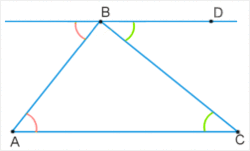
Let be {\ displaystyle \ Delta ABC} - arbitrary triangle. Draw a vertex B through the line parallel to the line AC . We mark the point D on it so that the points A and D lie on opposite sides of the line BC . The corners of DBC and ACB are equal as internal crosswise lying, formed by the secant BC with parallel lines AC and BD . Therefore, the sum of the angles of the triangle at vertices B and C is equal to the angle ABD . The sum of all three corners of the triangle is equal to the sum of the angles ABD and BAC . Since these angles are internal one-sided for parallel AC and BD with a secant AB , their sum is 180 °. Q.E.D.
Consequences
From the theorem it follows that any triangle has at least two acute angles. Indeed, applying the proof by contradiction , let us assume that a triangle has only one acute angle or no acute angles at all. Then this triangle has at least two angles, each of which is at least 90 °. The sum of these angles is at least 180 °. And this is impossible, since the sum of all angles of a triangle is 180 °.
Generalization for simplexes
There is a more complex relationship between the dihedral angles of an arbitrary simplex . Namely, if - the angle between i and j faces of the simplex, then the determinant of the following matrix (which is a circulant ) is 0:
- .
This follows from the fact that this determinant is the Gram determinant of normals to the faces of the simplex, and the Gram determinant of linearly dependent vectors is 0, and vector in -dimensional space is always linearly dependent.
In non-Euclidean geometries
- On a sphere, the sum of the angles of a triangle always exceeds 180 °; the difference is called a spherical excess and is proportional to the area of the triangle. A spherical triangle can have two or even three right or obtuse angles.
- Example. One vertex of the triangle on the sphere is the north pole. This angle can be up to 180 °. Two other vertices lie at the equator, the corresponding angles are 90 °.
- In Lobachevsky's geometry, the sum of the angles of a triangle is always less than 180 ° and can be arbitrarily small. The difference is also proportional to the area of the triangle.
See also
- Triangle
- The theorem of the sum of the angles of the polygon