Daniel Harvey Hill ( eng. Daniel Harvey Hill ; July 12, 1821 - September 24, 1889 ) - General of the Confederate Army during the American Civil War . He was known as an aggressive commander, a strictly religious person with a dry, sarcastic sense of humor. He was the brother-in-law of Jackson Stone Wall , a close friend of James Longstreet and Joseph Johnston , but disagreements with General Lee and Braxton Bragg deprived him of the trust of President Jefferson Davis . Despite the recognition of his military talents, the Confederation almost did not address him at the end of the Civil War.
| Daniel Harvey Hill | |
|---|---|
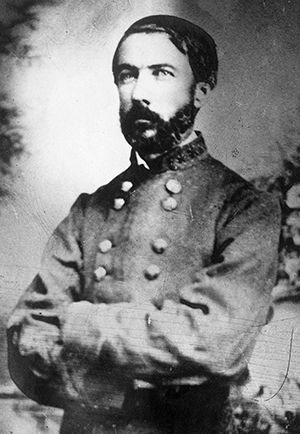 | |
| Date of Birth | |
| Place of Birth | York County, South Carolina |
| Date of death | |
| Place of death | Charlotte |
| Affiliation | USA KSA |
| Type of army | Confederate Army |
| Years of service | 1842–49 (USA) 1861–65 (KSA) |
| Rank | major lieutenant general |
| Commanded | Division Commander, North Virginia Army ; Comcor, Tennessee Army |
| Battles / wars | Mexican war
U.S. Civil War
|
| Retired | • editor of Beloved Land magazine • President of the University of Arkansas • President of the Military Agricultural College . |
Daniel Harvey Hill is usually referred to in the story as D.H. Hill (DH Hill), to distinguish him from the namesake E.P. Hill (AP Hill), who served with him in the North Virginia Army .
Content
The early years
Daniel Harvey Hill was born in the Hills Iron Works, in York County, South Carolina . He was the son of Solomon and Nancy Kabyin Hill. His paternal grandfather, Colonel William "Billy" Hill, a nee Irishman, built an iron factory in York County, where he made guns for the Continental Army . His maternal grandfather was a Scotsman. Hill graduated from the Military Academy with the 28th of 56 cadets graduating in 1842 and was enrolled in the 1st artillery regiment in the temporary rank of second lieutenant. In 1843-1844 he served at Fort Moltri, and on October 13, 1854 received the permanent rank of second lieutenant [4] .
He proved himself during the Mexican War and received the temporary rank of captain for the courage shown in the battle of Contreras and Churubusco , and on September 13, 1847 - the temporary rank of major for bravery in the battle of Chapultepec . In February 1849, he retired from the army and became a professor of mathematics at Washington College (now the University of Washington and Lee ) in Lexington, Virginia . In 1854, he entered Davidson College (S. Carolina) and in 1859 became superintendent of the North Carolina Military Institute in Charlotte.
Marriage and children
On November 2, 1848, Hill married Isabella Morrison, the daughter of Robert Hall Morrison, the first president of Davidson College , and through his mother, the niece of North Carolina Governor William Alexander Graham. They had 9 children. One of his sons will later become president of North Carolina College (now North Carolina State University ). Their youngest son, Joseph Morrison, will be the supreme judge of the Arkansas Supreme Court from 1904 to 1909.
In July 1857 , Isabella's younger sister, Mary Anna, married Thomas Jackson , and in the future, the famous Confederate general. Hill and Jackson crossed paths during the Mexican War , and subsequently they both lived in Lexington, where they became friends.
Civil War
When the civil war broke out, Hill became commander of the 1st North Carolian Infantry Regiment , and in this rank took part in the Battle of Big Bethel near Fort Monroe on June 10, 1861 . Soon after, he was promoted to brigadier general.
In the spring of 1862 he participated in the hostilities at Yorktown and Williamsburg , and already in the rank of major general led the division into battle in the battles of Seven Pines and in the Seven-Day Battle . In the battle of Malvern Hill, his division advanced after the division of Magruder and suffered heavy losses, without achieving any result. “This is not a war, this is a murder,” Hill said about this fight. After fighting on the peninsula, Hill's division was left near Richmond and did not take part in the North Virginia campaign .
On July 22, 1862, Hill and Federal General John Dicks entered into an agreement on the exchange of prisoners between the armies of the Union and the Confederation, known as the Dix-Hill Cartel Agreement.
Maryland Campaign
In September 1862, Hill's division participated in the Maryland campaign . The division was as follows:
- Roswell Ripley Brigade,
- Robert Rhodes Brigade,
- Samuel Garland Brigade,
- George B. Anderson Brigade
- Alfred Colquitt Brigade
After the division of Lee's army, Hill's division was left in the South Mountains to cover the gorges. With the support of the David Jones Division, she defended these gorges during the Battle of South Mountain . The division fought fiercely, allowing General Lee to gather his forces from Sharpsberg, but still this battle is considered Hill's failure. Douglas Freeman cites Chamberlain's opinion, who said: “Hill stupidly failed the battle for the South Mountains and we were left off the flank ... People increasingly began to call him a blockhead (numskull). If Harpers Ferry lasted 24 hours longer, Hill would cost us our army, our life and our freedom ” [5] .
At the Battle of Entityam , the Hill Division (Ripley, Rhodes , Garland, Anderson, and Colquitt Brigades) found themselves in a complex area known as Sanken Road or the Bloodline. Part of the brigades had to be transferred to the left flank, so that at the critical moment of the battle, the center of the Confederate positions was held only by the Rhodes and Joseph Buzhvin Anderson brigades. There were 2500 of them, but they withstood the attack of twice the superior forces of the federal division of General French. The division maintained its position, but the attack of the Richardson federal division forced them to retreat. In that battle near Gil, three horses were killed, General Anderson was mortally wounded.
In fact, this was his first and last major battle for that war.
After Entityem
After Entitym, some generals were nominated for the rank of lieutenant general, but Hill did not get on these lists, despite the fact that he clearly deserved it. On this occasion, Jackson noted that if he had been treated this way, he would have resigned. To this, Hill said that he defends his country and is ready to fight even as an ordinary, if necessary [6] .
In the Battle of Fredericksburg , the Hill Division did not actively participate, being in reserve. At this time, a conflict began to brew between Hill and General Lee. When the North Virginia Army was reorganized after Jackson's death, Hill received no corps and was generally sent to the rear to recruit recruits. Regarding Hill, General Lee wrote this: “I am afraid that General Hill is not quite suitable for his position. He is beautiful as a performer, but he lacks managerial abilities. Left to his own devices, he is lost ... ” [7] .
During the Gettysburg campaign, he led the defenders of Richmond and successfully opposed the federal forces of Dix and Case at the end of June. In 1863, he was sent to the reorganized Tennessee Army with the rank of lieutenant general and commanded one of the corps under the command of Braxton Bragg . In the bloody battle of Chikamog, his people again found themselves in the most difficult area. Subsequently, Hill joined those generals who accused Bragg of being unable to take advantage of the victory. President Davis resolved the conflict in favor of Bragg. The Tennessee army was reorganized again, Hill was removed from command and his promotion was not confirmed by the president, so he again became a major general.
After that, Hill commanded small units away from the main battles. He participated in the battle of Bentonville in North Carolina - which was the last battle of the Tennessee Army. He was the division commander when he was surrounded by Joseph Johnston on April 26, 1865 .
Post-war activities
From 1866 to 1869, Hill was editor of The Land We Love magazine in Charlotte, North Carolina . The magazine wrote about social and historical issues and had a strong influence in the south. In 1877, he became the first president of the University of Arkansas and held this post until 1884. In 1885 he became president of the Military Agricultural College (Georgia), and stayed with him until 1889 , when he quit due to health reasons. He died in Charlotte a month later and was buried in the cemetery of Davidson College .
Scientific Papers
- College Discipline: An Inaugural Address Delivered at Davidson College, NC, on the 28th February, 1855. [np: np], 1855. 19 p .; 23 cm. OCLC 7195350
- Elements of Algebra. Philadelphia, PA: JB Lippincott, [1857], 1859. xii, [13] -507 p. tables 22 cm. OCLC 19591232
- A Consideration of the Sermon on the Mount. Philadelphia, PA: WS & A. Martien, 1858, 1859. 3 pl, [5] -282 p. 19 cm. OCLC 7195011 e-Book version Ann Arbor, Mich .: Making of America, 2000. OCLC 612157953
- The Crucifixion of Christ. Philadelphia, PA: WS & A. Martien, 1859.345 p. 20 cm. OCLC 4392161
- Remarks of Major DH Hill of the NC Military Institute at Charlotte, before the Committee on Education of the North Carolina Legislature. [North Carolina: np, 1860?]. OCLC 41374540
- Gen. Hill founded and edited The Land We Love: A Monthly Magazine Devoted to Literature, Military History, and Agriculture. 6 vols. Charlotte, NC: JP Irwin & DH Hill, 1866-1869. Sabin no. 38821. This magazine merged with The New Eclectic Magazine of Baltimore, MD. Subsequently it was called The Southern Magazine. OCLC 752793193 OCLC Record Containing Contents List for Issues of The Land We Love.
- The Old South: An Address Delivered by Lieutenant-General DH Hill, at Ford's Grand Opera House, on Memorial Day, June 6, 1887, before the Society of the Army and Navy of the Confederate States in the State of Maryland. Baltimore, MD: Andrew J. Conlon, 1887. OCLC 5315299
Notes
- ↑ 1 2 German National Library , Berlin State Library , Bavarian State Library , etc. Record # 1017088829 // General regulatory control (GND) - 2012—2016.
- ↑ 1 2 SNAC - 2010.
- ↑ 1 2 Find a Grave - 1995. - ed. size: 165000000
- ↑ Cullum's register
- ↑ Freeman2, 1942 , p. 274.
- ↑ Hal Bridges, p. 146
- ↑ Robert I. Girardi, The Civil War Generals: Comrades, Peers, Rivals-In Their Own Words, Zenith Press, 2013 p. 218
Literature
- Bridges, Hal. Lee's Maverick General: Daniel Harvey Hill. Lincoln: University of Nebraska Press, 1991. ISBN 0-8032-6096-2 .
- Freeman, Douglas S. Lee's lieutenants v. II. - New York: Charles Scribners sons, 1942 .-- 772 p. - ISBN 978-0684101767 .