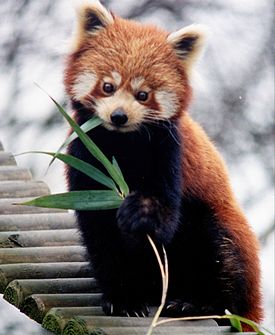
Small panda [2] , cat bear [3] or red panda ( lat. Ailurus fulgens ) - a mammal from the family of pandas suborder pssoobrazny order of predators , which, however, feeds mainly on vegetation ; the size roughly corresponds to the large individuals of the domestic cat .
| Little panda | |||||||||||||||||||||||||||||||||||||||
 | |||||||||||||||||||||||||||||||||||||||
| Scientific classification | |||||||||||||||||||||||||||||||||||||||
|---|---|---|---|---|---|---|---|---|---|---|---|---|---|---|---|---|---|---|---|---|---|---|---|---|---|---|---|---|---|---|---|---|---|---|---|---|---|---|---|
| |||||||||||||||||||||||||||||||||||||||
| International scientific name | |||||||||||||||||||||||||||||||||||||||
Ailurus fulgens FG Cuvier , 1825 | |||||||||||||||||||||||||||||||||||||||
| Synonyms | |||||||||||||||||||||||||||||||||||||||
| |||||||||||||||||||||||||||||||||||||||
| Subspecies | |||||||||||||||||||||||||||||||||||||||
| |||||||||||||||||||||||||||||||||||||||
| Area | |||||||||||||||||||||||||||||||||||||||
| |||||||||||||||||||||||||||||||||||||||
| Security status | |||||||||||||||||||||||||||||||||||||||


Content
Name Origin
The written records of this beast in China date back to the 13th century , but Europeans only found out about it in the 19th century. It was officially “discovered” in 1821 by the English general and naturalist Thomas Hardwick , who collected material on the territory of the English colonies.
He proposed to call this animal the word "wah" (wah) - one of its Chinese names, based on the imitation of sounds made by the animal. In addition, the general said, the Chinese call him "ho-hu" (huo-hu), and the Nepalese "punya" (poonya), from which came the modern "panda" (panda).
However, Hardwick failed to become the “godfather” of the newly discovered animal. He delayed his return to England with his materials, and the Latin name - Ailurus fulgens , which can be translated as “shining cat” - was managed to give a new animal by the French naturalist Frederic Cuvier . The British scientific community infuriated such "theft", but according to the rule accepted by the naturalists themselves, once the scientific name given to the organism can no longer be changed. And the “discoverer” of the species is the one who assigned this name to him.
However, writes zoologist Miles Roberts, perhaps this is for the best. Indeed, the poetic epithet "brilliant", "bright" is much better suited for such a beautiful animal than the incomprehensible "hha." Frederic Cuvier himself wrote about the new animal as "a wonderful creature, one of the cutest four-legged animals ."
The name proposed by General Hardwick did not take root, and as the English name of the animal. Although the word “wah” can sometimes be found in English-language literature, the general’s compatriots liked the Nepalese name “poonya”, which they quickly transformed into “panda”. So wah became a panda.
Description
Body length 51–64 cm, tail 28–48 cm. Males weigh about 3.7–6.2 kg, females 4.2–6.0 kg. The body is elongated, the tail is fluffy, the head is wide, with a short sharp muzzle and small rounded ears. Has 38 teeth. The paws are short, strong, with semi-retractable claws that help the panda easily climb trees and descend from them.
Small pandas, like large ones, have on their forepaws a “sixth (big) toe”, which is separated from five ordinary ones. In fact, this is a false finger, which is a modified sesamoid bone of the wrist . This anatomical feature allows the animal to cleverly climb branches and easily manage even with thin bamboo shoots.
Scientists from the Institute of Genetics and Biology of Development of the Chinese Academy of Sciences, with the assistance of colleagues from the British Sanger Institute, conducted a study and concluded that although the big and small pandas have a very distant common ancestor who lived over 40 million years ago, the sixth finger was not inherited by them from him, but appeared much later. Each of these two species belonging to different families, independently of the other, found the described supplement during convergent evolution : the bamboo diet and the need to retain bamboo stems and steel, according to researchers, the reasons for which the genetic changes were reflected, which were reflected in the general anatomical features of small and big pandas [4] [5] .
The fur of the little panda is from above a ginger or walnut color, from below it is dark, tan or black. The hairs on the back are yellow tips. The paws are glossy black, the tail is red, with subtle lighter narrow rings, the head is lighter, with the edges of the ears and muzzle almost white, and around the eyes a masked pattern, like raccoons , this pattern is unique for each individual. This is a wonderful camouflage for an animal spending most of the time on trees covered with mosses and lichens .
Lifestyle
The small panda leads a mostly nocturnal (or rather, twilight) lifestyle, sleeps in the hollow during the day, curled up and covered its head with its tail. In case of danger it also climbs trees. On the ground, pandas move slowly and awkwardly, but climb trees perfectly, but nevertheless feed mainly on the ground.
Although the small panda is a representative of the predatory order, 95% of its diet is made up of young leaves and bamboo shoots . The remaining 5% are various fruits , berries , mushrooms , bird eggs and even small rodents . It should not be forgotten that predators stand out in a separate detachment not because they eat animal food - for example, some ungulates also do not disdain it - but because of the availability of special devices for its extraction and, most important, assimilation. They have appropriate teeth, and the stomach is simple, and not multi-chambered, as in ruminants , and the intestines are short, therefore, fibrous plant food is usually not good for them. The situation with the dental system of pandas is relatively good: their molars have numerous tubercles that allow you to grind and chew on plant fibers. But the digestive tract of the red panda is the digestive tract of an ordinary predator, and therefore, as special studies have shown, the body of the animal assimilates no more than one fourth of the energy contained in the eaten bamboo leaves. Like the big panda , the small panda cannot digest cellulose , so it eats bamboo more readily than, for example, leaves. In winter, when the amount of bamboo is reduced, the small panda should diversify its diet with berries, bird eggs, mushrooms, otherwise it will not receive enough nutrients. However, in spring and summer, when the amount of bamboo and leaves is not limited, the small panda should eat more than 1.5 kg of leaves and 4 kg of young bamboo shoots per day.
Unlike the big panda, the small panda is very selective in nutrition. If the "bamboo bear" eats almost all parts of the bamboo , the small panda seeks out shoots fresher. Observations showed that small pandas spend 13 hours a day feeding.
In a calm state, small pandas make short sounds, reminiscent of bird chirping.
The small panda is distinguished by its peaceful nature and easily takes root in captivity.
The life span of a small panda is 8-10 years, although some individuals survive to 15. In captivity, one of the small pandas has survived to 18.5 years. Pandas live in pairs or families in the forests . The “personal” territory of the female, according to recent studies, covers an area of about 2.5 km², male - twice as much.
Reproduction
The breeding season for pandas begins in January . Between mating and childbirth, the female takes from 90 to 145 days, of which only 50 days are necessary for the development of the embryo , since the development of the fetus does not begin immediately after conception , but after a rather long time, called diapause .
Males rarely take part in the rearing of cubs, except that we are talking about small pandas living in a pair (or in a group)
Shortly before giving birth, the female builds a nest of branches and leaves in a hollow or crevice of a rock. In this nest, small pandas are born - blind and deaf, weighing only about 100 g, whose color is more like beige (from light walnut to gray) than red or orange. Usually 2-3 cubs, but sometimes four of them are born at once, but rarely more than one lives on to independent life. Cubs grow very slowly. Around the 18th day they open their eyes. Only at the age of three months does their color acquire a characteristic color for an adult, they begin to leave the nest and eat solid food. A little later, having left the nest, they roam with their mother along her plot - until the middle of winter (and according to other sources, a whole year). That is why in a number of books you can read that the red panda in nature is held in pairs or even in small groups. Young animals reach puberty at the age of 18 months. At this age, they are ready to have their own offspring, but the individual is considered an adult, only starting from 2-3 years of age. Sometimes they stay with their mother a whole year, until a new litter.
Evolution
Paleontological excavations have shown that the small panda (despite its name) is only a distant relative of the big panda ( Ailuropoda melanoleuca ). Their common ancestor supposedly lived in the early Tertiary period millions of years ago. It was widely distributed in Eurasia . The fossil remains of red pandas were found in the territory from eastern China to western Great Britain . Paleontologists have found the remains of small pandas even in North America (in the states of Tennessee and Washington ) and suggest that this could be some new subspecies of the red panda living in the Miocene .
Systematics
The systematic position of the little panda has long been unclear. It was assigned either to the raccoon family, or to the bear family, or to a separate family. However, recent genetic studies have shown that the small panda forms its own family Ailuridae , which, together with the families of skunk ( Mephitidae ), marten ( Mustelidae ) and raccoon ( Procyonidae ) forms a superfamily of marten-like ( Musteloidea ) [6] . The Ailuridae family is isolated from the raccoon family and includes one modern genus with one species - the red panda, as well as its extinct relatives from other genera (they have the characteristics of all the above families).
Subspecies
There are two subspecies of the small panda that exist today. The first - the western small (red) panda ( Ailurus fulgens fulgens FG Cuvier, 1825 ) lives in the western part of the aforementioned region ( Nepal , Bhutan ). The second subspecies - the small (red) panda Styana ( Ailurus fulgens styani Thomas, 1902 [7] ) lives in the east or northeast of its range (southern China and northern Myanmar ). The small panda Styana, presumably, is slightly larger and significantly darker than its western relative, although a large number of variations on the theme of "color-size" exist within the subspecies of the panda. In this regard, you can find many individuals not red, but rather yellowish brown.
Abundance and captivity
Although the range of the small panda occupies a very large territory and has few natural enemies, this species is included in the lists of the International Red Book with the status of “Endangered”. The species was classified as endangered, since only 2,500 individuals remained (according to other sources, about 10,000 [8] ). The fact is that the density of animals in nature is very low, and, in addition, the habitats of the red panda can easily be destroyed. The main danger is the constant deforestation in these regions, as well as poaching and hunting for small pandas in India and south-west of China because of its beautiful fur (from which they make hats). Over the past 50 years, the population of red pandas in the Himalayan mountains has decreased by 39%.
Fortunately, the small panda breeds well in captivity. Currently, about 350 of these animals are kept in 85 zoos in the world and the same number were born in captivity over the past two decades. However, the number of small panda cubs in one litter is usually not more than two individuals, and they are born with a frequency of only once a year. Therefore, the population of small pandas is still under threat, and in natural habitats, their mortality is very high.
Also in some regions of India and Nepal, small pandas are kept as pets, which is completely unacceptable for this animal. Keeping them even in zoos is very difficult, but at home it is simply impossible: a red panda needs a too specific diet. And with improper feeding, these animals quickly die from intestinal diseases.
See also
- Big panda
- Raccoons
Notes
- ↑ Systematics and synonymy (English) . BioLib. Date of treatment January 25, 2011.
- ↑ Sokolov V.E. The pagan dictionary of animal names. Mammals Latin, Russian, English, German, French. / edited by Acad. V. E. Sokolova. - M .: Rus. lang., 1984. - S. 97. - 10,000 copies.
- ↑ Panda - an article from the Great Soviet Encyclopedia .
- ↑ A. Melanoleikin. What does a panda eat . National Geographic Russia (October 9, 2014). Date of appeal March 27, 2018.
- ↑ Scientists have learned how the big and small pandas have grown the sixth finger . "Cute panda . " Date of appeal March 27, 2018.
- ↑ Whence the Red Panda . Date of treatment February 25, 2007. Archived August 23, 2011.
- ↑ On the Panda of Sze-chuen by Oldfield Thomas // Annals and Magazines of Natural History / Albert CLG Gunther, William Carruthers, and William Francis. - London: Taylor & Francis. - Vol. X. - P. 251-252.
- ↑ Lesser Panda ( Ailurus fulgens ) . www.iucnredlist.org . Date of treatment January 12, 2019. on the IUCN Red List website
Links
- Lesser Panda in Brema Encyclopedia (unavailable link) . www.povodok.ru . Date of treatment January 12, 2019. Archived November 19, 2017.
- BBC - Wildfacts . archive.is . Date of treatment January 12, 2019.
- Animal Info . www.animalinfo.org . Date of treatment January 12, 2019.