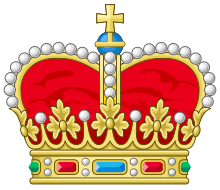
The imperial prince , Reichsfürst ( German: Reichsfürst ) - fürst (a person whose princely dignity was confirmed by the emperor of the Holy Roman Empire , whether he be a landgrave , duke or bishop ), provided that he owns a feud in the Holy Roman Empire and takes a place in the Reichstag .
The difference between the ordinary prince (Fürst) and the imperial prince (Reichsfürst) was significant. For example, it took Lichtenstein more than 100 years to bridge this chasm - from 1607 (when the emperor granted them the princely title) until 1713 (when a separate place in the Reichstag was assigned to them).
Content
Reichstag vote
The right to participate in the Reichstag in exceptional cases could be granted by the emperor to individual nobles for special merits to the empire. However, some of them did not have possessions having imperial status. So, the title of Prince of the Empire and a place in the Council of Princes was received at one time by representatives of the houses of Radziwill , Piccolomini , Lobkowicz , Croy and others.
At the turn of the 17th century, the Reichstag decided to prohibit the granting of the right to vote in the Council of Princes to persons who do not own direct imperial linen . Parts of the princes managed to acquire such flax and retain their place in the Council of Princes (the Liechtenstein became the owners of Vaduz , Auersperga - Tengen , etc.), others could not do this and their heirs lost their place in the Reichstag (Piccolomini, Porzia ).
Voters
About two-thirds of the princes sitting in the Reichstag were secular persons (63 out of 100 in 1792), the rest were spiritual , that is, bishops and archbishops . The imperial princes who elected the emperor were in a privileged position and were called electors :
- Habsburgs ( Bohemia )
- Wittelsbach ( Kurpfalz / Bavaria )
- Albertins ( Saxony )
- Hohenzollern ( Brandenburg )
- Welfers ( Hanover ) - after 1692
- Archbishops of Mainz , Trier and Cologne
After the reform of 1582, votes in the Council of Princes were assigned to territories, and not to specific individuals. As a result of this, some families held in their hands a lot of votes - according to the number of principalities belonging to them. For example, the Palatinate had six votes, and the Elector of Hanover had seven. Other voices were divided between different branches of the same family. The "Old Princes", who had the right to vote in the Reichstag of 1582, belonged to the following possessive houses (in order of seniority):
- Ernestins
- Askania
- Grabs
- Mecklenburg
- Württemberg
- Hessians
- Tseringen
- Oldenburgs
- Savoy
- Genenebergs
- Lorraine
- Arenbergs
- Lamarck
During the XVII — XVIII centuries, 15 names (“new princes”) received the right to vote in the Reichstag. Of these, the majority came from simple barons in the service of the Vienna court and, in order to obtain a separate voting right, by agreement with the Habsburgs, acquired a seigneur who was in direct vassal dependence on the emperor ( unmittelbar ), therefore, located outside the Habsburg possessions, mainly in Swabia :
- Hechingen
- Eggenbergs
- Lobkowicz
- Halls
- Dietrichstein
- Piccolomini
- Nassau
- Auerspergi
- Furstenberg
- Schwarzenberg
- Kirksen
- Liechtenstein
- Schwarzburg
- Thurn and Taxis
Four votes in the Reichstag were collectively imperial counts . Some of them were granted the princely title at the end of the 17th and beginning of the 19th centuries, without receiving a separate voting right. To this large group belonged, in particular, the Oettingen , Waldecki , Reuss , Hohenlohe , Leiningen and Lippe . Even some count family names that never owned immediate imperial linen (the Windischgrets , Neippergi and others) or lost them due to mediatization ( Shtolberg , Schoenburg ) had the right to vote.
During the Napoleonic Wars (1803-15), the Holy Roman Empire was dissolved. All imperial princes, whose territories at the same time became part of larger states, were mediated . The prerequisite for mediation was the possession of a prince (feud) within the Holy Roman Empire, which allowed him to take part in decision-making in the Reichstag, at least on the condition that a collective vote was cast through the council of counts.
Others
During the dissolution of the Holy Roman Empire, all those surnames that, although they were recognized by the emperor as princely dignity, did not have territories within the Holy Roman Empire and did not vote in the Reichstag, were not mediated. Thus, the entire foreign nobility turned out to be cut off from mediation, sometimes bearing the princely title for centuries (as, for example, the Polish magnates Radziwill and Lubomyr ). Of the Russian subjects of the princely title, five persons were awarded emperors of the Holy Roman Empire (all titles are selective):
- Alexander Danilovich Menshikov (1705)
- Dmitry Kanteminovich Kantemir (1723)
- Grigory G. Orlov (1763)
- Grigory Aleksandrovich Potemkin (1776)
- Platon Aleksandrovich Zubov (1796)
See also
- Composition of the Reichstag of the Holy Roman Empire in 1521
- Composition of the Reichstag of the Holy Roman Empire in 1792