 |
| Taoism |
|---|
| Story |
| People |
| Schools |
| Temples |
| Terminology |
| Texts |
| Gods |
| The medicine |
| Astrology |
| Immortality |
| Feng Shui |
| Portal |
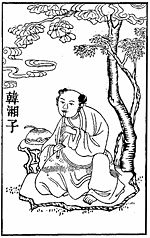
Han Xiangzi ( Chinese ит子 , Hán Xiāng zi) is a Chinese philosopher , one of the Eight Immortals in the Taoist pantheon. He was born under the Tang Dynasty and was named Tsingfu ( Chinese 清 夫 , qīng fū). He was the nephew or grandson of the famous statesman and poet Han Yu ( 768 - 824 ). His teacher was Patriarch Lu Dongbin . Han Xiang left the job of an official in the government and set off to seek the truth in Tao.
The literature mentions a case where Han Yu exhorted Han Xiang to give up Taoism, while Han Xiang wanted, on the contrary, to abandon his official career. At the banquet, Han Xiang demonstrated the power of Tao by drinking a huge amount of wine to the end and without getting drunk.
It is claimed that Han Xiang walked all the time with a magic flute, and everything around him blossomed from his flute. He is considered the patron saint of flutists.
It is claimed that Han Xiangzi was particularly successful in the study of magical knowledge. In addition, he was distinguished by a cheerful disposition that turned his teachings into a certain quality of life.
It is claimed that Han Xiangzi was able to make wine from water and grow flowers in winter. He is portrayed as a handsome young man who plays the flute. For this beauty, Han Xiangzi was associated with a woman, and in the images he was given feminine features.
Links
- The Eight Immortals of the Taoist Pantheon
- The Eight Immortals of Taoism. Kwok Man Ho, Joanne O'Brien, Penguin Books 1991. ISBN 0-452-01070-5