Grigory Lukich Khomishin , another variant of the surname is Khomyshin [1] ( Ukrainian Grigory Lukich Khomishin , Polish. Grzegorz Chomyszyn ; March 25, 1867 , Gadinkivtsi (now Gusyatinsky district , Ternopil region , Ukraine - December 12, 1947 , Kiev ) - bishop of the Ukrainian Church , a prominent public figure in the history of the revival of Ukrainian statehood, Blessed is the Catholic Church.
| Grigory Khomishin | |
|---|---|
| Grigory Khomishin | |
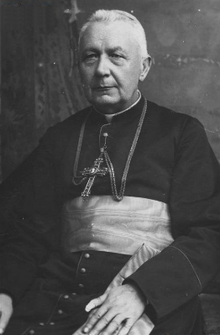 | |
| Birth | March 25, 1867 Gusyatinsky district Ternopil region |
| Death | December 12, 1947 (aged 80) Kiev |
| Is revered | Catholic Church |
| Beatified | year 2001 |
| In the face | blissful |
| Asceticism | bishop martyr |
Content
Biography
After graduating from a public school in Gadinkivtsi and later a gymnasium in Ternopol , he continued his education at the theological faculty at the University of Lviv . He studied at the Higher Theological Academy in Vienna , after which he taught the scientific title of Doctor of Theology. In 1893 he was ordained a priest .
From 1902 to 1904, he acted as rector of the Theological Seminary in Lviv. On June 19, 1904 he was ordained bishop by Metropolitan Andrey Galitsky of Andriy Sheptytsky , Konstantin Chekhovich and the Vienna Archbishop Joseph Theodorovich, and was appointed bishop of the Stanislavovsky diocese. As a bishop, he renewed the religious and spiritual life in his diocese, in 1907 he founded the seminary, from 1931-1939. published a journal for the priests “Good Shepherd” and the weekly newspaper “New Dawn”, which, thanks to his initiative, later became the organ of the Ukrainian Catholic People’s Party . He created in the parishes of his diocese folk reading rooms, charitable organizations to help those in need, founded monasteries and various Catholic movements . He called on Ukrainian political and public figures to normalize relations with Poland by issuing the current brochure “The Ukrainian Problem”.
As a Catholic hierarch, Grigory Khomishin tried to Latinize the Eastern Catholic rite: in 1916 he wanted to introduce the Gregorian calendar , but, seeing the resistance of the faithful, he abandoned his intention.
In 1931, Grigory Khomishin, accompanied by a visiting bishop for the Russian Greek Catholic apostolate Abroad Peter Buchis and the Italo-Albanian lord Mele, performed the bishop consecration of Nikolai Charnetskiy in Rome .
During the Second World War, Grigory Khomishin openly opposed the mass extermination of Jews, urged the citizens of Stanislav to help them and protect them from the Nazis. For this he was arrested and brutally beaten by the Germans.
Being a bishop of the Greek Catholic Church, he did not accept, reject and openly condemn radical nationalism and terrorist acts, claiming that this is the way against God, the way that the Ukrainian people can lead to degradation and self-destruction.
In his work “Two Kingdoms” [2], Grigory Khomishin, the blessed bishop of the Catholic Church, sharply criticizes the activities of the Lviv Metropolitan Andrey Sheptitsky, including for supporting Ukrainian nationalism [3] .
In 1945, Grigory Khomishin was arrested in preparation for the liquidation of the Ukrainian Greek Catholic Church, convicted of “anti-people activities” and sentenced to 10 years in prison. On December 12, 1947, Grigory Khomyshin died in a Kiev prison .
Praise
On June 27, 2001, Grigory Khomishin was beatified by Pope John Paul II during his visit to Ukraine.
Notes
- ↑ Right of the hierarchy of the UKHC
- ↑ Blessed Hieromartyr Gregory Khomishin. Two Kingdoms / Ed. about. І. Pelekhaty, V. Osadchy. Lublin: Ukrainicum, 2016.400 p.
- ↑ Osadczy W. Does the end justify the means? Blessed Bishop Hryhoriy Khomyshyn about Metropolitan Andrey Sheptytsky's proceedings in the religious and national fields // Studia Humanitatis. 2017. No. 4.
Source
- Encyclopedia of Ukrainian studies, (in 10 volumes), Editor-in-chief Volodimir Kubіyovich, Paris, New York: Molode Zhittya, 1954-1989.
- Ryszard Torzecki, Kwestia ukraińska w Polsce w latach 1923-1929, Kraków 1989, ISBN 83-08-01977-3