Kutaisi ( Georgian ქუთაისი , ancient names: აია, ქუთაია, ქოითაია, ქოთიაიონი, ქვათათისი - Ayia , Kutaya , Koytay , Kotiaioni , Kvatatisi , in the Russian Empire - Kutais ) is one of the most important historical and economic centers of the western region of Georgia Imereti .
| City | |||||
| Kutaisi | |||||
|---|---|---|---|---|---|
| cargo. ქუთაისი | |||||
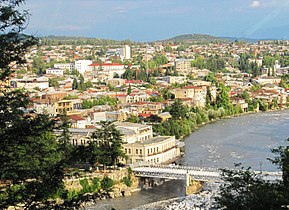 Kutaisi city | |||||
| |||||
| A country |  Georgia Georgia | ||||
| Edge | Imereti | ||||
| Municipality | Kutaisi | ||||
| The mayor | George Chigvaria | ||||
| History and Geography | |||||
| Based | 13th century BC e. | ||||
| Former names | Kutatis, Kutaia, Aiado 1936 - Kutais [1] [2] | ||||
| Square | 70 km² | ||||
| Center height | 200 m | ||||
| Climate type | humid, subtropical | ||||
| Timezone | UTC + 4 | ||||
| Population | |||||
| Population | 140 961 [3] people ( 2018 ) | ||||
| Nationalities | Georgians - 99.0% (2014) | ||||
| Denominations | Orthodox | ||||
| Digital identifiers | |||||
| Telephone code | +995 431 | ||||
| Postcode | 4600 | ||||
| kutaisi.gov.ge (cargo) (English) | |||||
![Flag [d]](http://upload.wikimedia.org/wikipedia/commons/thumb/1/1f/Flag_of_Kutaisi%2C_Georgia.svg/150px-Flag_of_Kutaisi%2C_Georgia.svg.png)
Kutaisi is called the city of May and roses - სავარდო და სამაისო - May 2 , for more than a hundred years in a row, is celebrated City Day - Kutaisoba .
Content
Geography
Located on both banks of the Rioni River , at an altitude of 125-300 m above sea level. Kopitnari International Airport is located 22 km southwest of the city. The distance to Tbilisi is 220 km, to Poti - 100 km, to Batumi - 150 km, to Sukhumi - 200 km, to Zugdidi - 100 km.
Etymology
The name of the city comes from the Georgian word ქვა - “ stone ”, since in ancient times only the northern side of the Rioni River was populated (which is perfectly consistent with the quote from Procopius of Caesarea below), which was rocky.
History
Archaeological excavations show that Kutaisi was founded in the 6-5th centuries. BC [4] . The documentary history of Kutaisi begins from the 2nd century BC, when it is described in the Argonautics of Apollonius of Rhodes "Book 2, 398-402" [5] :
“From the mountains of Amaranth from afar along the plain of Kirkay, Fasis raging in the sea carries wide waters. To the mouth of this river, the ship Argo directing, Can you see Eeta the city of Kiteisky "
It was in Kutaisi, the capital of the Colchis Kingdom (that is why the poets call Ayeta (Eeta) - Koytayey (Kiteyskoy), and the Colchian Kingdom - Koytayda (Colchis)) the Argonauts went to Tsar Ayet for the Golden Fleece .
The Byzantine historian Procopius of Caesarea (VI c.) In the book “War with the Goths” (book 4, section 14), describes Kutaisi as follows:
“There are many populated villages in this area. Of all the lands of Colchis, this is the best. Here wine is produced and many good fruits grow, which is not found anywhere else in the rest of Lazik. A river named Rion flows through this country; in ancient times, the kolkhs built a fortification here, most of which they later destroyed to the ground, since it was located on a plain and, in their opinion, gave easy access and the opportunity to conquer it. In Greek at that time, this fortification was called Cotiaion, now Lazs call it Kutais, changing the pronunciation of letters in this name due to ignorance of the Greek language. So Argian conveyed this in his story. From here came and began to march Eet, and as a result of this the poets call him Koytay, and the Colchian land Koytaida. ... Very close to Kutais there is a very strong fortification called Ufimery; he was guarded by his garrison with all care. In this guard, Roman soldiers also took part with them, though very few ”
Ufimerei is the Greek or Latin version of the Georgian name of the fortress Ukimerioni (see photo), which has long been in the city and borders on Bagrati Cathedral .
According to the same historian, Procopius of Caesarea (VI c.), The book “War with the Goths 4/2” :
“In this country, very high mountains rise, covered with forests and hard to reach. They stretch to the very Caucasus torus, behind them towards the east lies Iberia, extending to the limits of the Persian-Armenians. Through these mountains, rising high into the sky, the Phasis River flows, starting from the mountains of the Caucasus and flowing into the middle of this “half-month” Pontus Bay. Some believe that in this place the Phasis River serves as the border of two continents. Places that go to the left, when looking downstream, are Asia, and those to the right are called Europe. In the part that belongs to Europe, there are all the inhabited places of Laz, on the other side of the Laz there are neither cities, nor fortifications, nor a village that deserves any attention, except for the fact that before the Romans built the fortress of Petra here, According to local traditions inhabitants, in this part of Lazika there was also that golden fleece, because of which in their myths the poets forced the Hellenes to build Argo "
It is obvious from the text that in those times (VI c.), Some considered the Phasis (Rioni) river to be the natural border of Europe and Asia. Interestingly, in Latin Riunion (Riunion) - "meeting". Therefore, it is likely that Phasis is the Greek name, and Rioni (in the Georgian way) is Latin .
In ancient times, according to many ancient historians and writers, including the ones mentioned above, Kutaisi was the capital of the Colchis kingdom, that is, kolkhs - ancient Georgians. From VIII to XIII centuries Kutaisi was the capital of the Abkhazian Kingdom . In the 1760s, it was captured by the Turks and liberated by Russian troops in 1770.
In 1810 it was annexed to the Russian Empire , from 1811 to 1840 it was the center of the Imereti region . From 1846 to 1917 - the center of Kutaisi province .
During the years of Soviet power - the second most important industrial center of Georgia. Were built: automobile , tractor, lithoponic , electromechanical and other plants. The Kutaisi Special Design Bureau (SKB Proektpribor, 1960-1990) was the lead organization in the USSR Ministry of Instrument for moisture measurement and viscometry . After the collapse of the USSR, the ensuing economic crisis led to the closure of many enterprises in the city.
In October 1993, during the civil war in Georgia, the Zviadists launched an offensive on Kutaisi, the fall of which opened the way for Tbilisi to Zviadists. The fighting took place near the city [6] . After an unsuccessful attack on the city of Tskhaltubo , located 8 km from Kutaisi, a counterattack by government forces began.
In 2008-2012. the buildings of the Parliament and Government of Georgia were built in Kutaisi, and in 2012, Kutaisi was declared the parliamentary capital of Georgia [7] . The memorial of military glory was demolished for the construction of the parliament building.
Population
The population of the city and the municipality as of January 1, 2018 was 140,961 people [3] , as of January 1, 2014 - 197,000 people [8] , as of January 1, 2005 - 184,500 people [9] , for 2002 - 186 000 people [8] , as of January 1989 - 234 870 people [10] .
|
|
Transport
The main transport in Kutaisi is currently minibuses . There is also a city bus (used are the Steyr SL11 HUA280, Neoplan N407, Gräf & Stift, Neoplan N4007NF buses, etc.). Two railway stations connect Kutaisi with Western and Eastern Georgia. Also near the city is the Kopitnari International Airport, reconstructed and reopened at the end of 2012 [14] .
Until 2009, the city had a trolleybus system .
Culture
A drama theater has been operating in the city since the end of the 19th century; in December 1969, the M. Balanchivadze Opera and Ballet Theater was opened [15] .
Here are located the State Historical Museum of Georgia , the Museum of Military Glory and the Museum of Sports.
Attractions
Of the 4 UNESCO World Heritage Sites in Georgia, 2 are located in Kutaisi: Bagrati Cathedral and Gelati Monastery
- The complex of the ancient city with the Bagrat Temple
- Gelati Monastery Complex
- Monastery complex Motsameta
- Gegutsky complex (ruins) - summer residence of kings X — XI c
- Sataplia
- Prometheus Cave
- Jewish Quarter (with three synagogues)
In 2012, the construction of the new building of the Parliament of Georgia was completed , which moved here from Tbilisi . The first meeting of the newly elected parliament was held on October 21, 2012.
Sport
Professional sports clubs are based in the city:
- Football : Torpedo , performs in the Georgian Football Championship ,
- Basketball : Kutaisi , performs in the Georgian Basketball Championship ,
- Rugby : “ Ayia ” and “ Bagrati ” perform in the Georgian Rugby Championship
Chapters
- Nugzar Paliani (2002-2004)
- Georgy Georgadze (2004-2005, acting)
- Beso Gulodrava (2005)
- Georgy Chogovadze (2005-2006, acting)
- Bakur Balanchivadze (2006-2007)
- Niko Kachkachishvili (2007, acting)
- Nugzar Shamugia (2007-2009)
- Gia Tevdoradze (☎)
- Besik Bregadze (2012—2013)
- Dmitry Kopaliani (2013)
- Niko Kachkachishvili (2013, acting)
- Shota Murgulia (2013—2017)
- George Chigvaria (since 2017)
Famous Natives
- Valyansky, Mikhail Yakovlevich (1915-1987), participant in the Great Patriotic War, Hero of the Soviet Union.
- Dzotsenidze, Georgy Samsonovich (1910-1976) - Georgian geologist, full member of the Academy of Sciences of the Georgian SSR (1955), academician of the Academy of Sciences of the USSR (1968).
- Mzhavanadze, Vasily Pavlovich (1902-1988) - Soviet party leader, first secretary of the Central Committee of the Communist Party of Georgia (1953—72). Hero of Socialist Labor (1962).
- Mikhailov, Victor Vasilievich (1901-1990) - Soviet scientist, academician of the USSR Academy of Construction and Architecture (1956). The founder of the theory and technique of using prestressed concrete in the USSR. Laureate of the Stalin Prizes (1949, 1950).
- Molodov, Sergey Georgievich - Hero of the Russian Federation.
- Otrakovsky, Alexander Ivanovich - Hero of the Russian Federation.
- Gobedzhishvili, David Nikolaevich (b. 1963) - Georgian, Soviet freestyle wrestler in the weight category up to 130 kg, Olympic champion (1988), world champion (1985, 1990) and Europe (1985). Included in the International Amateur Wrestling Federation Hall of Fame. Honored Master of Sports of the USSR (1985).
- Paliashvili, Zakhary Petrovich ( Georgian ზაქარია პეტრეს ძე ფალიაშვილი ; 1871 - 1933 ) - Georgian composer , teacher, musical and public figure, the largest representative of Georgian classical music, people's artist of the Georgian SSR ( 1925 ).
- Rezo Chkheidze ( Georgian რეზო (რევაზ) დავითის ძე ჩხეიძე; December 8, 1926 , Kutaisi - May 3, 2015 , Tbilisi ) - Soviet Georgian film director , actor , screenwriter , producer , teacher . People's Artist of the USSR (1980).
- Gabriadze, Rezo Levanovich (b. 1936 ) - Soviet and Georgian film director and screenwriter, playwright, artist, sculptor. The head of the puppet theater named after himself.
- Burjanadze, Nino Anzorovna ( b. 1964 ) - Georgian state and political figure, in 2001 - 2008 - Chairman of the Parliament of Georgia , in 2003 - 2004 and 2007 - 2008 - Acting President of Georgia
- Abuladze, Tengiz Evgenievich ( 1924 - 1994 ) - Soviet Georgian film director , teacher . People's Artist of the USSR ( 1980 )
- Chiburdanidze, Maya Grigorievna (b. 1961) - Soviet and Georgian chess player, 6th world chess champion from 1978 to 1991. Nine-time winner of the Chess Olympiads (five in the USSR team and four in the Georgian team). Honored Master of Sports of the USSR since 1978, and since 1984, Grandmaster.
- Melua, Katie full name Ketevan Melua (b. 1984) - British and Georgian singer.
Twin Cities
- Germany , Gelsenkirchen
- Greece , Nicaea
- Ukraine , Dnipro [16]
- Ukraine , Kharkov
- Ukraine , Donetsk
- Ukraine , Zhytomyr
- Poland , Poznan
- Azerbaijan , Ganja
- Armenia , Gyumri
- Israel , Ashkelon
- United Kingdom , Newport
Gallery
Fortress Ukimerioni
Satellite view
Street in Kutaisi
Notes
- ↑ Abkhazia: documents testify. 1937-1953 - . - Sukhum : Alashara, 1992 .-- S. 488 - Not found !!!. Archived September 4, 2011 on Wayback Machine
- ↑ Geographic names (inaccessible link) . Date of treatment October 7, 2010. Archived October 25, 2011.
- ↑ 1 2 Population of the territories and municipalities of Georgia at the beginning of the year in 1994—2018. (inaccessible link) . National Statistical Service of Georgia . Date of treatment October 29, 2018. Archived July 23, 2018. (eng.)
- ↑ Gela Gamkrelidze. RESEARCHES IN IBERIA-COLCHOLOGY . Edited by David Braiind (Prof, of University of Exeter (UK)) // Olar LORDKIPANIDZE CENTER OF ARCHAEOLOGY OF GEORGIAN NATIONAL MUSEUM. P. 43 "According to the data on archaeological excavations on the Gabashvili, Dateshidze and Ukimerioni hills in Kutaisi, an urban-type settlement of the 6-5 cent. BC was found to be concentrated »
- ↑ Argonautics - Rhodes Apollonius :: Reading Mode
- ↑ Kamyshev D. Supporters of the Georgian ex-president storm Kutaisi // Kommersant . - 1993. - October 21. (inaccessible link)
- ↑ Georgian Parliament returned to Tbilisi? (inaccessible link)
- ↑ 1 2 Statistical Yearbook Of Georgia, 2014 (unavailable link) . Date of treatment June 4, 2016. Archived on April 16, 2016.
- ↑ Population of the municipalities and territories of Georgia at the beginning of the year 2000–2016 (inaccessible link) . National Statistical Service of Georgia . Date of treatment April 29, 2016. Archived June 25, 2016. (eng.)
- ↑ 1989 All-Union Population Census. Number of urban population of Union republics, their territorial units, urban settlements and urban areas by gender Demoscope
- ↑ Georgia Census 2002: Ethnic group by major administrative-territorial units . State Departments of Statistics of Georgia. Date of treatment October 11, 2007. Archived on August 25, 2011.
- ↑ Georgia ethnic 2002
- ↑ National composition of the population of Georgia, its regions and settlements according to the 2014 census
- ↑ Saakashvili: A visa-free regime will be established between Georgia and Europe in a year
- ↑ Yu. Moseshvili . Two big debuts // Soviet Culture. - 1970. - January 6. - S. 3 .
- ↑ Archived copy (inaccessible link) . Date accessed August 8, 2019. Archived February 26, 2014.
Topographic maps
- Map sheet K-38-62 Kutaisi . Scale: 1: 100,000. State of the terrain for 1987. 1989 Edition