German-speaking, Germanic peoples, Germans - the fourth largest ethnic -speaking community in the world, the number second only to the primordially Asian : Sino-Tibetan and Indo-Aryan ethnic - speaking families, as well as Romance languages. It is characterized primarily by the use of one of the Germanic languages as a mother tongue .
| Germans | |
|---|---|
| Abundance and area | |
| Total: approximately 550 million | |
| North , Central Europe , North America , Australia , New Zealand , etc. | |
| Language | Germanic languages |
| Religion | Protestantism , Catholicism |
| Related peoples | Indo-Europeans |
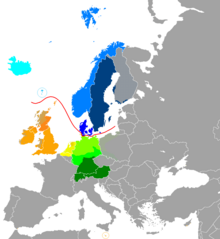
European countries with a predominant German population. The colors highlight the various languages of the Germanic branch ; West German and North German are separated by red.
At present, the Germans are densely settled in the vast territory of many countries of Northern and Central Europe , North America , Australia , and New Zealand . The German minority is also present in the states of Eastern Europe, South America, South Africa and other territories. The total number of Germans is about 550 million people.
Content
- 1 Germanic languages
- 1.1 Classification of Germanic languages and dialects
- 1.1.1 Scandinavian (North German) group
- 1.1.2 West German Group
- 1.1.3 East German Group
- 1.1 Classification of Germanic languages and dialects
- 2 Origin
- 2.1 Ancestral home
- 3 Historical settlement
- 4 Modern peoples related to the Germans
- 5 Modern states where Germans make up the majority of the population
- 5.1 In Europe
- 5.2 In North America
- 5.3 In Oceania
- 6 See also
- 7 notes
- 8 Literature
Germanic languages
Classification of Germanic Languages and Dialects
Germanic languages are divided into 3 groups: northern, western and eastern.
“ Clusters ” generally correspond to languages in the linguistic sense of the word with the separation of chronological periods, although recently in the German-speaking world the tendency to distinguish smaller units (= " adverbs ") as separate languages has prevailed.
- Runic Germanic
Scandinavian (North Germanic) group
- Ancient North Language †
- Western subgroup
- Island cluster (stood out from ancient Norwegian)
- Greenlandic †
- Icelandic
- Faroese language
- Norn †
- Continental cluster
- Old Norwegian language †
- Norwegian ( Nynorsk ), especially Western dialects
- Island cluster (stood out from ancient Norwegian)
- Eastern subgroup
- Bokmål (Danish-Norwegian)
- Danish
- Skone dialect †
- Swedish language
- Ancient Gutnian † (assimilated by Swedish )
West German group
- Anglo-Frisian subgroup
- English Cluster (Anglic)
- Old English
- Middle English
- English language
- American English
- Canadian English
- Australian English
- New Zealand English
- Yola (language) †
- Friesian cluster
- Old Frisian language
- West Frisian language
- East Frisian language
- North Frisian language
- English Cluster (Anglic)
- South German subgroup
- Nizhnefranksky cluster
- Ancient Nizhne-Frankish language
- Mid-Dutch
- Dutch
- Afrikaans
- Limburg dialect
- Low German cluster
- Saxon
- Middle Low German
- Low German , incl. Lower Saxon dialects
- High German cluster
- Old High German
- Middle High German
- Middle German dialects
- West German dialect
- Luxembourgish language
- Middle Frankish
- Rhine-Frankish
- Yiddish (European Jewish)
- Vymysorish
- East Middle German dialect, on the basis of which the German literary language was formed
- West German dialect
- South German dialects
- North German dialect
- Alemannic dialect incl. Swiss German
- Bavarian-Austrian dialect
- Cymbrian language
- Nizhnefranksky cluster
Modern dialects of the Low German and High German clusters are combined into the concept of “ German language ”, being functionally dialects of the German literary language . This does not apply to Yiddish and Luxembourgish .
- Lombard language - the exact position among the Germanic languages is unclear
East German Group
All languages of this group are extinct. In some ways, it is moving closer to the Scandinavian group, and even is included in its composition by a number of linguists.
- Gothic language †
- Crimean Gothic language †
- Vandal language †
- Burgundy language †
- Herul language †
- Hepids †
As the modern Germanist V. Berkov notes, due to the constant interaction of Germanic languages among themselves, their modern genetic classification is significantly different from the historical one. In particular, the Scandinavian group historically consisted of the western ( Norwegian , Icelandic , Faroese ) and eastern ( Danish , Swedish ) subgroups, at present, as a result of the mutual penetration of languages, the North German group is divided into continental (Swedish, Norwegian, Danish) and island (Icelandic, Faroese) subgroups. Similarly with the West Germanic languages, from which English is distinguished grammatically and lexically; its native speakers have completely lost their understanding with native speakers of other West Germanic languages.
Origin
Ancestral home
Historic Settlement
The Germans as an ethnos formed in northern Europe from Indo-European tribes who settled in the region of Jutland , lower Elbe and southern Scandinavia. They began to stand out as an independent ethnic group only from the 1st century AD . BC e. Since the beginning of our era, there has been an expansion of Germanic tribes to neighboring areas, in the 3rd century they attack the northern borders of the Roman Empire on the entire front and in the 5th century during the Great Migration of Peoples they destroy the Western Roman Empire, settling throughout Europe from England and Spain to Crimea and even on the coast of North Africa.
During the migration, Germanic tribes mixed with the larger indigenous population of the conquered territories, losing their ethnic identity and participating in the formation of modern ethnic groups . The names of Germanic tribes gave names to such major states as France and England , although the proportion of Germans in their population was relatively small. Germany as a nationally united state was formed only in 1871 on the lands occupied by Germanic tribes in the first centuries of our era, and included both descendants of ancient Germans and descendants of assimilated Celts , Slavs, and ethnically unknown tribes. It is believed that the inhabitants of Denmark and southern Sweden remain genetically closest to the ancient Germans.
In the era of the great geographical discoveries , the colonization by Europeans of other continents began. As a result of the formation of the British Empire, large territories around the world came under the rule of the British crown. An intensive flow of immigrants from many countries of Europe went to these countries, with the decisive role of English and British immigrants and English as the dominant language. As a result, a number of new Germanic peoples appeared - Anglo-Americans , Anglo-Canadians , Anglo-Australians , Anglo-New Zealanders , etc.
Modern peoples belonging to the Germans
- Scandinavians
- Northern Scandinavians
- Western Scandinavians
- Island scandinavians
- Greenlanders †
- Icelanders
- Faroese
- Shetlandians
- Orkneys
- Norse
- Kola Norwegians
- Swedes
- Finnish Swedes
- Baltic Swedes
- American swedes
- Danes
- Island scandinavians
- Western Scandinavians
- Northern Scandinavians
- The British
- Anglo-Americans
- Anglo Canadians
- Anglo-Australians
- Anglo-New Zealanders
- Dutch
- Afrikaner ( Boers )
- Friezes
- Flemings
- Germans
- Pennsylvania Germans
- Austrians
- Alsatians
Modern states where Germans make up the majority of the population
In Europe
- Iceland ( Isl. Ísland )
- Faroes ( headlight Føroyar )
- Shetland Islands ( Norn Hjetland , Shetland Scotts )
- Orkney Islands ( Norn Orknøjar , Scotts Orkney )
- Norway ( Nunorsk Kongeriket Noreg , Bookmaker Kongeriket Norge )
- Sweden ( Swede. Sverige )
- Denmark ( Danmark )
- United Kingdom of Great Britain and Northern Ireland
- Netherlands ( Netherlands. Nederland )
- Belgium ( Netherlands. Koninkrijk België )
- Luxembourg ( Luxembourg. Groussherzogtum Lëtzebuerg )
- Germany ( German: Deutschland )
- Switzerland ( German: Schweiz )
- Liechtenstein ( German: Liechtenstein )
- Austria ( German: Österreich )
In North America
- United States of America
- Canada
In Oceania
- Australia ( English Commonwealth of Australia )
- New Zealand
See also
- Latin
- Germanic languages
- Caucasian peoples
- Romance peoples
- Slavic peoples
- Iranian peoples
- Finno-Ugric peoples
- Baltic peoples
Notes
Literature
- Germans, tribe // Brockhaus and Efron Encyclopedic Dictionary : in 86 volumes (82 volumes and 4 additional). - SPb. , 1890-1907.
- Alfan L. Great empires of barbarians: from the Great Migration of Peoples to the Turkic conquests of the XI century. M., Veche, 2006