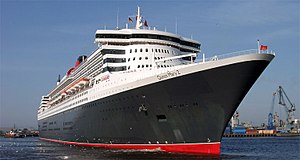
Heat sink is a generalized concept describing a class of self-propelled ships , the ship’s power plant (hereinafter - SEC) of which is based on an engine that converts the energy of fuel combustion into mechanical energy, but which is not a steamer . In the vast majority of cases, a diesel engine is used in the ship's SEU. Vessels whose SEUs are driven by a steam turbine or gas turbine are also commonly referred to as motor ships, especially since the SEUs of such vessels often include diesel engines. Thus, motor ships are almost all self-propelled modern ships, except nuclear powered ships , sailing ships , and ships using other sources of energy.
Classification
The motor ship, as follows from the definition, can be called almost any modern ship.
Motor ships can be divided according to their purpose:
- Passenger motor ships - include passenger ships with both unlimited and limited navigation areas, ferries , hydrofoils.
- Freight motor ships - include vessels for the transport of goods of various purposes, such as bulk , dry cargo , container ships , ro-ro vessels, car carriers, lighter carriers, timber trucks, ore carriers, etc.
- Fishing vessels
- Auxiliary vessels - for example, icebreakers .
- Warships.
By navigation area:
- Unlimited.
- Limited marine swimming area.
- Mixed swimming (river-sea).
- Inland navigation area (lake and river).
By type of power plant:
- Diesel.
- Steam turbine (boiler turbine).
- Gas turbine (gas turbine passages, gas turbine electric passages).
- Combined GEM - includes, for example, a gas turbine and a diesel engine.
By the number of propeller shafts of the power plant:
- Single shaft.
- Two-shaft.
- Multi-verbal.
Device
The motor ship's engine can be low revolving (in this case, it works directly on the propeller shaft ) or high speed. A high-speed engine is connected to the propeller shaft via a gear. The most common gear types:
- mechanical ( gear )
- electric
- hydraulic (less often)
In the case of electric transmission , the engine rotates a direct current generator or alternating current generator , the electricity generated by which feeds the electric motors that drive the propeller shaft. Electric transmission allows you to smoothly adjust the speed of rotation of the propeller. Motor ships with power transmission are often allocated to a separate class of ships - diesel-electric ships , or “turboelectric ships”.
Ship diesel engines are started using compressed air. The heat of exhaust gases is used to generate steam, which, in turn, is used for heating, heating water, generating electricity and other marine needs.
Currently, the most powerful marine diesel engine is the RTA96-C engine, manufactured by the Finnish company Wärtsilä. This 14-cylinder engine has an output of 108,920 liters. with.
Distribution
Currently, ships are the most common type of ship. They almost completely replaced the ships . Only high-speed vessels more often use a turbine power plant (however, such vessels, turbo-boats , are also ranked as motor ships).
Also, a diesel-electric power plant is used on non-nuclear submarines for surface movement.
History
The first diesel vessels in the world appeared in Russia , thanks to the company " Nobel Brothers Petroleum Production Partnership ".
Nobels early became interested in the invention of the engineer Rudolph Diesel . Already in 1898, Nobel acquired drawings of a diesel engine with a capacity of 20 liters. with. After several years of technical research, Nobel engineers managed to create a working marine diesel. Three of these engines were installed in 1903 on the Vandal oil-loading river barge (built at the Sormovsky plant and brought to St. Petersburg), which became, thus, the first ship in the world. Three diesel engines were installed on the Vandal, each with a capacity of 120 liters. with., which propelled the screws with an electric transmission, consisting of three generators and electric motors. Such a complex drive scheme was chosen due to the unsolved problem of diesel reversal and speed control over a wide range.
In 1904, the next ship, Sarmat, also a former river tanker, was built by Nobel’s company. He had two diesel engines of 180 liters. with. and two electric generators, but the power transmission was used only for reverse gear and maneuvering, and the rest of the time the diesels set the propeller shafts directly in motion. “Vandal” and “Sarmat” had a carrying capacity of 750 tons each.
The first reversible (capable of working in both directions) diesel engine was also created in Russia. It was installed on the Lamprey submarine built in 1908. In the same year, the design of the mechanical reverse device was tested on the ship “Thought”.
In the same year, and again in Russia, the first marine ship, the Delo tanker, was designed to operate on the Caspian Sea . He had two engines with a total capacity of 1000 liters. with. (according to other sources - 2000 hp.). The Delo was a large vessel, its length was 106 meters, its width was 15 meters, and its carrying capacity reached 4,000 tons.
It is interesting that, along with screw motor ships, wheeled motor ships were also built: for example, the Kolomensky tugboat (later the Mys). However, such vessels were unsuccessful: a complex mechanical transmission was used to drive the propeller wheels with a diesel engine, which often broke. Soon abandoned wheeled motor ships.
The first ships of Russia:
- 1903 - The Vandal
- 1904 - “Sarmat”
- 1907 - Kolomensky
- 1908 - Ilya of Muromets
- 1908 - Lezgin (360 rated forces)
- 1908 - The Case
- 1910 - “Experience” - a wheeled motor ship for the transportation of flour, with a carrying capacity of about 50 tons
- 1911 - “ Ural ” - a wheeled motor ship, the first passenger motor ship in the world, 800 rated forces (burned down in 1916)
- 1912 - “Koreyvo Engineer” - a cargo motor ship with a capacity of 600 rated forces and a lifting capacity of 70 thousand pounds. Built at Kolomensky Zavod
- 1913 - “Danilikha” - a dry cargo ship, carrying capacity of 2000 tons, capacity of 300 rated forces. Built according to the project of engineer N.V. Kabachinsky at the Sormovsky plant
- 1915 - Moskvich, the world's first horizontal motorized tug boat
In addition to the large ones, some of which are listed, were built or converted into motor ships and small vessels. By 1914, there were already about two hundred of them on the Volga, and the number of large motor ships was 48 (passenger and cargo-passenger - 16, freight - 12, tugboats - 20). Thus, in a very short time, Russian industry mastered the production of motor ships. The experience gained has allowed us to move from experienced single vessels to mass production. In 1907, the Kolomensky Zavod began construction of a series of passenger motor ships with a screw drive (the customer was the Caucasus and Mercury Joint-Stock Company). The first ship of the series, which was called "Borodino", was ready by 1911. The construction of a series of such motor ships continued until 1917, a total of 11 motor ships were built. The most durable vessels of this series are Uritsky (originally Tsargrad), the Paris Commune (initially John the Terrible), and, in fact, Comrade Comrade Markina ”(originally“ Bagration ”) - worked on the Volga until 1991.
Outside of Russia, ships began to be built in 1911 in Germany and in 1912 in Great Britain and Denmark . The Danish "Zealand" (Sealandia), launched in 1911, became the first ocean boat. This ship was very successful: in the first twelve years of service, engine repairs had to be carried out only once. "Zealand" worked until 1942.
Motor ships became quite massive by the thirties (according to the Lloyd's register, in 1930 they made up 10% of the world civilian fleet), and by 1974, according to the same source, they already made up 88.5% of the world civilian fleet.
Compared with steamboats, motor ships had the following advantages: higher efficiency , lower fuel consumption (and consequently, greater load-carrying capacity and greater power reserve), and higher engine reliability.
Sources
- K.V. Ryzhkov. One Hundred Great Inventions, Moscow, Veche, 2002. ISBN 5-7838-0528-9
- Encyclopedia of ships. Polygon, Ast, Moscow - St. Petersburg, MCMXCVII. ISBN 5-89173-008-1
- Great Soviet Encyclopedia
Links
See also
- Moscow (type of river vessels)
- Homeland (type of river vessels)
- Russia (type of river vessels, 1952)
- Victory (ship)
- Meteor (ship)
- Satellite (motor ship)
- Elbrus motor ship