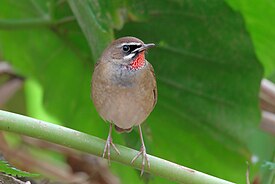
Red-necked Nightingale [1] ( lat. Luscinia calliope ) is a small bird of olive-brown color with a whitish bottom. The male has a bright red throat, the bridle and strip at the chin and throat are black. The song is loud, almost equal in sounding to the nightingale, but short. Often begins with imitation of other birds. They feed on insects and other invertebrates, which are collected almost exclusively on the ground among grass, bushes, undergrowth, and deadwood. Berries are also eaten.
| Red-eyed nightingale |
 |
| Scientific classification |
|---|
| No rank : | Bilateral symmetrical |
| Infrastructure : | Passerida |
| Superfamily : | Muscicapoidea |
| View: | Red-eyed nightingale |
|
| International scientific name |
|---|
Luscinia calliope ( Pallas , 1776 ) |
| Area |
|---|
|
| Security status |
|---|
Least ConcernedIUCN 3.1 Least Concern : 22709701 |
|
Content
A small bird of olive-brown color with a whitish bottom. The male has a bright red throat, the bridle and strip at the chin and throat are black. The song is loud, almost equal in sounding to the nightingale, but short. Often begins with imitation of other birds.
Often his sonorous whistle is heard, like “fiut-fiut”, with an emphasis on the second syllable.
A female builds a nest on the ground, in a well-sheltered place, among bushes and tall grass, usually under a bush on a small hill. Less commonly, the nest fits relatively openly. It has the form of a ball or an incomplete ball with an entrance from the side or from the side and from above. Nesting material - wood leaves, grass, moss, the tray is lined with the same, but softer material, sometimes a little wool. Clutch of 2-6, usually 4-5 eggs. Their color is light, bluish- or greenish-gray, often with brownish or reddish pigmentation in the form of plaque or weak specks, usually only at the blunt end. The size of the eggs is 19-23 x 14-17 mm. Only female incubates for 13-14 days, both adult birds feed the chicks. Chicks with rare long feathers on the head and back, the oral cavity is yellow, with pale yellow beak ridges. Leave the nest at the age of 13-15 days.
- Luscinia calliope beicki
- Luscinia calliope calliope
- Luscinia calliope camtschatkensis
- ↑ Boehme R. L. , Flint V. E. The Bilingual Dictionary of Animal Names. Birds. Latin, Russian, English, German, French / Ed. ed. Acad. V. E. Sokolova . - M .: Rus. lang., "RUSSO", 1994. - S. 305. - 2030 copies. - ISBN 5-200-00643-0 .