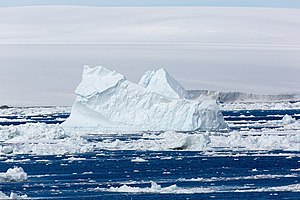
Iceberg ( German Eisberg , "ice mountain") - a large free-floating piece of ice in the ocean or sea . As a rule, icebergs break off ice shelves . Since the density of ice is 920 kg / m³, and the density of sea water is about 1025 kg / m³, about 90% of the volume of the iceberg is under water. Therefore, 10% of the volume of the iceberg is above the water. Long-term snowfalls, compaction of the snow cover cause the iceberg to “grow”, turning it into a collection of billions of tiny ice mirrors reflecting light.
Content
Basic Information
The shape of the iceberg depends on its origin:
- Icebergs of the outlet glaciers are table-shaped with a slightly convex upper surface, which is dissected by various types of bumps and cracks. Typical of the Southern Ocean.
- Icebergs of integumentary glaciers differ in that their upper surface is practically never even. It is somewhat tilted, like a pitched roof. Their sizes, in comparison with other types of icebergs of the Southern Ocean , are the smallest.
- Icebergs of ice shelves are, as a rule, of considerable horizontal dimensions (tens or even hundreds of kilometers). Their average height is 35-50 m. They have a smooth horizontal surface, almost strictly vertical and even side walls.
In 2000, as a result of mechanical ablation, the largest known iceberg B-15 with an area of over 11,000 km² broke off from the ice shelf Ross , which is about 3 times larger than Ingushetia or 4 times bigger than New Moscow. In the spring of 2005 , its fragment, the B-15A iceberg, was over 115 kilometers long and more than 2,500 km² in area, and was still the largest iceberg observed.
An iceberg breaking away from the Ross Ice Shelf, called the B7B, measuring 19 by 8 kilometers (ice area larger than Hong Kong) was spotted at the beginning of 2010 using satellite imagery from NASA and ESA, about 1,700 kilometers south of Australia . The initial size of this iceberg was about 400 square kilometers. To sail so far north, the B7B iceberg took about 10 years. The coordinates of the B7B iceberg at the beginning of 2010 are
Icebergs, especially table-shaped, are characteristic of the southern polar region. Icebergs are more rare in the northern circumpolar regions, among them icebergs of relatively small sizes of outlet and cover glaciers predominate. Since the formation of an iceberg of any kind, the process of its destruction continuously occurs, in the sea part of the ocean it is especially active. Numerous forms of icebergs - pyramidal, sloping, rounded, with arches, rams - arise when they are destroyed. Inclined icebergs are a characteristic initial form of destruction, especially offshore table-shaped icebergs. The wave surf underwater terrace, trying to surface, raises one edge of the iceberg. Inclined icebergs are very tall. The average duration of icebergs in Antarctic waters is about 2 years (with the volume of iceberg runoff to the ocean 2.2 thousand km 3 / year and their total volume in the ocean 4.7 thousand km 3 ).
The color of the iceberg directly depends on the age of the iceberg: only the breakaway ice mass contains a large amount of air in the upper layers, therefore it has a dull white color. Thanks to the replacement of air with water drops, an iceberg changes its color to white with a blue tint. Also, do not be surprised by the pale pink iceberg.
Icebergs and Man
Shipping
Icebergs pose a great danger to shipping. A necessary condition for improving the safety of navigation in the presence of icebergs is to reduce the speed of the vessel when it enters the iceberg waters. One of the most famous examples of an iceberg collision with a ship is the death of the Titanic in 1912 . It is noteworthy that then the liner collided with the so-called “black iceberg”, that is, an iceberg that turned upside down, and above the surface of the ocean was its previously underwater part, which is much darker than the surface. Thus, it was difficult to notice him on time and the collision could not be avoided. The presence of icebergs in some cases increases the efficiency of swimming in ice. In cohesive ice with a large accumulation of icebergs, the so-called "water shadows" form - patches of clean water and sparse ice on the leeward side of the icebergs. If the icebergs are large and there are many, then the “water shadows”, when combined, form huge wormwoods that stretch for tens of miles. These wormwoods can be used to overcome heavy cohesive ice. During stormy weather, ships can defend icebergs at a safe distance, using them as a massive breakwater and as a means of protection from perennial ice. Icebergs, having great sediment, move in ice fields and cohesive drifting ice like an icebreaker, destroying and dragging ice along with them. Danger for swimming is represented by “plumes” of icebergs, consisting of fragments and smaller blocks of ice. With a quick change in the direction of the wind, they can be on the windward side of the iceberg.
In the presence of deep counterflows or after changing the direction of the prevailing wind, icebergs often move in the opposite direction to the drift of sea ice. In this case, icebergs pose a great danger to ships jammed in ice, since they can fall on them. In the spring, faults (calving) and destruction of icebergs are most intense early in the morning shortly after direct sunlight on the ice or after the iceberg emerges from the fog. They are due to the appearance of thermal stresses in the surface layer. The split-off multi-ton ice massifs with a loud splash go under water, causing huge swift waves, and then forcefully pushed to the surface, often often at a great distance from the bulk. In some cases, a hydrodynamic or sound wave from a ship traveling at high speed is enough to upset the iceberg's balance. In case of an forced approach to the iceberg at a distance of less than two miles, vessels should go at the smallest speed with the sonar turned on , in order to avoid a collision with underwater ledges (rams), sometimes 300-500 m away from its underwater part.
The detection range of icebergs by ship radars depends on the shape of the objects. Large icebergs with steep slopes can be determined from 14-30 miles. Worst icebergs with a gentle slope are worst identified. From some angles, their detection range does not exceed 3 miles [1] .
On icebergs, the construction of inhabited research bases is practiced. An example of such an iceberg is Fletcher's Ice Island . In the Antarctic, when supplying research stations, icebergs were used as a berth. Carrying out cargo operations from icebergs takes place in special conditions. They are used when the ice conditions do not allow the vessel to approach the barrier, and the landfast ice is absent or does not have sufficient strength to use it when unloading. In this case, the ship is moored to a table-shaped iceberg and flights from airplanes and helicopters are already being made from it.
Communications
As the icebergs melt, the moraine material contained in them is thawed and deposited.
The height of the surface of the icebergs in the Arctic basin does not exceed 25 m, horizontal dimensions are 100-500 m. Instrumental measurements of the ratio of the surface of the icebergs to their sediment, performed from the submarine Sea dragon (USA), showed that it is within 1: 3 - 1: 4. Thus, a depth of 100 m can tentatively be considered the maximum for exaration exposure. It should be taken into account for ice, which can be regarded as an iceberg, due to the spread in the density-looseness characteristics, the height of the surface part may turn out to be only 1: 7 - 1:10 of the total height.
The intensity of the effect of the underwater part of the icebergs on the bottom soils , estimated by the geolocation of the side view from the traces left, was studied in the Norwegian and Canadian sectors of the Arctic. The depth of the hollows (furrows) averaged 3-5 m, width 25-50 m. The maximum values are up to 20 m in depth and 200 m wide with a length of several kilometers. According to EXXON experts, the construction of pipelines above or near the plowing strip can cause the pipe to shift, resulting in deformations that exceed design standards. .
Water Supply
Icebergs are considered as one of the options for providing fresh water to the arid regions of the planet. This idea was first expressed about 200 years ago, but has not yet been implemented. The most serious attempt to implement this project was made by French scientists Paul Emile Victor ( French Paul Emile Victor ) and Georges Mougins ( French Georges Mougin ) together with Saudi Arabia , who carried out work in the 1970s and 1980s and resumed them in 2009 with using computer simulation. According to their calculations, it is possible to deliver an iceberg weighing up to 7 million tons from the shores of Newfoundland to the Canary Islands in 141 days, while the remaining amount of ice is enough for annual consumption of 35,000 people.
The main difficulties in transporting an iceberg:
- instability
- lump breaking
- melting ice.
Practical transportation of icebergs, not related to water supply, has been carried out in Chile since the second half of the 19th century. In addition, to avoid collisions with oil platforms, oil companies carry out short towing of icebergs, the weight of which reaches 4 million tons [2] .
Portable Value
In the figurative meaning of a word , an iceberg often compares any phenomenon, most of which is not immediately visible (like the underwater part of an iceberg).
See also
- Fletcher Ice Island
- Icebergs (Church painting)
Notes
- ↑ Ice conditions in the Southern Ocean
- ↑ Bikmurzina, Ella. To get an iceberg (Russian) // Science in focus: a magazine. - 2012. - No. 2 (005) . - ISSN 2222-8268 .