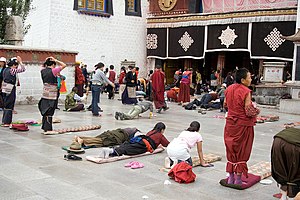

Traditional Tibetan holidays are recorded in the Tibetan calendar , which traces its main points from Vinaya and celebrating significant events in the life of the Buddha . [1] During the celebrations, religious rites are performed. At the same time, the monks act as actors , and the laity as spectators. Performed cult rites are believed to generate merit that helps to clear oneself of bad karma .
The most important days of the Tibetan calendar are days associated with the acts of the Buddha [2] . The religious calendar reaches its maximum on the day on which the Buddha is believed to have reached enlightenment (on the same calendar day he was born, set in motion the Wheels of Learning , entered nirvana ). Other holidays associated with the Buddha are the feast of the first sermon , the feast of descent from heaven and the feast dedicated to the miracle created by Buddha, when he "reproduced himself in an endless series of incarnations, and flame alternately flowed from his head and legs." [2] Each important day of the Tibetan religious calendar is, like the celebration of the New Year, a “great time” ( dujen ).
The Tibetan calendar lags behind the western by about 4-6 weeks. For example, the first Tibetan month usually falls in February, and the eighth in September.
List
| Month | date | Celebration | Description |
|---|---|---|---|
| 1st month | 1-7 | New Year's Day Losar | Week holiday with carnivals , horse racing and archery. |
| 1st month | 4-25 | Monlam School Galugpa | The Great Vow festival is the most important ritual event of the year introduced by Tsongkhapa . Numerous pilgrims gather at the Jokhang in Lhasa . |
| 1st month | 10-15 | Chotul Chenmo | The celebration of the Great Miracle in Shravasti , when the Buddha reproduced himself in an endless series of incarnations, and flame alternately flowed from his head and legs. On this holiday, lights are lit on the roofs of houses, and lamps in the windows. |
| 2nd month | 28-29 | - | A holiday during which evil spirits are expelled. On this day, llamas with large trumpets surround Lhasa. |
| 4th month | 7 | Pilgrim day | An important month for pilgrims. Shakyamuni Buddha's Birthday |
| 4th month | 15 | Saga dava | Feast of Enlightenment of Buddha Shakyamuni and his entry into nirvana . On this day, opera is played in the open air, and the captured animals are released. Believers flock to the Jokhang Temple in Lhasa for prayer. |
| 5th month | 14-16 | Hanging tanks | A giant tanka is hung out at Tashilunpo in Shigatse. |
| 5th month | 15 | Incense festival | They say that ghosts scour this day. Tibetans dress up and have fun in order to drive them away. |
| 5th month | 15-24 | Holiday Shoton | Literally " Yogurt Celebration." Worship of buddha. In parks, especially under the trees of Norbulinka, picnics are held, operas are played. Bonfires are often burned at night. |
| 6th month | four | Buddha's sermon | Celebration in honor of the first sermon of the Buddha in Sarnath . Pilgrims climb the sacred mountains. |
| 6th month | ten | Guru Rinpoche 's Birthday | This holiday is especially popular in Nyingma monasteries. |
| 7th month | Start | Bathing holiday | It lasts about a week. People go to the river to wash themselves and their clothes. They say it cures any disease. |
| 7th month | ending | Onkar holiday | Literally 'Inspecting Fields'. Provides a good harvest. Horse races , competitions in archery and opera are held. |
| 7-8 months | completely | Golden Star Festival | During the holiday, Tibetans wash away all passions , greed and envy , abandon their ego . Ritual bathing is carried out in the rivers and picnics are arranged. |
| 8th month | 1-10 | Holiday Dajur | The dajur is held in Gyantse and Damksung . These are horse races, various sports competitions and games. |
| 8th month | 1-7 | Harvest Festival | The festival is held with prayers , dances, songs and drinking. |
| 9th month | 22 | - | The Buddha’s descent from heaven is celebrated, where he ascended to preach the law of his mother. All monasteries where pilgrims gather are open. |
| 10th month | 25 | Tsongkhapa festival | The day I remember Tsongkhapa's departure. Roof lights and lamps are lit. |
| 12th month | 1-7 | New year holiday | Held in Shigatse |
| 12th month | 29th | Expulsion of Evil Spirits | Cham dance is held to expel all the evil of the outgoing year and prepare for the New Year. |
Losar
Tibetan calendar - lunar-solar . Losar (New Year's Day) is celebrated on the first three days of the first lunar month . Tibetans do not observe losar strictly on the new moon . Their days begin at dawn regardless of the position of the moon . But the “energetic” quality of the year switches precisely to the new moon, when the element and / or animal of the year is replaced. [3]
| Gregorian year | Tibetan year | Losar | element and animal |
|---|---|---|---|
| 2001 | 2127 | January 24 - 26 | iron snake |
| 2002 | 2128 | February 12 - 14 | water — horse |
| 2003 | 2129 | February 13 | water — sheep |
| 2004 | 2130 | January 22 - 24 | tree — monkey |
| 2005 | 2131 | February 9 - 11 | tree — bird (or rooster) |
| 2006 | 2132 | January 30 - February 1 | fire — dog |
| 2007 | 2133 | February 18 - 20 | fire pig |
| 2008 | 2134 | February 7 - 9 | earth — rat |
| 2009 | 2135 | January 25 - 27 | bull earth |
| 2010 | 2136 | February 14 - 16 | metal tiger |
Literature
- Tucci, Giuseppe . "Religions of Tibet." St. Petersburg: Eurasia, 2005 .-- 448 p. ISBN 5-8071-0168-5 .
- Ogneva E. D. Tibetans \\ in the book. Calendar customs and rites of the peoples of East Asia. Annual cycle. M., Science, 1989. ISBN 5-02-016952-8
Notes
- ↑ Tucci, p. 188
- ↑ 1 2 Tucci, p. 189
- ↑ Kruglikov V.M. Five forces of time. The beginning of Tibetan astrology. - SPb .: A.V.K. - Timoshka, 2002. ISBN 5-324-00165-1 . p. 156