Millet Veronica ( Latin Veronica agrestis ) is an annual herbaceous plant, a species of the genus Veronica ( Veronica ) of the family Plantain ( Plantaginaceae ).
| Veronica the plow | |||||||||||||||||||||||
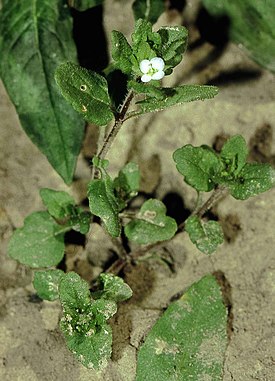 General view of a flowering plant. | |||||||||||||||||||||||
| Scientific classification | |||||||||||||||||||||||
|---|---|---|---|---|---|---|---|---|---|---|---|---|---|---|---|---|---|---|---|---|---|---|---|
| |||||||||||||||||||||||
| International scientific name | |||||||||||||||||||||||
Veronica agrestis L. | |||||||||||||||||||||||
Content
Distribution and Ecology
Western Europe : almost all countries, absent on some islands of the Mediterranean and North Seas , in Iceland , Turkey , in most of Fennoscandia ; territory of the former USSR : western and central regions of the European part, extreme northeastern location - south of the Arkhangelsk region , Ustya river, extreme east - Penza river; Africa : Tunisia , Algeria , mainly in the mountains.
It grows in forest and forest-steppe zones, rarely in the foothills and mountains up to 1800 m above sea level, in herbaceous and grassy groups, like weed in the fields, in gardens, kitchen gardens.
Veronica plow can be infected with raspberry ring spotting , a viral disease transmitted through the soil, weeds, and also transmitted by nematodes . This disease leads to a decrease in productivity and death of garden varieties of raspberries [2] .
Leaf (top side). Flower with flowering leaves. |
Botanical Description
Stems 5-30 (up to 40) cm tall, thin, ascending, lying and rooting, strongly branched, leafy from the base.
Leaves are opposite, ovate or round-ovate, apical to oblong-ovate, 7–9 mm long, 6–8 mm wide, marginally serrate, serrated, dentate, or coarse, light green. The lower leaves are heart-ovate, roundish or truncated at the base, short petiolate , decreasing upward; upper - oblong, all serrated, wedge-shaped, all somewhat fleshy, with sparse hairs.
Flowers , one or several in the axils of the leaves, on long pedicels equal to the flowers or slightly longer than them, with fruits bent down. Calyx deeply four-parted; lobes of the calyx from ovate to oblong-lanceolate, obtuse, rounded or rounded wedge-shaped at the base, do not cover each other, with sparse hairs or almost naked; corolla light blue with a whitish lower lobe, whitish with blue veins, pale pink or white, with a diameter of 6-8 mm, does not exceed the calyx. Stamens are much shorter than the corolla.
The capsules are somewhat shorter than the calyx, with a length equal to or slightly less than the width, convex, rounded, short, back-cordate, glandular-hairy, with a narrow deep notch, with round, dull thin-mesh lobes, with inconspicuous veins. Seeds 1.75-2 mm long, 1.5-1.75 mm wide, roundish or ovoid-spherical, finely wrinkled, concave, cup-shaped.
Taxonomy
Species Veronica plow is a member of the genus Veronica ( Veronica ) of the family Plantain ( Plantaginaceae ) of the order Lamiaceae ( Lamiales ).
| another 21 families (according to APG II System ) | another 300 to 500 species | ||||||||||||
| the order is Lamiaceae | clan Veronica | ||||||||||||
| Department of Flowering, or Angiosperms | plantain family | view Veronica the plow | |||||||||||
| 44 more order flowering plants (according to APG II System ) | another 90 births | ||||||||||||
Notes
- ↑ For the conventionality of specifying the class of dicotyledons as a superior taxon for the plant group described in this article, see the APG Systems section of the Dicotyledonous article .
- ↑ Dbhecyst Viral diseases of berry crops and grapes (Retrieved May 28, 2010)
Literature
- Flora of the USSR : in 30 tons / started at hand. and under chap. ed. V. L. Komarova . - M .; L .: Publishing House of the Academy of Sciences of the USSR , 1955. - T. 22 / ed. volumes B.K. Shishkin , E.G. Bobrov . - S. 408-409. - 861 s. - 3000 copies.
- Elenevsky A.G. Systematics and geography of Veronics of the USSR and adjacent countries - M .: Nauka, 1978. - S. 223. - 259 p.