Louis Jacques Mandé Daguerre ( fr. Louis Jacques Mandé Daguerre , there is a variant of transliteration Daguerre ; November 18, 1787 - July 10, 1851 ) - French artist, chemist and inventor, one of the creators of photography .
| Louis Jacques Mande Daguerre | |
|---|---|
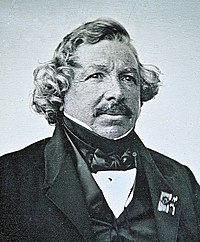 Daguerreotype portrait of Daguerre, 1844 | |
| Birth name | |
| Date of Birth | |
| Place of Birth | Cormay-en-Parisis , France |
| Date of death | |
| A place of death | Brie-sur-Marne , France |
| Citizenship |  France France |
| Awards |  |
| Signature | |

Content
- 1 Biography
- 2 memory
- 3 Bibliography
- 4 See also
- 5 Literature
- 6 notes
- 7 References
Biography
Louis Daguerre was born on November 18, 1787 in the town of Cormeilles-en-Parisis near Paris . I practically didn’t get school education, at thirteen my father sent him to the architect as a student. In 1804, when Louis Daguerre was 16 years old, his father took him to Paris and arranged for Degotti as a student in the workshop of the theater designer of the Grand Opera .
Daguerre was also known as a dancer , tightrope walker , and theater artist. By the time he came to Degotti, he already knew the laws of perspective, so the decorator took him as a student. The artist’s natural gift immediately highlighted Dagger’s productions; critics began to celebrate him. He worked miracles on stage, for example, built a diorama with his companion: sitting spectators could see some huge cathedral from the outside, and then suddenly find themselves inside. For this, two paintings were painted, measuring up to twenty-two meters in height. The diorama was a huge success in Paris and glorified Daguerre.
To simplify his work when creating such huge paintings, Dager used a pinhole camera , but could not fix the image on the screen. Daguerre carried out a huge number of experiments, experimenting with chemicals, and then found out about Nisephor Niepse , who was engaged in approximately the same experiments. Daguerre writes a letter to him, and Nieps offers to conclude a cooperation agreement. In the late 1820s, along with Joseph Niepce, he worked on a method of photography. In 1833, Nieps died. Daguerreotype was invented after that, almost by accident, as a result of another experiment.
Daguer did everything to turn Niepce’s invention into a really applicable technology, though using chemicals that were unknown to Niepce. Daguerre’s idea was to capture mercury vapor . At first he conducted experiments with mercury dichloride, but the images were very weak. Then he improved the process using sugar or chlorine oxide, and finally, in 1837, after eleven years of experimentation, he began to heat the mercury, the vapors of which showed the image. He perfectly captured the image, using a strong solution of ordinary salt and hot water to wash off particles of silver iodide that were not exposed to light.
On January 7, 1839, the French physicist Francois Arago made a report on daguerreotype at a joint meeting of the French Academy of Sciences and the Academy of Fine Arts . After that, the name of Daguerre and his technology became known throughout the world. Among his direct students is Antoine Claude . Fame, wealth and confidence came to him. Niepce's name was almost forgotten.
The principle of Daguerre to manifest with the help of mercury vapor was original and reliable, and was based, no doubt, on the knowledge Daguerre received from Niepce. Nieps did nothing to further develop his invention after 1829, as did his son Isidore, who became a partner of Daguerre after the death of his father. The son, in great need of funds, a few years later signed a new contract, which indicated that Dager was the inventor of the daguerreotype .
Daguerre died on July 10, 1851 in Bree-sur-Marne . His name is included in the list of the greatest scientists of France , placed on the ground floor of the Eiffel Tower .
Memory
In 1935, the International Astronomical Union named Louis Daguerre crater on the visible side of the moon .
Bibliography
- Daguerre Composition: Historique et description des precedes du daguerreotype et du diorama. P., 1839.
- Lit .:
- Evgenov S.V. , Daguerre, Nieps, Talbot. A popular essay on the inventors of photography, M., 1938;
- Documents on the history of the invention of photography. Correspondence of J. N. Niepce, J. M. Daguerre and other persons, M., 1949.
See also
- Daguerreotype
Literature
- Gershun A. L. Daguerre, Louis Jacques // Brockhaus and Efron Encyclopedic Dictionary : in 86 volumes (82 volumes and 4 additional). - SPb. , 1890-1907.
- Burinsky V.F. Daguerr and Nieps, their life and discoveries in connection with the history of the development of photography: biographical and popular scientific essays. - SPb., 1893.
Notes
- ↑ 1 2 BNF identifier : Open Data Platform 2011.
- ↑ 1 2 Louis-Jacques-Mandé Daguerre
- ↑ Louis Jacques Mande Daguerre - ministère de la Culture .
- ↑ Louis Jacques Mandé Daguerre - 2006. - ISBN 978-0-19-977378-7 , 978-0-19-989991-3