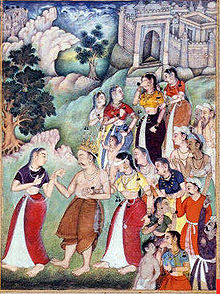
Dhritarashtra ( Skt. धृतराष्ट्र , dhritarāṣṭra IAST “powerful king”) is the blind king of the Kauravas , the hero of the ancient Indian epic Mahabharata , the son of the holy hermit Vyasa and the queen of Ambika , the widow of the king of the Moon dynasty Vichitravira . Dhrtarastra represents an extreme case of the indecisive, child-loving old king, unable to curb the malicious son.
When the young king of Wichitravirya died, his widows, Queen Ambika and Ambalika, remained childless. So that the Kaurava family would not be stopped, the mother of Vichitravirya, the old queen Satyavati, called her illegitimate son, the holy hermit Vyasu, to produce offspring Ambika and Ambalika from a brother-in-law according to the Niyoga tradition.
When a terrible forest ascetic, with a red beard and a disgusting smell, entered the bedroom of the young queen, she closed her eyes in horror, and at the curse of an angry hermit, her son Dhrtarastra, "with the power of ten thousand elephants," was born blind. The younger Queen Ambalika also gave birth to Vyasa, the younger Prince Panda , who was anointed for the kingdom because of the blindness of Dhritarashtra. The uncle of Dhritarashtra, the mighty Bhishma , a former regent under the princes of minors, snatched him Princess Gandhari. The righteous Gandhari put on a blindfold forever so as not to surpass her blind husband in any way. According to the promise of Shiva and through the mediation of Vyasa, one hundred sons ( Kaurava brothers) and one daughter were miraculously born to Gandhari and Dhrtarastra.
The first-born and beloved of Dhritarashtra Duryodhana was born under adverse signs: jackals and other terrible predators raised a howl and the sages said to Dhritarashtra: “Obviously, this your son will be the destroyer of the clan. Calmness can only come when it is removed; if you grow it, a great calamity will happen. ” The weak-willed Dhritarastra did not follow the advice of the sages and relatives (cf. Priam , who, due to terrible omens, agreed to get rid of Paris ). After the death of Pandu, Dhrtarastra became king, and the orphaned sons of Pandu (the five Pandava brothers) lived at his court. Duryodhana, envious and power-hungry, from his youth tried to deal with the Pandavas. When the subjects spoke of the anointing of the elder Pandava, the pious Yudhisthira to the kingdom, Duryodhana persuaded his father to send his nephews to exile, where he organized the arson of their house. The old king mourned the fallen nephews and their mother Kunti , not knowing that they had been saved. Having learned later that the nephews were alive, Dhrtarastra, under the pressure of the aged Bhishma and the sages, allocated half of the kingdom to them, despite the objections of Duryodhana and his sister and adviser Karna . Expanding the borders of his power, the Pandavas achieved unprecedented prosperity and wealth, and Yudhisthira accepted the title of king of kings, without ceasing to pay respect to the old uncle who replaced his father. Sick from the envy of Duryodhana persuaded the weak-willed king to call Yudhisthira for a dice game in order to seize the Pandava kingdom by cunning. The blind king at each bet asked who won, and could not hide the joy that his sons defeated his nephews. The losers of the Pandavas went into thirteen years of exile, and the blind king refused to return them, despite the persuasion of wise advisers. After the expulsion of the Pandavas, Duryodhana did not return the kingdom to them, and Dhritartastra did not contradict the wayward heir. So the Pandavas and the Kauravas came together in a terrible eighteen-day battle at Kuruksetra , and the Pandavas won, regaining the kingdom. The unfortunate Dhrtarastra lost all his sons, grandchildren, Shuryev, his son-in-law and his nephews of his wife, and lived at the court of the victorious Pandavas. The king of justice, Yudhisthira, invariably showed respect and care for the blind king and the old queen, but the frantic Bhimasena could not forgive Dhritarashtra for letting go of the machinations of Duryodhana. Grieved by the insults of Bhimasena and constantly tormented by remorse for the terrible feud, which he did not prevent, Dhrtarastra, accompanied by Gandhari, retired into the forest, where the elderly couple soon died in a forest fire.
Dhrtarastra represents one of the most vivid and tragic images in the gallery of old rulers and weak-willed fathers, whose reputation suffers from unworthy sons (cf. high priest Eli of the Old Testament ), who is involved in the unsightly intrigues of sons and nephews (cf. old king David ) , is a victim of manipulation of relatives (king Dasaratha " Ramayana ") or himself is at enmity with his nephews ( king Arthur - Mordred , king Kansa - Krishna ).
Literature
- Mahabharata. Book One Adiparva. Per. from Skt. and comment. V.I. Kalyanova. M.-L., 1950.
- Mahabharata. Book Two Sabhaparva (Book of the Congregation). Per. from Skt. and comment. V.I. Kalyanova. M.-L., 1962.
- Mahabharata. Book Five Udyogaparva (The book of diligence). Per. from Skt. and comment. V.I. Kalyanova. L., 1976.
- Mahabharata. Book Seventh Dronaparva (Book of the Dron). Per. from Skt. and comment. V.I. Kalyanova. SPb., 1992.
- Mahabharata. Book Fourteenth Ashvamedhikaparva (Book of the Sacrifice of a Horse). Per. from Skt. and comment. Ya. V. Vasilkova and S. L. Neveleva. SPb., 2003.
- Mahabharata. Book Fifteenth Ashramavasikaparva (Book of life in the monastery). Per. from Skt. and comment. S. L. Neveleva and Y. V. Vasilkova. SPb., 2005.
- Ibragimov A.R. The Old King of Mahabharata. Freedom of choice and fate in the Indian epic. Montreal, AGC. 2016. ISBN 978-1-5337-3029-9 .
- Brokington J. The Sanskrit Epics. Leiden-Boston, 1998