Smorodina golden or Smorodina gold ( Latin Ribes aureum ) - shrub , species of the genus Currant ( Ribes ) of the family Gooseberry ( Grossulariaceae ).
| Golden currant | |||||||||||||||||||||||
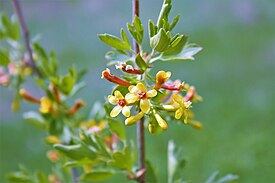 Flowering plants | |||||||||||||||||||||||
| Scientific classification | |||||||||||||||||||||||
|---|---|---|---|---|---|---|---|---|---|---|---|---|---|---|---|---|---|---|---|---|---|---|---|
| |||||||||||||||||||||||
| International Scientific Name | |||||||||||||||||||||||
Ribes aureum pursh | |||||||||||||||||||||||
| Synonyms | |||||||||||||||||||||||
| |||||||||||||||||||||||
| Subsidiary taxa | |||||||||||||||||||||||
See text | |||||||||||||||||||||||
In the south of Russia and in Central Asia, the plant has the colloquial name "krandal" (after the name of one of the varieties cultivated in the territory of the former USSR).
Content
Area
In nature , the species range covers the southwestern regions of Canada , the central and western regions of the United States , and the north of Mexico . The plant has been naturalized and cultivated in Europe , Central Asia and throughout North America . On the territory of Russia it is found in the European part , in the Caucasus , the Altai Territory and in the Far East .
The plant is drought-resistant (unlike other types of currants).
Top down. Sheet. Flowers and buds. Autumn leaves and fruits |
Botanical description
Golden currant - deciduous shrub height of 2-2.5 m. The shoots are red, bare or finely pubescent, less branched , with an annual increase of 30-40 cm. The roots are powerful, extending into the soil to a depth of about 1.5 m.
The leaves are alternate, about 5 cm long, 6 cm wide, rounded-bud-shaped in shape, with 3 deep blunt 2-3-toothed lobes and a wedge-shaped base, naked on both sides.
Racemes 5-15 flower , 3-7 cm long, with large bracts , erect. The flowers are yellow, yellow-green, fragrant, up to 1.5 cm in diameter, with a tubular thin hypanthium (the organ formed as a result of growing together with a floral receptacle ) up to 1 cm long; sepals during flowering prostrate, with upright fruits; the petals are twice as long as the sepals, at the beginning of flowering they have the same color as the sepals, and later become orange-red or red-violet.
The berries are spherical, black or purple-brown, in some varieties - transparent yellow, with a diameter of 6-8 mm, edible, with 2-26 seeds .
It blooms in May, the duration of flowering - 15-20 days. Fruits in July.
From the middle of August, the thick foliage becomes orange-red, and by September it has a purple-carmine color, which remains in this form until winter.
Economic value and application
In culture since the beginning of the XIX century. It is used for the organization of hedges, single and group plantings. In Uzbekistan , Kazakhstan and some southern regions of Russia, they are cultivated as a berry crop with high annual crops.
Ivan Michurin, from sowing seeds of the American variety Crandall [2] , cultivated several varieties, in particular, the Krandal Seedling, which became one of the pioneers of varieties and elite forms, bred in other research institutions in Russia, Ukraine and Of Uzbekistan. In the years 1930-1940, golden currant was widely spread in the south and south-east of Russia, including the steppe regions of Siberia and the Altai Territory , as well as northern Kazakhstan, in connection with the implementation of agroforestry measures to combat drought and the creation of forest shelter belts [3] , as undemanding to soil conditions, drought-resistant culture [4] .
Classification
Varieties
Within the framework of the species there are several varieties :
- Ribes aureum subsp. gracillimum ( Coville & Britton ) AEMurray [5] - grows in California ;
- Ribes aureum var. villosum DC. [6] [ syn. Ribes odoratum HLWendl. ] - grows in the central regions of the United States ( Arkansas , Texas , Iowa , Kansas , Minnesota , Missouri , Nebraska , North and South Dakota , Oklahoma ).
Taxonomy
Currant Golden species is a member of the genus Currants ( Ribes ) of the Gooseberry ( Grossulariaceae ) family of the order Saxifragales .
| 14 more families (according to the APG III System ) | ||||||||||||
| order stone-colored | Currant Golden | |||||||||||
| department Flowering, or Angiosperms | Kryzhovnikovye family | genus Currant | ||||||||||
| another 58 orders of flowering plants (according to the APG III System ) | about 150 more species | |||||||||||
Notes
- ↑ About the conditionality of specifying the class of dicotyledons as a higher taxon for the group of plants described in this article, see the section “APG Systems” of the article “Dicotyledons” .
- ↑ The variety was created by Crandall from Newton, Kansas in 1888.
- ↑ Resolution of the Council of Ministers of the USSR and the Central Committee of the CPSU (b) of 20.10.1948 No. 3960.
- ↑ Currant golden . NIICC named after M. A. Lisavenko. (Checked April 11, 2013)
- ↑ Ragracillimum (English) : information on the name of the taxon on The Plant List (version 1.1, 2013) .
- ↑ Ravillosum (English) : information on the GRIN website.
Literature
- Flora of the USSR : 30 tons / hl. ed. V.L. Komarov . - M. L .: Publishing House of the Academy of Sciences of the USSR , 1939. - Vol. 9 / ed. Toma S. V. Yuzepchuk . - p. 266-267. - 540, XIX c. - 5200 copies
- Trees and shrubs of the USSR. Wild, cultivated and promising for introduction. / Ed. Toma S. Ya. Sokolov . - M. - L .: Publishing House of the Academy of Sciences of the USSR , 1954. - T. III. Angiosperms. Trohodendron families are Rosaceae. - p. 204. - 872 p. - 3000 copies
Links
- Currant varieties golden // Research Institute named after M. A. Lisavenko. (Checked April 11, 2013)
- Currant golden on the site EDSR