The battle at Asan Bay (Azan) or the Battle at Phundo Island is the first naval battle of the Sino-Japanese War of 1894-1895 . It happened on July 25, 1894, off the west coast of Korea, near the Asan Bay in the Yellow Sea between Chinese and Japanese ships.
| Asan fight | |||
|---|---|---|---|
| Main Conflict: Sino-Japanese War (1894–1895) | |||
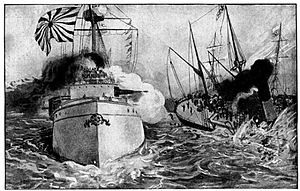 The death of Cowing. From an illustrated magazine of the time | |||
| date of | July 25, 1894 | ||
| A place | in the Yellow Sea near Asan Bay | ||
| Total | Japanese victory | ||
| Opponents | |||
| |||
| Commanders | |||
| |||
| Forces of the parties | |||
| |||
| Losses | |||
| |||


Content
- 1 Situation before the battle
- 2 The balance of power
- 3 First shots of war
- 4 Battle Cruisers
- 5 What saved Jiyuan
- 6 The sinking of the "Gosheng"
- 7 Results of the battle
- 8 Interesting Facts
- 9 notes
- 10 Literature
The situation before the battle
On July 22, 1894, the Chinese warships Jiyuan, Guangyi, Weiyuan arrived at the Korean port of Asan. The ships were escorted by two chartered transport vessels - Aizhen and Feijin - with an infantry battalion and military equipment. After the landing of the troops, the transports left. Senior commander Fan Boqian, having received information from the British about the suspicious actions of Japanese cruisers off the coast of Korea, sent the Weiyuan back to China. In Asan, the armored cruiser of the Northern (“Beiyang”) Chinese Jiyuan squadron (2355 tons of displacement, speed 15 knots, Captain Fan Boqian) and the guangyi mine cruiser (1110 tons, 17 knots, captain Lin Guosiang) sent from the southern Guangdong squadron remained in Asan. ) They expected the arrival of the third Gosheng transport (in the old Russian texts - “Cushing”), which left Dagu later and followed along with the messenger ship “Caojiang”.
Japan at that moment was ready to start hostilities before the official declaration of war on China. On July 23, the Joint Japanese Fleet left its base in Sasebo . Rear Admiral Kodzo Tsuboi, an outfit of 4 armored cruisers, separated from the main squadron: Yoshino (Ioshino) (4200 tons, 23 knots), Takachiho (3600 tons, 18 knots) and the same type Naniva ”(commander - H. Togo ), as well as“ Akitsushima ”(3100 tons, 19 knots, commander - H. Kamimura ). On the morning of July 25, Japanese cruisers approached the entrance to the Gulf of Asan.
The balance of power
According to some reports, on the eve of the battle, Takatikho separated from the Flying Squad and did not take part in the battle. However, even three Japanese cruisers were completely superior to the two small Chinese ships in Asana. The Chinese “class 3 cruisers”, according to the traditional classification, were actually low-speed gunboats with the corresponding armament: the Jiyuan had two 8-inch and one 6-inch guns, the Guanyi had three 4.7-inch guns. Japanese armored cruisers of the 2nd class were much larger, faster and more heavily armed. "Ioshino" had four 6-inch and eight 4.7-inch guns, "Naniva" - two 10-inch and six 6-inch guns, "Akitsushima" - four 6-inch and six 4.7-inch guns; only 30 large and medium caliber guns against six Chinese. The most important advantage of the Japanese was the surprise factor - the Chinese were not ready for the Japanese to attack them without a formal announcement of the start of hostilities.
The first shots of war
At about 5 o’clock in the morning, the Jiyuan and Guangyi anchored and headed for the exit from the bay. Apparently, the Chinese believed that the Japanese might try to somehow impede the passage of the "Gosheng" to Asan, but they hardly imagined that the war had actually begun. In this case, of course, it would be more profitable for the Chinese gunboats (coastal defense ships) to stay in the bay and accept the battle in its narrowness.
Near the island of Phundo, two Chinese ships approached three Japanese. According to the official Japanese version, the Chinese did not salute the flag of Admiral Tsuboi, which the Japanese considered sufficient grounds for opening fire. According to another version, the Jiyuan, having previously hoisted a white flag, the first fired a torpedo towards the Naniva, passing by. The Japanese also claimed that they thought of seeing the Yayeyama and Takao sentinel ships sent to Korea earlier in Asan, and when they found the Chinese instead, they decided that they had sunk light Japanese ships. However, almost all independent observers come to the conclusion that the Japanese explanations are far-fetched. From the very beginning, Tsuboi’s detachment aimed to attack and destroy Chinese ships.
At around 8 a.m., the Naniva cruiser opened fire on the Jiyuan passing by. The distance between the ships did not exceed 300 yards (274 m). These were the first shots of the Sino-Japanese war.
Battle of the Cruisers
The sudden fire at close range took the Chinese by surprise. The first salvos of the Naniva on Jiyuan hit a conning tower and a bow tower with two 8-inch guns. The Chinese cruiser lost control and the ability to fight - the last 6-inch cannon at the stern could not shoot due to the peacetime jute awning. The Naniva continued to bombard the Jiyuan shells. One of them, breaking through the board, smashed the living quarters, the other, having exploded on the casing of the pipe, killed several stokers, the third hit the mast. The ship was enveloped in the smoke of fires from the burning wreckage of the boats, mutilated corpses were visible everywhere, the mangled deck and superstructures were covered in blood.
Despite the severity of the damage, the Jiyuan did not lose speed. Launched at close range, Japanese shells ricocheted from the armored deck, so the boilers and ship mechanisms sheltered beneath it did not suffer. The German instructor Hoffman, who was on the Jiyuan, set about adjusting the steering, holding out temporary tiller-hoists under fire. When the helm began to act again, the Jiyuan got a chance for salvation.
At this time, the second Chinese ship - the mine cruiser (torpedo gunboat) "Guanyi" itself attacked the "Naniva", thereby diverting the Japanese fire on themselves. Unlike the older Jiyuan, the Guanyi had new quick-firing guns, of which the Chinese managed to release almost all of their ammunition in a short battle. The Guanyi exchanged fire with the Naniva, and then with the approaching Akitsushima. The Chinese ship was badly damaged, caught fire and began to sink. Captain Lin Guoxiang ordered to land on the coast off Sippaldo Island. 79 surviving crew members went ashore. The boiler and the mine cellar were blown up. After some time, the cruiser Akitsushima approached the Guanyi reefs and fired more than thirty shots at it.
Meanwhile, "Jiyuan" managed to retire from the Japanese who were engaged in the destruction of "Guanyi" at a considerable distance. In pursuit of a slow-moving Chinese ship, the flagship of Admiral Tsuboi, Yoshino, was rushed to be recognized as the fastest cruiser in the world at the recent commissioning. However, Jiyuan managed to break away from the persecution and go to sea [1] . The battle lasted an hour and a quarter. According to official reports from the Japanese side, the Japanese did not have any dead or wounded, only a few sailors burst their eardrums from firing their own guns. The Jiyuan team lost 13 people killed (including 5 officers) and more than 40 wounded. There were 31 dead on the Guanyi, the rest, led by Lin Gosyan, were able to reach the Korean coast and were transported to China by English ship. One Chinese ship was destroyed, the other was badly damaged, but, nevertheless, managed to escape.
What saved Jiyuan
The successful breakthrough of the low-speed Jiyuan through the screen of three high-speed enemy cruisers from the very beginning raised questions. According to the Japanese version, the Chinese ship Yoshino was prevented by fog that had accumulated over the sea and a malfunction in the car. According to the Chinese, they repelled the attack of the enemy flagship with the fire of the last remaining 6-inch gun. To put this gun into action, it was necessary to demolish a shot in an upright tent, although this threatened to explode the mines below. Against the outdated 6-inch stern Jiyuan, Yoshino had three 6-inch quick-fire guns firing at the bow. The explosion of a Japanese shell destroyed the calculation of the Chinese guns, only one person survived who continued to fire (modern Chinese historiography claims that there were two heroes of the gunners: gunner Wang Gocheng and sailor Li Shimao, bringing the shells). Fan Boqian stated that the Jiyuan shots hit Yoshino in the conning tower, the bridge, and also shot down one of the guns, after which the Japanese left the battle. The loss of the Japanese, according to his report, amounted to 27 people killed and several dozen wounded, including the Japanese admiral who was allegedly killed.
Given the doubtfulness of such accuracy, the allegations that the Yoshino sustained serious damage in battle seemed quite reasonable. There are examples of recognition of this by the Japanese. The memoirs of the head of the medical service of the Japanese fleet are known, in which it is said that Asan got to Yoshino twice. The first shell knocked the hafels off the mast, the second pierced the armored deck and flew into the engine room, fortunately for the Japanese, without breaking. Apparently, it was he who caused the malfunctions in the car of the Japanese cruiser, which did not allow him to catch up and finish off the Jiyuan.
GaoSheng sinking
The most serious consequences for China were the death of the Gosheng transport, a rented steamer of a British private company that transported 1,100 Chinese soldiers and officers and 14 field guns from the Chinese port of Dagu to Korea, as well as a large amount of other military equipment. On the steamboat was a retired German major, K. von Genneken, a former construction manager for the Bayan fleet, who was trying to leave home through Korea (according to another version, he remained an instructor officer in the service of China). For the "Gaosheng" went the Chinese messenger ship "Caojiang" (Captain Wang Yongfa. 950 tons of displacement, 8 knots of travel) - an old wooden gunboat, with four 90-pound muzzle-loading guns.
At 9:00 a.m. on July 25, the GaoSheng approached Asan. Approaching the steamboat "Naniva" gave a signal to stop. An officer was sent to Gaosheng who demanded that the English captain T. Galsworthy follow the Japanese cruiser. Genneken after a formal protest (the ship was neutral, and the war has not yet been declared) agreed to accept Japanese demands. However, the Chinese soldiers refused to obey the surrender order. At one o'clock in the afternoon, waiting for the return of their officer, they sent a signal from the Naniva to foreigners to leave the ship immediately, after which they fired a torpedo at the Gosheng (passed by) and opened fire from guns. One of the 10-inch Japanese shells blew up a boiler on the steamboat, the Gaosheng shrouded in a cloud of steam and coal dust, tipped and slowly began to sink into the water. The Chinese fired at the Naniva from rifles from the deck of a sinking ship, the Japanese mowed them from mitraliasis and quick-firing small-caliber guns. The fire from the Naniva did not stop, even when the Gaosheng sank after an hour - the Japanese shot the Chinese on boats and floating in the water. Only a few English were raised to the Naniva. About 300 Chinese still survived by swimming to the island. Then they, along with Genneken, were taken out from there to China by neutral vessels - the French and German gunboats.
Around 14:00, Akitsushima intercepted the Caojiang approaching the battlefield and demanded to surrender. Wang Yongfa did not dare to accept the battle, and after half an hour 24 Japanese sailors and officers from the Akitsushima landed aboard the Caojiang. 82 captured members of the Caojiang crew were transferred to the Japanese ship Yaeyama, where they were subsequently seen by the captain Galsworthy who was saved by the Japanese.
Battle Results
The first naval battle of the undeclared war [2] caused heavy losses to China - it lost two ships and two infantry battalions with artillery. The losses of the Japanese were insignificant. The plan of the Japanese turned out to be brilliantly executed, but it cannot be said that he would do them a special honor , ”wrote Russian lieutenant N. Klado, who analyzed the events of the Sino-Japanese war, [3] .
An attack without a declaration of war, and especially the sinking of neutral vehicles, the barbaric extermination of its passengers in distress - all this clearly violated the then European standards, which Japan tried to comply with. However, for the Japanese, all this got away with it. The world community was outraged, but outweighed the political interests. Britain even forgave Japan for the sinking of the ship under its flag, having justified the actions of Japanese commanders during the court session and referring to the precedent of 1804 (!), When Nelson sank several Spanish merchant ships before the official start of the war between Spain and England.
There is no excuse for shooting at people in the water; it was an act of barbarism and at the same time cruel , ”wrote Fleet historian H. Wilson, but he noticed it right there. - True, the Japanese commander could refer to the following circumstance: if he took the enemies on board, they would be a very dangerous element on the deck of his own ship, since the Chinese are an ignorant, treacherous, and cruel race that cannot be expected from so that she obeys the rules of war " [4] .
Interesting Facts
It is not difficult to notice some situational similarity between the battle at Asan and the battle that took place 10 years later at Chemulpo in the Russian-Japanese war . The Jiyuan and Guangyi, as in the subsequent Varangian and Korean, had to withstand the battle with a much stronger Japanese squadron in isolation from their main forces. Like the later events in Chemulpo in Russia, in China, the Asan battle caused a great patriotic upsurge. The sailors of the Bayan Navy were determined to take revenge on the Japanese. Admiral Dean Zhuchang ordered not to spare the enemy, even if he raises a white flag.
Although the Jiyuan, unlike the Varangian, managed to break through, its commander Fang Boqian did not receive the award. Subsequently, Captain Fan Boqian was executed for cowardice in the battle of Yalu . Admiral Ding generously awarded the gunner Jiyuan, who hit the Japanese cruiser, he received 1,000 liang (about 2 thousand rubles in silver at that time), and Hoffman instructor, who managed to fix the steering gear in battle, was awarded a cash prize.
Notes
- ↑ The next day, “Jiyuan” came to Weihaiwei, impressing everyone with its terrible condition after the battle: “The ship looked like an old, wrecked ship. The mast was shot at half its height, the steering gear was torn to pieces, and the gears hung in disarray. The deck view was terrible ... Wooden things, rigging, fragments of iron and dead bodies - everything was lying in a heap ... Huge pieces of armor and wooden lining were torn from their places and went inside the ship, crushing many poor creatures into an ugly mass, so even the tops of smoke the pipes were spattered with blood ... ” Wilson H. Armadillos in battle. Chapter 21. The battle of Asan and the sinking of the steamer "Cushing" July 25, 1894
- ↑ War will be declared only on August 1
- ↑ Lieutenant N. Clado. Military operations at sea during the Sino-Japanese War. SPb., Printing house of the Ministry of the Sea, 1896. - 66 p.
- ↑ Wilson H. Armadillos in battle. Chapter 21. The battle of Asan and the sinking of the steamer "Cushing" July 25, 1894