CanJet Airlines is a low - cost airline in Canada with headquarters in Anfield ( Nova Scotia ) near Robert L. Stanfield Halifax International Airport , specializing in scheduled and charter flights to Canada and the United States of America [1] . It is a subsidiary of IMP Group International .
| Canjet airlines | ||||
|---|---|---|---|---|
 | ||||
| Established | 1999 | |||
| Base airports | Halifax International Airport | |||
| Hubs |
| |||
| Fleet size | eleven | |||
| Destinations | 37 | |||
| Headquarters |  Halifax Canada Halifax Canada | |||
| Guide | Kenneth Sea Row ( CEO ) | |||
| Website | web.archive.org/web/2002... | |||

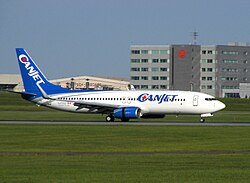
Until the beginning of September 2006, CanJet Airlines operated regular flights to 15 airports in the USA and Canada as a discounter airline, however, on September 5 of the same year, CanJet management announced the closure of all regular routes and reorientation of the company exclusively to charter flights [2] .
As of March 2007, 572 employees were employed by the airline [3] .
Content
- 1 History
- 1.1 1999-2001: the beginning
- 1.2 2002-2006: scheduled transport
- 1.3 Since 2006: charter flights
- 1.4 2009: Partnership with Transat
- 2 Route network
- 3 Fleet
- 3.1 Decommissioned
- 4 Meals
- 5 Accidents and accidents
- 6 notes
- 7 References
History
1999-2001: Beginning
CanJet Airlines was founded in 1999 as a subsidiary of IMP Group Holding and began operating on September 5 of the following year. In May 2001, the company merged with the regional carrier Canada 3000 , a few months before the bankruptcy of the latter.
2002-2006: scheduled transportation
CanJet Airlines resumed operations as an independent carrier on June 20, 2002. The route network of scheduled flights initially consisted of three destinations and expanded consistently over the next few years. The company's fleet consisted of one Boeing 737-300 airliner and eight Boeing 737-500 aircraft of the 1990s, seven of which were previously operated by United Airlines , one of the main airlines, and Lufthansa, the German flagship. The management of CanJet Airlines planned to expand the fleet of Boeing 737-500 to twenty units by 2006, however, for several reasons, these plans were not implemented.
In April 2004, CanJet announced the opening of its own transit hub ( hub ) at John Munro Hamilton International Airport to fill the vacuum created after WestJet discounter moved its center of gravity from Hamilton to Toronto Pearson International Airport .
In May 2005, the airline continued its expansion in the western direction, opening regular flights between Calgary and Toronto and planning to occupy the regional transportation market in the route network of airports of these two cities. After the bankruptcy of the carrier Jetsgo , CanJet Airlines management announced its intention to fill some of the vacant airline markets, however, in order not to go the way of another Canada 3000 bankrupt, this process was planned to be implemented gradually. In June 2005, two weeks after the regional airline Air Canada Jazz opened regular flights from Hamilton to Montreal and Ottawa , CanJet Airlines announced new routes from Toronto to Fort Lauderdale / Hollywood International Airport .
In May 2006, CanJet Airlines signed a partnership agreement with another Canadian airline, Harmony Airways , under which both carriers significantly expanded their route networks across the country, effectively integrating the two flight schedules into a single whole. At the same time, CanJet transferred flights west of Toronto to Harmony Airways and reoriented its flights to settlements in Atlantic Canada . This agreement was a code-sharing agreement, that is, it allowed passengers of one airline to use the services of another carrier at the same applicable tariffs and benefits.
Since 2006: charter operations
On September 5, 2006, CanJet Airlines management announced the completion of all scheduled flights on September 10 and a complete reassignment of the company's operations to charter flights. As the main reason for this step, top managers cited high competition among Canadian airlines and, as a result, a constant decrease in operating profit of carriers operating on local and regional lines. According to Ken Rove, President of IMP Group Holding, CanJet Airlines CEO , "... since the business risks of companies are constantly growing in the airline market, IMP decided to suspend all regular all-season flights and focus on charter operations." The management of the company emphasized that passengers who purchased tickets for dates later than September 10, 2006 will either be transported by other airlines or will receive full compensation for the cost of tickets [4] .
On September 27, 2006, CanJet announced the recruitment of more than one hundred pilots and cabin crew - about 20% of the total number of laid-off flight crews on September 10 of the same year. The expansion of the staff became possible after the conclusion of a major contract with the tourist operator Sunquest and the introduction of a large number of charter flights to tourist destinations [5] .
2009: Partnership with Transat
On February 13, 2009, CanJet Arilines announced its five-year partnership program with Transat AT , a large Canadian holding, which includes the airline Air Transat . This commercial agreement replaced the contract that ended with another budget airline WestJet [6] . From May 1, 2009, Transat tourist tours between the cities of the country are carried out on B737 CanJet aircraft.
Since May 2010, charter flights from Halifax and Fredericton to London Gatwick Airport have been planned as part of the Canadian Affair Travel Program. Flights will be operated once a week from Fredericton and twice a week from Halifax on Boeing-737 aircraft . At the same time, CanJet Airlines replaces Thomas Cook Airlines and Air Transat , which operated on these routes in 2009.
Routing Network
Fleet
As of December 13, 2009, CanJet Airlines had the following aircraft [7] :
| Type of aircraft | Total | Passengers |
|---|---|---|
| Boeing 737-800 | 11 (6 out of 11 aircraft leased for the winter season) | 189 |
As of December 13, 2009, the average age of CanJet aircraft was 8.7 years [8] .
Decommissioned
- Boeing 737-200
- Boeing 737-300
- Boeing 737-500
Meals
During the flight, CanJet Airlines offers passengers free meals and soft drinks. Snacks and alcohol are available at an additional cost. An on-board entertainment system service is offered for CAD 3 per person per flight.
Accidents and accidents
April 19, 2009, flight 918 Sangster International Airport ( Montego Bay , Jamaica ) - Halifax Stanfield International Airport . The plane Boeing 737-800 , preparing for the departure from Montego Bay, was captured by an armed territorian who slipped through the security check system of the Sangster International Airport. After the capture, all passengers were released, and six crew members remained hostage. A few hours after negotiations with the participation of Prime Minister Bruce Golding, the terrorist surrendered to the authorities [9] .
Notes
- ↑ Contact Us Archived December 27, 2008. . ” CanJet . Retrieved on May 21, 2009.
- ↑ CanJet website - Press Release (link not available)
- ↑ Directory: World Airlines, Flight International (April 3, 2007), p. 60.
- ↑ Discount carrier CanJet cancels scheduled service as of Sept. 10
- ↑ CanJet will rehire 100 pilots, attendants, says CEO
- ↑ Transat and CanJet forge 5-year partnership for narrow-body aircraft
- ↑ CanJet Fleet - Airfleets.net
- ↑ CanJet fleet age
- ↑ euronews - Hijack drama in Jamaica ends without incident