


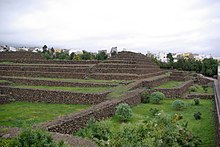
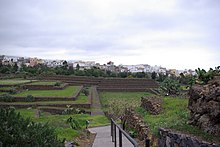
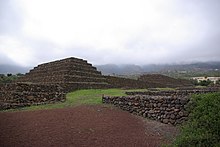
Pyramids of Guimar ( Spanish: Pirámides de Güímar ) - six step pyramids located in the city of Guimar on the southeast coast of the island of Tenerife , part of the Canary Islands . According to most scholars, these structures are not ancient monuments, and were piled up in modern times by local farmers who, when plowing the land, have the custom of stacking found stones at the borders of the fields. This was a common practice in the Canary Islands, especially in the second half of the 19th century . At the same time, according to local residents and according to ancient images, such pyramids have long existed in many places of the island, but were demolished due to their alleged uselessness and used as a source of cheap building material. There were nine pyramids directly in Guimar, of which only six were preserved.
Content
Pyramids
The pyramids are located on the territory of an ethnographic park with an area of several hectares. All six preserved pyramids have a rectangular base, the length of the faces is from 15 to 80 meters, the height is up to 12 meters. Large-scale reconstructions were carried out on pyramids No. 5 and No. 6 in the late 1990s and early 2000s, while minor restorations were carried out on the remaining pyramids. In 1992, archaeologists at La Laguna University excavated the park. In the cave under the pyramid No. 1, bones, ceramics and various artifacts belonging to the Guanche culture were discovered. Radiocarbon analysis attributed these findings to 680-1020. AD As a result of the excavation between the pyramids No. 2 and No. 3 in the second layer (25 cm), the remains of household utensils, ceramics and a vine were discovered. This layer was dated to the second half of the XIX - the first half of the XX century. The third layer (50-150 cm) contained volcanic stones, gravel, as well as utensils traditional for the Canary Islands and imported ceramics. The time to build the pyramids could not be established [1] . More than 100,000 tourists visit the pyramids annually.
In the chronicle of the chronicler-monk Juan de Abreu Galindo (1632) there is a text describing how the natives of the island erected and used these structures: “They stacked a lot of stones in the shape of a pyramid, trying to make it as high as possible, as far as nothing bonded stones allowed them. These days they held ceremonial worships: everyone gathered around piles of stones, danced, sang mournful songs, fought with each other and held other competitions, which usually served as entertainment. These were their holidays of worship ” [1] .
Heyerdahl's Theory
In 1991, the famous traveler Thor Heyerdahl studied the pyramids. There were distinct traces of stone processing at the corners of the pyramids, and also that the land was leveled before the construction of the pyramids. Material is not round boulders from local fields, but lava pieces. Heyerdahl also gave an opinion on the astronomical orientation of the pyramids. On the day of the summer solstice from the platform at the top of the largest pyramid, you can observe a twofold sunset: the sun disappears behind the mountain peak, then appears again, sets behind the neighboring peak a second time. All the pyramids on the west side have staircases that on the morning of the winter solstice lead exactly to the rising sun.
Heyerdahl was never able to find out the age of the pyramids or answer the question of who built them. However firmly known that in the cave under one of the pyramids lived the Guanches - the Canar natives. Guimar, until the Spanish conquest of the Canary Islands at the end of the 15th century , was the residence of one of the 10 Mensei (leaders) of Tenerife. It is noteworthy that according to Pliny the Elder , the Canary Islands were uninhabited during the time of Hannon the Navigator (approximately 600 BC), but, however, the ruins of large structures were located on them. The origin of the Guanches is not entirely clear. Crossing the Canary Islands from the nearest coast in southern Morocco is difficult due to sea currents , while at the same time it is much easier from Europe and the Mediterranean .
Heyerdahl hypothesized that the Canary Islands in ancient times were a transit point on the route between America and the Mediterranean. The fastest route between these two parts of the world really goes through the Canary Islands - it was used, for example, by Christopher Columbus . As early as 1970, Heyerdahl showed that shipping between North Africa and the Caribbean is possible by sailing from Morocco to Barbados on a papyrus boat Ra II , built using ancient technologies [2] [3] [4] .
Tourism
In 1998, with the financial support of Tour Heyerdahl and his friend, the Norwegian shipowner Fred Olsen, the Guimar Pyramid Ethnological Park was opened with an area of 65,000 m². The information center introduces visitors to the expeditions of Heyerdahl and his theories of the origin of the pyramids. Two pavilions contain exhibitions dedicated to Heyerdahl and models of his boats, among other exhibits - a full-size Ra II model.
Literature
- Maria Cruz Jiménez Gómez / Juan Francisco Navarro Mederos: El complejo de las morras de Chacona (Güímar, Tenerife): resultados del proyecto de investigación , XII Coloquio de Historia Canario-Americana (1996), Cabildo Insular de Gran Canaria, Las Palmas de Gran Canaria 1998, Volume 1.
- Juan Francisco Navarro Mederos / Maria Cruz Jiménez Gómez: El difusionismo atlántico y las pirámides de Chacona , in: Miguel Ángel Molinero Polo y Domingo Sola Antequera: Arte y Sociedad del Egipto antiguo. Madrid 2000, ISBN 978-84-7490-604-2 , S. 241-253.
- Antonio Aparicio Juan / César Esteban López: Las Pirámides de Güímar: mito y realidad . Centro de la Cultura Popular Canaria, La Laguna 2005, ISBN 978-84-7926-510-6 .
- Juan Francisco Navarro Mederos: Arqueología de las Islas Canarias " , in: Espacio, Tiempo y Forma, Serie I, Prehistoria y Arqueología, Bd. 10, 1997, S. 447-478.
Links
- Official site of the ethnological park (Spanish - English - German)
- Las Pirámides de Güímar: mito y realidad (Spanish) . - A brief review of the book. Date of treatment November 30, 2011. Archived on February 3, 2012.
Notes
- ↑ 1 2 S. Osmanagich. All the pyramids of the world. - Moscow: Veche, 2014 .-- S. 11-24. - ISBN 978-5-4444-2030-0 .
- ↑ Juan Francisco Navarro Mederos: Arqueología de las Islas Canarias ", in: Espacio, Tiempo y Forma, Serie I, Prehistoria y Arqueología, Bd. 10, 1997, S. 467.
- ↑ Antonio Aparicio Juan / César Esteban López, Las Pirámides de Güímar: mito y realidad . Centro de la Cultura Popular Canaria, La Laguna 2005, ISBN 978-84-7926-510-6 , p. 35-52.
- ↑ Antonio Aparicio Juan / César Esteban López, Las Pirámides de Güímar: mito y realidad . Centro de la Cultura Popular Canaria, La Laguna 2005, ISBN 978-84-7926-510-6 , p. 30-31.