

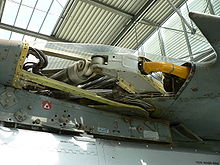
Variable sweep wing (KIS) is a type of aircraft design heavier than air with a fixed wing , which allows you to change one of the types of wing geometry in flight - sweep . At high flight speeds, more sweep is more effective, and at low ( take-off , landing ) - less.
Content
Principle of Operation
The main advantage of a direct (or with a small sweep) wing is its high coefficient of lift . A disadvantage that determines the unsuitability of such a wing at transonic and supersonic flight speeds is a sharp increase in drag coefficient when the critical value of the Mach number is exceeded . Therefore, the direct wing cannot be used on aircraft with high flight speeds.
At the same time, the swept wing has a number of disadvantages, including a reduced bearing capacity and a deterioration in the stability and controllability of the aircraft.
To solve this problem, a variable sweep wing was developed. It was used, in particular, to achieve acceptable take-off take-off values due to low thrust -to- weight ratio (engine thrust to aircraft weight ratio).
Strengths and weaknesses
Aircraft with a variable sweep wing and a sufficiently high maximum speed have good takeoff and landing characteristics [1] . For example, the Su-24 bomber has a maximum speed of 1700 km / h with a wing sweep along the leading edge of 69 ° and a landing speed of 280–290 km / h with a sweep of 16 ° (nevertheless, brake parachutes are used for each landing [2] ).
The disadvantages of the wing with variable sweep are its significantly greater mass and design complexity.
Design
The wing with variable sweep consists of rotary consoles (or rotary parts of the wing - ПЧК), the middle part of the wing (СЧК), center section and rotation mechanism. The rotary consoles with the help of the rotation mechanism during take-off and landing are set to the minimum sweep angle, during cruising subsonic flight they move to some intermediate position, and when flying at supersonic speed, they are set to the maximum sweep angle.
As elevation mechanisms, screw hoists are commonly used. On aircraft manufactured in the USSR ( Su-24 , Tu-22M , Tu-160 ) for the synchronization of the consoles, which is required to prevent the aircraft from tipping over due to the difference in the lifting forces of the consoles, the lifts are driven by a common drive through a single transmission . For example, on the Tu-22M and Su-24, the RP-60-4 drive, controlled by the 6TS254 block , is installed, together with the control handle (MKV limit switch mechanism) they make up the SPK-2 wing movement system, which is aggregated (RP-60 and block 6TS254 of other series, MKV-43M mechanism) is almost similar to the system of flaps movement SPZ-1A of Tu-154 aircraft [3] .
History
Professor of Messerschmitt AG Alexander Lippisch received a patent for such a wing as far back as 1942 , but he lost to the competitor, Focke , in February 1945 at the fighter competition held by the Luftwaffe supreme command in the German fighter Messerschmitt P.1101 fighter , which never flew, in February 1945 -Wulf Ta 183 Huckebein) a mechanism for changing the sweep directly in flight was not provided (the angle of the wings was supposed to be changed on the ground, and only after the tests it was already necessary to introduce mechanization). After the war, the Americans repeated the captured Messerschmitt P.1101, creating its improved copy - the Bell X-5 (the first flight in 1947).
The world's first production aircraft with a variable sweep wing was the American F-111 company General Dynamics , produced since 1967 . The most numerous were the models produced in the USSR developed by the Design Bureau of Mikoyan and Sukhoi (the first of them is the Su-17 , created in the first half of the 60s, serial production since 1969).
Variable Sweep Aircraft List
- USSR Su-17 / -20 / -22 (2867 copies)
- USSR MiG-23 (3630 + 769 copies)
- USSR Su-24 (~ 1400 copies)
- USSR MiG-27 (650 + 760 copies)
- USSR Tu-22M (497 copies)
- USSR Tu-160 (35 copies)
- USA General Dynamics F-111 (640 copies, from 1967, the first serial)
- United States Grumman F-14 Tomcat (712 copies)
- United States Rockwell B-1 Lancer (104 copies)
- France France Dassault Mirage G (3 experimental, 60s - 70s)
- European Union Panavia Tornado (~ 1000 copies)
- Messerschmitt P.1101 (1944)
- Bell X-5 (1947, experimental, copy of Messerschmitt P.1101)
- NASA AD-1 (experimental)
- Northrop Grumman Switchblade (Concept)
- Northrop Switchblade (concept)
- Grumman XF10F Jaguar (prototype)
- Short SB5 (prototype)
Notes
- ↑ §4. Features of the aerodynamic layout of modern aircraft
- ↑ V. Ilyin, M. Levin . Bombers. - M.: Victoria, AST, 1996. - Volume 2. - c. 48
- ↑ Block 6C254. Technical manual