Leipzig ( German: Leipzig , IPA (German) : [ˈlaɪptsɪç]  listen lat. Lipsia , v. Puddles. Lipsk ) is a city in Germany located in the west of Saxony . In terms of population (more than 595,000 people [3] ) Leipzig is the largest city in Saxony, and the eighth in Germany [4] , as well as the fastest growing largest [5] German city.
| City | ||||||||
| Leipzig | ||||||||
|---|---|---|---|---|---|---|---|---|
| ||||||||
| ||||||||
| A country | ||||||||
| Status | administrative center of the district non-district city | |||||||
| Land | Saxony | |||||||
| Directional District | Leipzig | |||||||
| Ober-burgomaster | ||||||||
| History and Geography | ||||||||
| City with | 1165 | |||||||
| Square | ||||||||
| Center height | ||||||||
| Timezone | and | |||||||
| Population | ||||||||
| Population | 587,857 people ( 2018 ) | |||||||
| Density | 1 974 people / km² | |||||||
| Digital identifiers | ||||||||
| Telephone code | +49 341 | |||||||
| Postcode | , , , , , , , and | |||||||
| Car code | ||||||||
| Identification code | 14 7 13 | |||||||


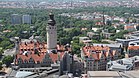

Known for its university and fairs , Leipzig is the economic, cultural, scientific and transport center of Central Germany .
Together with the city of Saxony-Anhalt, located 32 km west of Halle, Leipzig forms an urban agglomeration with a population of about 1.1 million people, and is one of the most economically developed regions of East Germany .
After receiving city and trade privileges in 1165, Leipzig acquired the status of an important trade center already during the German settlement to the east , primarily due to the trade in furs that died out after the Second World War . In addition, since the Late Middle Ages , especially since the founding of the University of Leipzig , the city has been the center of German printing and bookselling, maintaining this status until the end of the 1940s. The many years of activity of Johann Sebastian Bach and Felix Mendelssohn Bartholdi founded the rich musical tradition of Leipzig, which continues to this day, and the choir of St. Thomas and Gewandhaus are currently the embodiment of it.
Physico-geographical characteristics
- Geographical position
Leipzig is located in the center of the Leipzig Lowland ( German: Leipziger Tieflandbucht ), which forms the southern part of the North German Lowland , at the confluence of the Weiss-Elster , Plais and Parte rivers, which, having many branched channels in the city, form here a kind of internal delta with a characteristic vast flood forest that cuts the city from north to south. At the same time, the city’s surroundings are currently relatively poor in forests, but due to loess deposits they are actively used in agriculture.
Since the 20th century, open development of brown coal deposits has been conducted south of the city (Central German coal basin); after running out of reserves as part of the reclamation project, part of the quarries was flooded, forming the system of the so-called New Leipzig Lakes ( German: Leipziger Neuseenland ), which are used as a place for mass recreation and bathing of citizens.
- Climate
Leipzig is located in the temperate climatic zone, in the zone of humid temperate continental climate . The influence of the ocean is great, so winter temperatures are much higher than at similar latitudes in Russia. Summer is warm and humid, winters are cool and changeable. The average temperature in winter is from −5 to +7, and in summer from +13 to +23. The weather is very unstable, in winter it often happens that one day is +10 and rain, and the next day there is quite severe frost (below −10), which leads to problems on roads and disruption of the city’s infrastructure. Due to the variable and capricious climate characteristic of Central Europe , it is almost never known for certain what kind of weather should be expected.
| Climate Leipzig | |||||||||||||
|---|---|---|---|---|---|---|---|---|---|---|---|---|---|
| Indicator | Jan | Feb | March | Apr | May | June | July | Aug | Sep | Oct | Nov | Dec | Year |
| Absolute maximum, ° C | 15.9 | 18.9 | 24.7 | 31.1 | 33,4 | 35.0 | 37.9 | 37,2 | 34.5 | 28.6 | 21.6 | 16.9 | 37.9 |
| Average maximum, ° C | 3.2 | 4.3 | 8.8 | 14.0 | 19.1 | 21.8 | 24.6 | 24.2 | 19,4 | 14.1 | 7.7 | 3,7 | 13.7 |
| Average temperature, ° C | 0.5 | 1,2 | 4.7 | 8.9 | 13.8 | 16.5 | 19.0 | 18.6 | 14,4 | 9.8 | 4.7 | 1.3 | 9.5 |
| Average minimum ° C | −2.1 | −1.9 | 1,2 | 4.2 | 8.6 | 11.6 | 13.9 | 13.7 | 10.3 | 6.3 | 2.2 | −1.1 | 5,6 |
| Absolute minimum, ° C | −27.6 | −27.1 | −16.6 | −6.5 | −2.6 | 1,1 | 5.7 | 5.5 | 0.5 | −7 | −14 | −22.5 | −27.6 |
| Precipitation rate, mm | 32 | 26 | 39 | 40 | 47 | 55 | 69 | 63 | 50 | 31 | 43 | 40 | 534 |
| Source: Weather and Climate | |||||||||||||
History
- Early story
According to archaeological data [6], Leipzig was founded around 900 as a Slavic (Serbo-Luga) settlement, located on both banks of the Parte River. At the beginning of the 10th century, the Leipzig Lowland was conquered by the Franks , and a small fortification was built in the north of the future city, probably completed around 930. The first written mention of him under the name lat. urbs Libzi is found in the Chronicle of Titmar of Merseburg , and dates back to 1015 (Chronikon VII, 25): according to this record, Bishop Meisen Eido I ( German Eido I , 955-1015) died on his way from Poland.
- The history of the origin and phonetic transformation of the name of the city
Under 1165, Lipz transcription occurs ; under 1190, it was also TG . Lipz , under 1196th - Lipzk , under 1216th - Lipzc , under 1240th - Lipzik , under 1292th - Lipzic , under 1350th - Lipzcik . According to some linguists, this toponym comes from the name of the linden tree - thus, Leipzig can be considered a kind of namesake of the Russian Lipetsk [7] .
- Alternative version of the origin of the name
Other transcription methods recorded in the sources allow us to reconstruct the Slavic name of this German fortress otherwise - as * Lib . It, in turn, could be borrowed by the Slavs who came from the German * Lībja "high water place". [eight]
- The medieval history of the city
In 1165, the settlement - thanks to the Meissen Margrave Otton II - gained urban rights and market privileges. [9] Around this time, the city church of St. Nicholas and the monastery church of St. Thomas , which are the architectural dominants of the city center today.
Leipzig, located at the intersection of Via Regia ( Santiago de Compostela - Paris - Frankfurt - Leipzig - Krakow ) and Via Imperii ( Stettin - Nuremberg - Rome ), important for the Middle Ages trade routes, gradually became a major trading center. The Leipzig Trade Fair , which in 1497 received the imperial protective status, was one of the first of its kind, and was of great importance not only for economic relations with Eastern Europe , but, first of all, for the development of the city.
An important milestone was the founding of the university on December 2, 1409 by German professors and students who had to leave Prague Charles University shortly before (on the basis of the Kutnogorsk decree), which greatly contributed to the rapid development of publishing and related craft activities.
In 1439, Leipzig, as part of the Meissen Margrave, became part of the Elector of Saxony , and since 1485 - following the results of the so-called Leipzig division - was ruled by the Saxon dukes , who had chosen the insignificant Dresden as their capital.
In 1519, at the invitation of the University of Leipzig, a theological discussion took place in the Margrave castle between Martin Luther , Andreas Karlstadt and Philip Melanchton , on the one hand, and Johann Ekk , on the other, which went down in history under the name of the Leipzig dispute , and considered one of the key events era of the Reformation . In May 1539, Leipzig - with a sermon by Martin Luther in the church of St. Nicholas - officially joined the new creed .
The Thirty Years War , not only leading to significant destruction (between 1631 and 1642, Leipzig was besieged by as much as five times), but also reduced the population of the city by a third: from 18 to 12 thousand people, was a severe blow to the city. In addition, Leipzig witnessed two major battles of this war: Breitenfeld on September 17, 1631 and Lutzen on November 16, 1632, and the Swedish king Gustav II Adolf fell on the battlefield last.
Since the mid-17th century, Leipzig has been one of the important centers of the Enlightenment in Germany. In 1646, the future philosopher and mathematician Gottfried Wilhelm von Leibniz was born here, in 1661–1663 he studied at the local university with Jacob Tomasia. The son of the latter, jurist Christian Tomasius , worked actively in his native city in 1679–1690, and in October 1687 he delivered the first public lecture in German, according to legend, in the university church . [ten]
The 18th century was a quiet period, which brought significant wealth to Leipzig, which was embodied, first of all, in the construction of many luxurious baroque buildings and trading houses, which gradually replaced medieval half-timbered buildings; at the same time, in the immediate vicinity of the city walls, wealthy citizens built numerous baroque gardens, most of which were built up in the 19th century.
In 1723, the post of cantor of the Church of St. Thomas was then occupied by the already famous Johann Sebastian Bach , and, despite a number of contradictions with the members of the city council, he remained in this position until his death in 1750. In 1724, in Leipzig, in the city church of St. Nicholas was first performed by Bach's largest musical work, "Passion of John."
In the Seven Years War , between 1756 and 1763, the city was occupied by Prussian troops. As a result, in subsequent years, the old city fortifications, which proved to be ineffective, were dismantled, on the site of which trees were planted, which since 1784 - on the initiative of the then burgomaster Karl Wilhelm Müller - resulted in the arrangement of a wide promenade encircling the inner city with its generally preserved up to now regular green spaces.
In the second half of the 18th century, Leipzig experienced a period of rapid economic, scientific and cultural growth. In 1746-1748, the young Gotthold Efraim Lessing studied at the University of Leipzig, and a little later, in 1765-1768, Johann Wolfgang von Goethe . At the same time Christian Fürhtegott Gellert , Christian Gottfried Körner and Adam Ezer lived and worked in the city (from 1759); the latter was the first director of the Academy of Fine Arts (currently the Higher School of Graphics and Book Art). In 1785, invited by Körner, the 25-year-old Friedrich Schiller spent several months in Leipzig writing here the first version of Ode to Joy.
In October 1813, Leipzig and its environs became the scene of a fierce multi-day battle, which went down in history as the Battle of the Nations , and became the largest armed confrontation not only of the era of the Napoleonic Wars , but of the whole of the 19th century. In the same year, Richard Wagner was born in Leipzig.
Under the influence of the ideas of Friedrich Liszt and the efforts of the private Leipzig-Dresden railway company in 1839, a direct railway link was opened with Dresden (the link to Alten was already open on April 24, 1837); this section of the route became the first long-distance railway route in Germany. Thanks to this, Leipzig quickly became the most important transport center of Central Germany, and in the second half of the 19th century there were already 6 stations.
At about the same time, in the first half of the 19th century, in connection with the introduction of modern steam printing machines, Leipzig became one of the most important printing centers in Europe, with many printing houses located east of the historic city center, forming the so-called Printing Quarter ( it Graphisches Viertel ). The most famous publishers of this time include: Heinrich Brockhaus, Solomon Hirzel , Anton Philipp Reklam , Bernhard Tauchnitz, Benedict Toibner and Otto Wiegand. The key event was the founding of the Stock Exchange Association of German Booksellers ( German: Börsenverein der Deutschen Buchhändler zu Leipzig ) in 1825, designed not only to streamline and control the financial flows of the book fair , but also to represent the interests of the printing industry and bookselling.
During the period of industrialization , the landowner and entrepreneur Karl Heine ( German Carl Erdmann Heine , 1819–1888) had a significant influence on the development of the city, to a large extent through the efforts of which the western suburbs ( German Westvorstadt ) were built up and large-scale infrastructural and industrial development of Plagwitz began, in that time still located outside Leipzig (annexed in 1891). Convinced of the benefits of water and rail transport, in 1856, Karl Heine began the construction of a shipping canal , later named in his honor, which according to the plan was to connect the Weiss-Elster and Saale rivers, and thereby provide Leipzig with access to the sea. The canal allowed, first of all, to drain significant areas in Plagwitz, which made it possible to use it to accommodate large-scale industrial production, to promote which a whole system of access roads was laid. In addition, Karl Heine was able to conclude a number of beneficial service contracts for the city with the Prussian and Saxon railways. This and a number of other related incentive measures allowed Leipzig to become one of the most important centers of German industry as soon as possible. On the other hand, the development of production has created a demand for labor, which has significantly increased the population of the city and increased social tension.
For the sake of financial support for industrial development, several joint-stock banks were founded, the most significant of which were it. Leipziger Bank (founded in 1838) and Allgemeine Deutsche Credit-Anstalt (founded in 1856), which carried out an active investment policy outside Germany.
On May 23, 1863, the General German Workers' Union was founded in Leipzig - the forerunner of the modern Social Democratic Party , whose president was a politician and philosopher Ferdinand Lassalle .
Already since 1869, the Imperial Supreme Trade Court ( German: Reichsoberhandelsgericht ) was located in Leipzig; after the founding of the German Empire, its place was taken by the Imperial Supreme Court ( German: Reichsgericht ) in 1879.
The second half of the XIX century was marked for Leipzig, as elsewhere in Europe, accelerated urbanization , more and more encompassing and adjacent villages, so that the border between the city and its suburbs gradually disappeared, which made the issue of expanding the urban area relevant. And if in 1864 the city council of Leipzig still refused to accept the Roidnitz community ( German Reudnitz ) into the city for fear of uncontrolled cost increases, then already in 1889-1892 17 suburbs and villages were annexed, in 1910 - 7, and in 1915 year - two more. The total area of Leipzig thereby increased from 17.8 km² in 1885 to 84 km² in 1915. [11] At the same time, the historical center of the city became increasingly important for the exhibition, trade, entertainment, transport and banking sectors, and the new urban outskirts turned into a kind of industrial and workers' settlement.
The rapid development and expansion of the city also transformed the appearance of Leipzig: it was at the turn of the 19th and 20th centuries that the significant monumental public buildings of the Imperial Court, the University Library , the New Town Hall , the Conservatory, the new Gewandhaus , the City Commercial Courtyard, the Main Station , the New Theater, the main mail were built and the university on Augustus Square , etc.
In 1912, the German Library was founded in the city ( German: Deutsche Bücherei ), which is now an important part of the German National Library .
In September-December 1933, a trial was organized by the Nazi authorities on those accused of arson of the Reichstag.
During the Second World War, there were branches of the Buchenwald concentration camp within the city: the Tecla / Abtnaundorf concentration camp and the Leipzig concentration camp.
After the Second World War, Leipzig became one of the bases of captured aviation equipment, its restoration was led by an experienced pilot, Lieutenant Colonel Leonard Kruse [12] .
In 1989, after prayers for the preservation of peace in the church of St. Nicholas in the city held massive spontaneous demonstrations against the East German government of the SED .
In 2003, Leipzig was a candidate for the 2012 Summer Olympics .
Administrative Division
Since 1992, Leipzig has been administratively subdivided into 10 urban districts ( German Stadtbezirk ), covering 63 historical districts - once independent suburbs and villages included in the city in the 19th-20th centuries.
Administrative districts of Leipzig:
- Central ( German Mitte ),
- North ( German: Nord ),
- Northeast ( German: Nordost ),
- East ( German Ost ),
- Southeast ( German: Südost ),
- Southern ( German: Süd ),
- Southwest ( German: Südwest ),
- West ( German: West ),
- Old West ( German Alt-West ),
- Northwest ( German: Nordwest ).
Population
As in most European cities, the population of Leipzig in the Middle Ages and in the early New Age grew extremely slowly, which was due to frequent military conflicts, epidemics and famine. The population of the city began to grow rapidly only with the beginning of industrialization in the 19th century: if around 1800 there were only about 32,000 people living in Leipzig, and mainly within the former medieval walls, then by 1870 the overgrown city had more than 100,000 inhabitants . By 1930, the population of Leipzig reached its maximum, and amounted to 718,200 people. By the end of World War II, Leipzig, however, had only about 580,000 inhabitants. Their number, which had grown to 617,000 by 1950, has been steadily declining in subsequent decades, reaching 530,000 in 1990, and in 1998, its lowest point in recent history, 437,000. After expanding the territory of Leipzig in 1999–2000, the population dynamics was almost doubled, and from the mid-2000s the population growth of Leipzig resumed, although initially at a slow pace. In 2015 (according to the city registry office) the population of Leipzig increased by 15 975 people, which is the all-German record among large cities (in 2014, the increase was about 13 000 people). The positive dynamics of growth in this case is due not only to the influx, first of all, of relatively young people from other regions and cities of the country, but also from outside Germany and Europe, and also - since 2013 - due to the excess of fertility over mortality (for the first time since 1965 of the year). [13]
According to the official (conservative) estimate of the Statistical Office of Saxony, as of December 31, 2018, the population of Leipzig was 587,857 people [14] . Moreover, according to the data as of December 31, 2011 (taking into account the results of the 2011 census) - only 510,043 residents (moreover, earlier on the same date it was estimated at 531,809 inhabitants) [15] . According to the constantly updated registry of the city registry office at the end of 2018, the population of Leipzig was 596 517 people (with the right of primary residence; considering having the right of secondary residence - 601 737). [sixteen]
At the end of 2017, 13.4% of the population of Leipzig were foreigners, which is one of the largest indicators in East Germany. Most of them came from the Russian Federation (about 8,000 people), Syria (about 5,000 people), Poland (about 4,000 people), Ukraine (a little more than 3,000 people), Vietnam and Kazakhstan . [17]
Religion
Currently, the vast majority of the population of Leipzig (according to data for 2015 - more than 83%) does not consider itself to be a particular religion. [18]
In the Middle Ages and up to the Reformation, Leipzig belonged to the bishopric of Merseburg . There were four monasteries in the city, founded in the 13th century: the Dominican monastery of St. St. Paul, Augustinian monastery of St. Thomas, the Franciscan monastery of St. Духа и цистерцианский (позднее — бенедиктинский ) монастырь св. Георгия.
Первые протестантские проповеди были проведены в Лейпциге уже в 1522 году, однако — поскольку город входил в состав альбертинского герцогства — официально Реформация была введена лишь в мае 1539 года, после смерти строго католического Георга Бородатого . В настоящее время с административной точки зрения все лютеранские общины города подчиняются земельной церкви Саксонии , либо Независимой евангелической церкви . По данным на 2015 год к евангелическо-лютеранской церкви себя причисляли около 65 000 человек (11 % городского населения).
Католические церковные службы были вновь разрешены с 1697 года в связи с переходом Августа Сильного в католическую веру. С возобновлением Мейсенского епископства в 1921 году Лейпциг представляет собой административный центр соответствующего деканата . В настоящее время главной католической церковью города является освящённая в 2015 году церковь св. Троицы . Католическая церковь в Лейпциге насчитывает порядка 25 000 человек (около 4 % населения).
С 1700 года в городе существует также активная евангелическо-реформисткая община, образовавшаяся после прихода в Лейпциг гугенотов . Её главным храмом служит реформатская церковь на Ринг-штрассе постройки 1900 года.
К прочим представленным в городе христианским деноминациям относятся общины различных православных церквей (с примерно 1700 года), а также англикане , старокатолики , баптисты , методисты , меннониты , адвентисты Седьмого дня и т. д.
Первое письменное свидетельство иудейской религиозной жизни в Лейпциге датируется 1248 годом; еврейская община существовала здесь однако лишь до 1441 года. В последующие столетия евреям в качестве торговцев пушниной было позволено посещать город лишь во времена проведения торговых ярмарок . В середине XIX века религиозная еврейская община была основана заново; в 1855 году была выстроена так называемая Большая синагога (разрушена в 1938 году). К 1929 году община насчитывала более 14 000 человек, и была тем самым крупнейшей в Саксонии и одной из самых больших в Германии. Систематическое уничтожение еврейской жизни началось в Лейпциге сразу после прихода к власти национал-социалистов , и было настолько «успешным», что к концу Второй мировой войны в городе насчитывалось 24 выживших члена общины. Лишь в 1980—1990 годах в ходе массовой еврейской эмиграции из стран бывшего СССР еврейская община города смогла пополнить свои ряды, и насчитывает сегодня более 1000 человек. Из некогда 17 синагог в настоящее время активной остаётся лишь одна.
Самой молодой религиозной общиной города является мусульманская , насчитывающая около 20 000 человек.
Economics
Компании, которые находятся в Лейпциге:
- Amazon
- Blüthner , производство фортепиано
- BMW
- Comparex
- Porsche
- Siemens
- EMAG Leipzig Maschinenfabrik GmbH
- DHL , для аэропорта Лейпциг/Галле
- Microsoft , дешёвые боксы
Transport
Главными видами городского транспорта, наряду с трамваем , являются автобус и городская электричка (S-Bahn) , при этом последняя также обслуживает Галле и ряд других прилегающих городов, и в центре Лейпцига имеет подобный метро подземный участок со станциями — Сити-туннель — между Главным и Баварским вокзалами.
Центральный железнодорожный вокзал Лейпцига играет не только исключительно важную роль транспортно-пересадочного узла всей Средней Германии, но и по площади помещений считается одним из крупнейших железнодорожных вокзалов Европы.
Воздушное сообщение обеспечивают международный аэропорт Лейпциг/Галле (второй по величине грузовой авиахаб Германии) и региональный аэропорт Лейпциг-Альтенбург в Тюрингии .
Attractions
- Церковь Святого Фомы ( нем. Thomaskirche ) XIV века в готическом стиле известна основанным в 1212 году хором мальчиков ( нем. Thomanerchor ), которым в течение 27 лет руководил Иоганн Себастьян Бах . На площади ( нем. Thomaskirchhof ) перед церковью находится памятник Баху и посвящённый его творчеству музей.
- Лейпцигская филармония Гевандхаус ( нем. Gewandhaus ) — домашняя сцена одноимённого оркестра ( нем. Gewandhausorchester ).
- Старая ратуша ( нем. Altes Rathaus ) 1556—1567 годов постройки в стиле ренессанс на Рыночной площади; в настоящее время — Музей городской истории. Фасад здания не следует принятой в то время осевой симметрии , а выполнен по правилу золотого сечения : башня ратуши смещена в сторону относительно центральной оси фасада.
- Старая биржа ( нем. Alte Börse ) в стиле барокко , служившая в XVIII веке местом собраний городского купечества .
- Новая ратуша ( нем. Neues Rathaus ).
- Церковь Святого Николая ( нем. Nikolaikirche ) XII века — старейшая церковь города. Место собрания понедельничных демонстраций .
- Бывшее здание Имперского суда ( нем. Reichsgericht ), выстроенное в 1887—1895 годы по проекту Людвига Хофмана и Петера Дюбвада . В настоящее время здесь располагается Федеральный административный суд .
- Памятник битве народов ( нем. Völkerschlachtdenkmal ) — крупнейший памятник в Европе , построенный в 1898—1913 годы в память о сражении за Лейпциг в октябре 1813 года .
- Мемориальная русская церковь ( нем. Russische Gedächtniskirche ) в память о 22 000 русских солдатах, павших в Битве народов.
- Погреб Ауэрбаха ( нем. Auerbachs Keller ) — знаменитый благодаря «Фаусту» Гёте ресторан, расположенный в Пассаже Медлера .
- Кафе и музей « Цум арабишен кофе баум » ( нем. Zum arabischen Coffe Baum ) — одна из старейших кофеен Европы.
- Лейпцигский зоопарк ( нем. Leipziger Zoo ), по оснащению один из современных в Европе, и обладающий одной из лучших на континенте коллекций; известен своей традицией разведения диких животных в неволе.
- Голизский дворец ( нем. Gohliser Schlösschen ) — единственная в Лейпциге сохранившаяся усадьба эпохи барокко .
- Дом-музей Шиллера ( нем. Schillerhaus ) — литературный музей; старейший сохранившийся крестьянский дом в Лейпциге.
- Альте Вааге ( нем. Alte Waage ).
Events
- Баховский фестиваль ( нем. Das Bachfest ) — один из самых крупных фестивалей, на котором звучит музыка Иоганна Себастьяна Баха проходит каждое лето сразу на нескольких площадках города. Открытие и закрытие проходит в Церкви Св. Фомы . Первый фестиваль прошёл в 1904 году , с 1999 года проходит на ежегодной основе.
- Лейпцигская ярмарка ( нем. Leipziger Messe ).
- Международный фестиваль документального и анимационного кино
- Wave-Gotik-Treffen — крупнейший готический фестиваль в Европе, продолжительностью более 4 дней.
Культура и образование
- Лейпцигский университет ( нем. Universität Leipzig ), основан 4 декабря 1409 года. Один из старейших университетов Европы . Здесь работали лауреат нобелевской премии Вернер Карл Гейзенберг (профессор физики с 1927 по 1942 год), физик Густав Людвиг Герц , химик Вильгельм Фридрих Оствальд , филолог Теодор Моммзен . Среди студентов университета были также писатели Иоганн Вольфганг Гёте и Эрих Кестнер , философы Готфрид Вильгельм фон Лейбниц и Фридрих Вильгельм Ницше , политический деятель Карл Либкнехт и композитор Рихард Вагнер . Канцлер Германии Ангела Меркель окончила университет в 1978 году по специальности физика . В зимнем семестре 2007—2008 годов в университете обучалось около 27 000 студентов.
- Университет прикладных наук ( нем. Hochschule für Technik, Wirtschaft und Kultur, HTWK ), расположенный на юге города, с 2007 года насчитывает около 6000 студентов. Это второе по значимости высшее учебное заведение в Лейпциге, возникшее в 1992 году в результате объединения нескольких учебных заведений. Здесь проводится обучение по различным техническим предметам, математике , библиотековедению .
- Высшая школа графики и книжного искусства ( нем. Hochschule für Grafik und Buchkunst ), основана в 1764 году. Студенты академии посещают курсы живописи , графики , дизайна и фотографии . С 2006 года Академия насчитывает около 530 студентов.
- Лейпцигская опера ( нем. Oper Leipzig ), основанная в 1693 году, является одной из самых старых опер Европы. Известна своими экспериментальными и неожиданными оперными и балетными постановками. Театр регулярно принимает на своей сцене гастроли лучших театров мира.
- Высшая школа музыки и театра ( нем. Hochschule Leipzig für Musik und Theater ), основана в 1843 году в качестве консерватории. Первое высшее музыкальное учебное заведение Германии . Одним из её основателей был известный композитор Феликс Мендельсон . В 2006 году в ней обучалось около 900 студентов.
- Высшая школа менеджмента Лейпцига ( нем. Handelshochschule Leipzig, HHL ), основана в 1889 году, имеет аккредитацию AACSB International, ACQUIN, признаётся одной из лучших бизнес-школ Германии.
- Музей Грасси — крупнейший музейный комплекс города.
- Музей изобразительных искусств
- Музей Феликса Мендельсона Бартольди
- Музей Роберта и Клары Шуман
Sport
- В 1900 году в Лейпциге был основан Немецкий футбольный союз .
- Футбольный клуб «Лейпциг» , основанный в 1893 году, в 1903 году стал первым чемпионом Германии по футболу.
- Город стал местом для проведения чемпионата мира по футболу 2006 года . На Центральном стадионе («Ред Булл Арена») были проведены 5 матчей чемпионата.
- Местный футбольный клуб « РБ Лейпциг », основанный в 2009 году, с 2014 года выступал во Второй Бундеслиге . В 2016 году пробился в высшую лигу немецкого футбола и сразу в сезоне 2016/17 занял второе место, получив право выступать в Лиге чемпионов УЕФА
- Другой местный клуб, « Локомотив » успешно выступал во времена ГДР: 4 раза выигрывал кубок ГДР, а в 1987 году играл в финале Кубка обладателей кубков УЕФА (поражение от «Аякса»).
- В Лейпциге выступает одна из сильнейших женских гандбольных команд Германии, 15 раз побеждавшая в чемпионате ГДР и 6 раз в чемпионате Германии, а также дважды выигрывавшая Кубок европейских чемпионов (1966 и 1974)
- Мужской гандбольный клуб из Лейпцига также побеждал в Кубке европейских чемпионов (в 1966 году, как и женский), а также 6 раз становился чемпионом ГДР
- В городе проходил чемпионат мира по фехтованию 2005 .
Media
- По причине наличия в Лейпциге Книжной ярмарки и, до недавнего времени, большого количества книжных издательств город иногда называют «Книжный город Лейпциг» ( нем. Buchstadt Leipzig ).
- Газета « Leipziger Volkszeitung » (LVZ) — единственная ежедневная газета города. Основана в 1894 году. Стала первой ежедневной газетой в мире.
Quotes
Иоганн Вольфганг фон Гёте ( Фауст ) :
А Лейпциг — маленький Париж. На здешних всех налет особый, из тысячи нас отличишь.
Оригинальный текст (нем.)Mein Leipzig lob' ich mir! Es ist ein klein Paris und bildet seine Leute.
Twin Cities
|
|
Gallery
Федеральный административный суд
Church of st. Фомы
Памятник И.-С. Баху у церкви св. Фомы
Church of st. Nikolay
Оперный театр , 2012
Историческая застройка в Waldstrassenviertel, 2009
Музей Штази
Школа Святого Фомы
«Porsche Diamond»
Парк аттракционов «Kleinmesse», 2006
See also
- Лейпцигская всячина
Notes
- ↑ archINFORM - 1994.
- ↑ Alle politisch selbständigen Gemeinden mit ausgewählten Merkmalen am 31.12.2018 (4. Quartal) — DESTATIS .
- ↑ Согласно данным городского ЗАГСа на конец декабря 2018 года . Согласно консервативным данным Статистического ведомства Саксонии, ориентирующегося на данные переписи 2011 года, на 31.12.2018 население Лейпцига составляло 587 857 человек.
- ↑ Jens Rometsch: Leipzig überholt bei Einwohnerzahl Dortmund // LVZ, 1. August 2019
- ↑ Большими городами в Германии считаются населённые пункты с численностью населения более 100 000 человек.
- ↑ Küas, Herbert: Das alte Leipzig in archäologischer Sicht. Berlin, VEB Deutscher Verlag der Wissenschaften, 1976.
- ↑ Charnock, Richard Stephen . Local Etymology: A Derivative Dictionary of Geographical Names . — London: Houlston and Wright, 1859. — P. 155.
- ↑ Хенгст К. Названия университетских городов Лейпциг и Йена как источник этнолингвистической информации // Этнолингвистика. Ономастика. Этимология: материалы III Междунар. scientific конф. Екатеринбург, 7-11 сентября 2015 г. Екатеринбург: Изд-во Урал. ун-та, 2015. С. 290—291.
- ↑ Дошедший до наших дней документ, однако, не датирован, что оставляет место для предположений о его более позднем происхождении.
- ↑ О ложности это распространённого убеждения см. напр.: Richard Hodermann, Universitätsvorlesungen in deutscher Sprache um die Wende des 17. Jahrhunderts. Eine sprachgeschichtliche Abhandlung. Gotha 1891. Также: Werner Schneiders, 300 Jahre Aufklärung in Deutschland // Werner Schneiders (Hrsg.), Christian Thomasius. 1655—1728. Interpretationen zu Werk und Wirkung. Mit einer Bibliographie der neueren Thomasius-Literatur (= Studien zum achtzehnten Jahrhundert. 11). Hamburg, Meiner Verlag, 1989, S. 1-20.
- ↑ Geschichte der Stadt Leipzig. Bd. 3: Vom Wiener Kongress bis zum Ersten Weltkrieg (Hrsg. Susanne Schötz). Leipzig, Leipziger Universitätsverlag, 2018. S. 453.
- ↑ Оскар Круус. Вахтенный полярной трассы. — Таллин: Ээсти Раамат , 1976. — 160 p.
- ↑ Fabricius M.: Warum Leipzig den Rest der Bundesrepublik abhängt // welt.de (26.05.2015)
- ↑ Aktuelle Einwohnerzahlen nach Gemeinden 2018 — Численность населения по состоянию на 31 декабря 2018 (с учётом данных переписи населения 9 мая 2011 года)
- ↑ Statistisches Bundesamt : Gemeinden in Deutschland nach Bevölkerung am 31.12.2011 auf Grundlage des Zensus 2011 und früherer Zählungen
- ↑ Статистика городского ЗАГС.
- ↑ Leipzig in Zahlen: Jahrbuch zeigt, wie die Stadt aus den Nähten platzt — Leipziger Volkszeitung, 11.01.2018
- ↑ Bevölkerung von 2006 bis 2015 nach Religionszugehörigkeit// Statistisches Jahresbuch 2016. Leipzig, 2016. S. 25.