
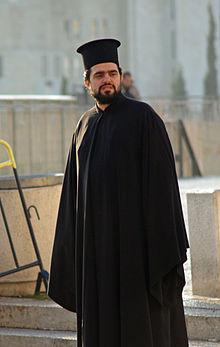
Kamilavka ( Greek kαμιλαύκα , καμηλαύκιον , καλυμμαύχιον , καλιμαυι ) - a headdress in the Orthodox Church in dark blue, purple or black colors in the form of a cylinder expanding upward, is a reward for priests [1] .
Initially, this is a hat like Turkish fez made of camel ( Greek: κάμηλος : hence the name) wool that was worn in the countries of the Middle East to protect it from the sun.
The Kamilavka was otherwise called the skyadium (from the Greek. Σκιά "shadow") and was worn by the Byzantine emperor and his dignitaries. Soon becoming the headdress of the clergy, the mantelpiece took on a distinctive shape (cylinder without fields, extended up). From the 15th century, a camilage (skiing ground) began to be used not only by priests, but also by protodeacons . In addition, it began to be made from more expensive material. In the Greek Orthodox Church, a kamilavka is given to priests upon ordination and is an integral part of the holy order .
In the Russian church, a kamilavka began to be used from the second half of the 17th century, replacing skufu . This innovation caused a protest from the defenders of antiquity and was not popular among the Russian clergy. In 1798, the kamilavka was assigned to the number of church awards [2] [3] .
The bastard, covered with basting , has become part of the monastic vestments and is called the hood .
Currently, the black Kamilavka is part of the liturgical vestments of the Hierodeacon and ( Riasophore monk - deacon ); monks in the priestly dignity are supposed to wear a hood .
The kamilavka is worn both during the service and outside it. Representatives of the white clergy can receive it only as a reward. Such fireplaces, unlike monastic ones, are usually purple . According to the church’s charter, clergymen don’t put on fireplaces only at certain points during worship. The metropolitans' kamilavki (like the entire hood) are white .
The Greek kamilavka differs from the Russian one in that it has small fields at the top of the cylinder; Russian Kamilavka has no fields at all. Balkan (Serbian, Bulgarian) kamilavki differ from Russians in lower height and diameter (the lower edge of the kamilavka is located above the ears).
Symbolically, the mantle means the crown of thorns of Jesus Christ and the mortification of the flesh.
At the Old Believers, “kamilavka” is called a skufu .
The headdress of the pope is camauro . Catholic priests wear a biretta .
Notes
- ↑ II. Hierarchical awards of the Russian Orthodox Church (inaccessible link) .
- ↑ Christianity: Encyclopedic Dictionary : in 2 volumes / chap. ed. S. S. Averintsev . - M .: Great Russian Encyclopedia , 1993. - T. 1: A - K .. - S. 672.
- ↑ Church Awards Archival copy of February 3, 2009 on the Wayback Machine .
Literature
- R. M. Kirsanova . Kamilavka // Costume in Russian artistic culture of the 18th - first half of the 20th centuries: Experience of the encyclopedia / ed. T. G. Morozova , V. D. Sinyukova . - M .: Great Russian Encyclopedia , 1995. - S. 112-113. - 383 p.: Ill. with. - 50,000 copies. - ISBN 5-85270-144-0 .
Links
- Kamilavka - articles in BES and explanatory dictionaries of Dahl and Ozhegov
- Russian Kamilavka