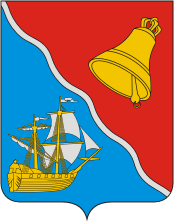
Coat of arms of the city of Polar in the Murmansk region of the Russian Federation .
| Coat of arms of the Polar | |
|---|---|
 | |
| Versions | |
 1990-1996 | |
| Details | |
| Approved by | September 26, 2001 |
| Early versions | March 1990 October 8, 1996 |
| GRG number | 890 |
| Team of authors | |
| Coat of arms idea | Igor Rozhkov, Peter Abarin |
| Painter | Peter Abarin |
| Computer design | Sergey Isaev |
| Justification symbolism | Galina Tunik |
The coat of arms was approved by Decision No. 50 of the Council of Deputies of the Municipal Formation Polyarny city on September 26, 2001 . [one]
The coat of arms is entered in the State Heraldic Register of the Russian Federation under registration number 890.
Content
Emblem Description
In a wavy scarlet and azure wavy beveled and azure shield, there is a golden bell in the left lanyard at the top left, and the converted golden ship with silver sails and pennants at the bottom right.
Justification of Symbols
The central figure of the coat of arms is a golden ship, symbolizing the Red Banner Kola Flotilla, the formations and units of which, which made a great contribution to the victory over fascist Germany , have glorious fighting traditions. In peacetime, the flotilla successfully masters the ships of new generations, during long voyages flawlessly fulfills the tasks of the Motherland in various parts of the World Ocean. New generations of Polar residents continue the chronicle of the city entering the second century with honor. The image of the ship among all the peoples of the coastal countries means the successful achievement of the goal: a ship under sail symbolizes a willingness to meet all kinds of surprises, to defend the national interests of the country, and soon find what is desired.
The bell symbolizes the church of Nicholas of Myra , the patron saint of sailors, whose bell ringing announced on June 23, 1899 the opening of the city and port of Alexandrovsk on the Kola Bay (now the city of Polyarny ), named after Emperor Alexander III .
The silver thread symbolizes the geographical location of the city of Polar on the Kola Bay.
Azure means that the city of Polar is a port city: all the activities of its inhabitants are connected with the sea. Azure in heraldry is a symbol of honesty, fidelity, and impeccability.
The red color in heraldry symbolizes courage, courage, love, generosity.
Gold is a sign of earthly and heavenly greatness. It means Christian virtues: faith, justice, mercy and humility, and worldly qualities: power, nobility, constancy, wealth.
Silver means purity, hope, truthfulness, nobility.
Coat of Arms History
On June 7, 1899, Emperor Nicholas II issued a Decree on the formation of a new city and port on Murman - Aleksandrovsk and approved the rules for the management of the city. By the same Decree, the Kola district of the Arkhangelsk province was renamed to Alexandrovsky. In 1925, the city was transformed into a village (from 1931 - Polyarnoye). In 1939, the status of the city was returned. All this time, the settlement continued to be a district center.
In March 1990, by the decision of the XII session of the City Council of People’s Deputies of the twentieth convocation, the coat of arms of the city of Polyarny was approved by draft Igor Dmitrievich Rozhkov . In the decision of the session of the Polyarny City Council on the approval of the coat of arms, it was written: “The coat of arms of the city has the form of a shield. The shield is divided into four parts by a “ wind rose ”, behind which is the globe. In the upper left part of the shield on a white background is the year the city was formed; in the upper right part against a dark blue background - northern lights ; in the lower left part on a dark blue background shows a Pomeranian boat ; in the lower right part on a green background is the image of the Navy flag, submarine and surface ship. The wind rose, the Globe, the Pomeranian boat - symbolize the rich historical past of the city, they say that the famous polar expeditions: E. Toll , V. Rusanov , G. Brusilov and other sailors left the Catherine’s harbor at the beginning of the 20th century . The Northern Lights recalls that the city is located in the Far North, beyond the Arctic Circle . The naval flag, submarine and surface ship - symbols of the powerful Red Banner Northern Fleet, indicate that the city of Polyarny is the cradle of the Northern Fleet , fanned with military glory and made a huge contribution to the victory over fascist Germany during the Great Patriotic War and is reliable protection of the northern borders of our country. Dark blue and white colors are symbols of the polar night and polar day . Green - ocean open spaces, the color of the sea wave. "
The adopted coat of arms had some inaccuracies in terms of the rules of land heraldry. [2]
In preparation for the celebration of the 100th anniversary of the founding of Polyarny, an initiative group headed by a full member of the All-Russian Heraldry Society, a representative of the Northern Fleet in the permanent heraldic group of the Russian Navy Yu.V. Rubtsov applied to the city administration. The group proposed to announce a competition to develop a new coat of arms of the city and after some time presented more than twenty designs of the coat of arms, which were submitted for discussion by residents. As a result of the competition, the joint project of the author of the first coat of arms of the Polar Rozhkov Igor Dmitrievich and the North Sea artist Pyotr Ivanovich Abarin won. [3]
A new version of the coat of arms was approved by the head of the Administration of the city of Polyarny on October 8, 1996 (Decree No. 752). The coat of arms was a shield of French form , crossed by a wave-shaped silver band slanted to the right. At the top of the scarlet (red) field is a golden bell. In the lower azure (blue) field is a military frigate sailing under the Andreevsky flag . The shield is crowned with a silver tower crown with three prongs. Behind the shield are two cross-laid gold anchors, intertwined with the Alexander (red) ribbon with the inscription “Polyarny” in gold below.
In 2001, the Union of Heraldists of Russia made the heraldic revision of the coat of arms and its description, after which the coat of arms of Polyarny was approved by the decision of the Council of Deputies of the municipality of the city of Polyarny (No. 50) dated September 26, 2001 and entered into the State Heraldry Register under No. 890. [4]
Author group: coat of arms idea: Igor Rozhkov (Polyarny). Peter Abarin ( Severomorsk ); heraldic refinement: Konstantin Mochenov ( Khimki ); substantiation of symbolism: Galina Tunik ( Moscow ); computer design: Sergey Isaev ( Moscow ).
Presumably, the city of Aleksandrovsk had an old coat of arms when it was part of the Arkhangelsk province. This is recorded in the appendix to the book of P. P. Winkler, “Coats of arms of cities, provinces, regions and towns of the Russian Empire, included in the complete collection of laws from 1649 to 1900,” but until now the description and drawing of this coat of arms have not yet been found in the heraldic literature.
May 5, 2008 By the Decree of the President of the Russian Federation, Polar was awarded the honorary title of the Russian Federation “ City of Military Glory ”. The coat of arms of Polar, made of bronze, is placed on the stele of "Military Glory", which was opened on October 18, 2010. [five]
On July 2, 2012, the Bank of Russia issued a commemorative coin with a face value of 10 rubles from the series “Cities of Military Glory”, the reverse of which depicts the arms of the Polyarny.
Notes
- ↑ Decision of the Council of Deputies of the Municipal Formation Polyarny city No. 50 dated September 26, 2001 on the emblem of the city.
- ↑ Yu.V. Rubtsov “Land heraldry of the Kola Peninsula” (part 2)
- ↑ Coat of arms of the city of military glory Polar. Archived November 24, 2011 on Wayback Machine
- ↑ Coat of arms of the municipality of the city of Polar.
- ↑ In the city of Polar, which is part of ZATO Aleksandrovsk, the stela "City of Military Glory" was opened (inaccessible link)
See also
- Polar flag
- Coats of arms of settlements of the Murmansk region
Sources
- Soboleva N.A. Coats of arms of Russian cities. - M., 1998
- Rubtsov Yu.V. Land heraldry of the Kola Peninsula // Murmansk Bulletin . - Murmansk, 2003.
- Winkler P.P. Coats of arms of cities, provinces, regions and posadas of the Russian Empire, included in the complete collection of laws from 1649 to 1900. - SPb., 1900