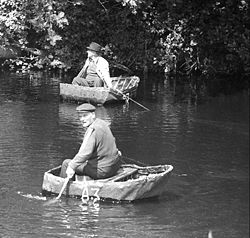
Korakl ( Wall. Cwrwgl , Eng. Coracle ) is a small traditional boat , used mainly on the rivers of Wales , but also in places in western and southwestern England , Ireland (especially on the Boyne River [2] ) and Scotland (especially on the River Spey ); similarly called similar boats of India , Vietnam , Iraq and Tibet [3] . The word corach comes from the Welsh cwrwgl , akin to the Irish and Gaelic curach , and has been registered in English since the 16th century . Other historical English spellings include corougle , corracle , curricle, and coricle .
Design

In shape, the coral resembles a half of a walnut shell . The supporting structure is a frame of willow rods intertwined with each other and fastened with plaits of willow bark. Initially, the frame was covered with animal skin or skin, for example, bovine or horse [4] , which was covered with a small layer of resin for greater waterproofness. Modern corals, regardless of the material of the frame, are covered with a dense fabric like tarpaulin , covered with several layers of bitumen varnish, or synthetic fabric. The force - free design and flat bottom allow you to evenly distribute your own weight and the weight of the load, so that the coral has a slight draft - often just a few centimeters, which makes it ideal for swimming on small rivers.
Corals differ in their construction and manufacturing technology, depending on which river they are made and used. The Taiwan river corals, for example, are flat-bottomed for swimming along the rapids, which are plentiful on the river in the summer, while the corals in Carmarthen are more rounded and deep because they are used in the tidal waters of the Taui River, on which there are no rapids. Tairai corals are made of locally produced wood without using nails - willow rods for the frame, which are intertwined, and hazel for fastening the frame in the upper part of the “side” by creating a braid, and Taui corals are made from sawing ash for a long time, and the frame fastened with copper nails. Mostly corals of the same type are used on the same river, but not always.
Such boats have been very successfully used for small-scale fishing; when driving by an experienced person, they are not much affected by the flow or random shocks of the fish, and it is easy to make maneuvers with a stroke in one hand and hold the net with the other. In fishing, one or two corals can be used. When using one, the net is tied with the free end to something on the shore, for example, a tree.
Another important feature of corals is their low weight, which allows them to be carried on their backs. LLwyth Dyn ei Gorwg - “man’s burden is his coral,” as they say in Wales.
History
Coracles have been used for many centuries and are mentioned in Roman sources of the 1st century BC. e.
These boats are one of the connecting links between modern Britain and its past. These ancient boats were used by the British until the invasion of the Romans, led by Julius Caesar , who described them, and even used them later in the Spanish campaign. [4] Coracles also served as protection for light infantry from throwing weapons.
During excavations of a Bronze Age burial site near Dalgeti Bay , the remains of a boat were discovered, which, presumably, was coral. More similar findings were found in Corbridge and near Ferribi [5] .
In the novel “ Treasure Island ”, Jim captured “Hispaniola” precisely on the coral built by Ben Gann , however, in the Russian translation, English coracle turned into “the shuttle of the ancient British.”
Modernity
Although corals have a very long history, and for a significant part of the 20th century they were of practical importance, these days they can be seen mainly in areas of West Wales that have tourist significance, rarely in Shropshire on the River Severn. In Sandorn , a suburb of Shrewsbury , on the plaque of The Coracle Pub is a man swimming in a coral along the river. The Wales of Taiwan and Taui are the best places to find corals, although they vary by river. In Taiwan, they are most often found between Kenart , Kilgerran and the village of Llehrid .
In 1974, Bernard Thomas from Llechrid crossed the English Channel in 13 and a half hours. This action was held to demonstrate that the bull boats of the Indian Mandan tribe from North Dakota can come from Welsh corals, allegedly brought during the resettlement by Prince Madog in the XII century [6] .
Over the years, Fred Davis, a Shrewsbury coral master builder recognized by local football fans, has offered an unusual service. During home football matches at the Shrewsbury Town Football Club, he swam in his coral next to the stadium along the River Severn and caught balls that fell into the water. Although Mr. Davis died many years ago, the legend about him is still associated with this club [7] .
Security
Because of their design, corals behave rather unstable. This is due to their slight precipitation, they “sit” on the water, as it were, and are not immersed in it, due to this they can also be easily carried away by the flow or gust of wind. The Coracle Society has published guidelines for the safe use of corals [8] .
Similar boats
The earliest reference to coral -like boats is the kuffa , which are also currently used in the Bible ( Exodus 2: 3 ).
Irish Currachs are similar in design but large-sized rowing boats used to date. Also used in western Scotland:
“A kurakh, or a boat made of leather and willow, may seem to be a very unreliable means for swimming on rough sea waters, but our fearless ancestors entrusted their lives to them, relying on the mercy of the weather. They are used in large numbers on the western islands of Scotland, and can be found in Wales . "The frame [in Gaelic] was called crannghail , now they call it dilapidated boats on Uiste ."
Original text"The curach or boat of leather and wicker may seem to moderns a very unsafe vehicle, to trust to tempestuous seas, yet our forefathers fearlessly committed themselves in these slight vehicles to the mercy of the most violent weather. They were once much in use in the Western Isles of Scotland, and are still found in Wales. The framework [in Gaelic] is called crannghail, a word now used in Uist to signify a frail boat. "- The Scottish-Gaelic Explanatory Dictionary " Dwelly's (Scottish) Gaelic Dictionary": Curach [9]
The Curraches on the Spey River are particularly similar to Welsh corals.
Other similar boats:
- Parisal - India
- Kuffa (or Kufa ) - Iraq
- Bull Boat - Native American Indian Tribes
- Ku-dru and Cova - Tibet
- Tung Tea - Vietnam
Tibetan ku-dru or kova boats are very similar to corals. Museum of Natural History Field , Chicago
Coral-like yak- skin boat, Tibet , 1938
Tibetan yak boat, 2006
Mandan Indian Bull Boat
Indian parisal
Indian parisal
Community
In the UK, there is the Coracle Society , created by Sir Peter Badge in 1990 . The initial five goals of society were:
- popularization of knowledge about corals, kurrah and similar boats, their construction and use, as well as the study and creation of collections;
- using all reasonable measures to support the use of corals in fishing, and encouraging regattas, races and similar events;
- publication of a newsletter as a way of communicating with anyone interested in corals;
- assistance in obtaining materials for the construction of corals;
- assistance in organizing shows, training courses, exhibitions, seminars and lectures related to corals [10] .
Many members of the community organize coral shows or training courses. Terry Kenny, the current chairman of the company, annually conducts several courses in the center of Green Wood. Every year, the company organizes many different events - a list of some of them can be found on the official website of the Coracle Society .
The Society participated in the Shrewsbury River Festival in 2005, which featured several corals of the River Severn. Every year, a regatta is organized, also called the Annual Coracle Regatta , which is held in Ironbridge for the August Bank Holiday . Each year, new participants come to this regatta with corals made at the Green Wood Center under the direction of Terry Kenny.
See also
- Corales of india
- Kurrach
- Kayak
- Umiak
Notes
- ↑ The two gentlemen in the photo are John (foreground) and Will Davis - the last real coral fishermen in Kenart. They both use the one-armed rowing method; The method allows you to control the boat during the descent. They carried their boats (along with fish) home, carrying them on their backs.
- ↑ Evans, E. Estyn. Irish Folk Ways . - Courier Dover Publications, 2000 .-- P. 233. - ISBN 9780486414409 .
- ↑ Korakli, ancient small boats (Inaccessible link) . Date of treatment February 21, 2010. Archived November 2, 1996.
- ↑ 1 2 " s: en: 1911 Encyclopædia Britannica / Coracle ", Encyclopædia Britannica (11th ed.)
- ↑ Proc Soc Antiq Scot, 112 (1982) 48-141, page 119. The excavation of an Early Bronze Age cemetery at Barns Farm, Dalgety, Fife. Trevor Watkins. With contributions by Mrs. Lin Barnetson, Miss AS Henshall, Dr Dorothy Lunt, Ms Ellen McAdam, Mrs Fiona Roe, Alan Shepherd and Dr CC McCawley
- ↑ Wales on Britannia: Facts About Wales & the Welsh (link not available) . Date of treatment February 21, 2010. Archived October 11, 2008.
- ↑ Gentlemen of the River by Phyllis Blakemore. Stenlake Publishing ISBN 9781840334739
- ↑ Coracle Society safety guidelines
- ↑ Dwelly's (Scottish) Gaelic Dictionary
- ↑ Rules of the British Coracle Society (Coracle Society constitution - available from the Society)
Literature
- Hornell, James . British Coracles // Mariner's Mirror. - 1936. - vol. XXII. - C. 5-41, 261-304 - ISSN 0025-3359
- Badge, Peter . The Coracles of the World. - Gwasg Carreg Gwalch, 2009 .-- 216 p. - ISBN 978-1-84-527255-5
- Jenkins, J. Geraint . The coracles. - Gwasg Carreg Gwalch, 2007 .-- 140 p. - ISBN 978-1-84-527045-2
- Thatcher, Dora . Coracle Builders. - Hodder & Stoughton Ltd, 1964 .-- 128 p. - ISBN 978-0-34-003283-1
- Watkins, Trevor . A prehistoric coracle in Fife // International Journal of Nautical Archeology. - 1980. - vol. 9, iss. 4. - C. 277-286 - ISSN 1057-2414
- Edmondson, Colin . Colin's Coracle, or How to Bodge a Boat. - 12 p.
- Jenkins, J. Geraint . Nets and Coracles. - David & Charles PLC, 1975 .-- 352 p. - ISBN 978-0-71-536546-5
- Stanley Joseph. Craft a Coracle . Mother Earth News (April / May 2003). Archived on April 18, 2012.
Links
- Coni Richards, a traditional coral builder
- Official site of the Coracle Society
- Canart Falls National Coral Center
- The Coracle Maker - Coral Builder Terry Kenny
- Coral World
- BBC Legacies - BBC Coral Article
- Coral Building Courses in Green Wood Center
- Corals of wales
- Coral Building Courses in Assington Mill, Suffolk
- Annual Coracle Regatta