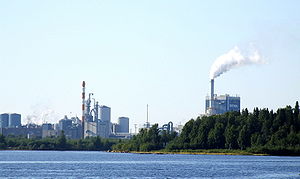
Sulphate process ( kraft process ) is one of the leading industrial methods of alkaline wood delignification for the production of cellulose . The main stage of this thermochemical process, sulphate cooking, consists in treating wood chips with an aqueous solution containing sodium hydroxide and sodium sulfide . Cellulose produced by the sulfate method is called sulfate cellulose .
The advantage of the method is the possibility of using practically all types of wood in it, and the regeneration of chemicals makes the process very economically efficient.
In the process of sulfate cooking, in addition to cellulose itself, a lot of waste and by-products are formed, from which fodder yeast , sulfate lignin , sulfate soap , phytosterol , tall oil , rosin , sulfur compounds, methanol , turpentine are obtained.
Unlike another alkaline method of production, soda , where only sodium hydroxide is used, the sulfate process allows to obtain cellulose of greater mechanical strength.
The sulfate method is currently the most common pulp production method in the world.
Sulfate Process Terms and Definitions
- White alkali is an aqueous solution intended for pulping and containing sodium hydroxide (NaOH) and sodium sulfide (Na 2 S) as the main components.
- Green alkali is a green solution formed by dissolving inorganic melt, which is obtained after burning black alkali in a regenerative furnace.
- Black or sulphate alkali - waste solution formed after the completion of pulping and is a complex mixture of organic and inorganic substances;
- Cooking hydraulic module - the ratio of the total volume of liquid in the cooking process to the mass of absolutely dry wood;
- Caustization is the process of clarifying (regenerating) a green alkali into a white alkali .
- Blow - off is a periodic process of forced removal of a gas-vapor mixture from a digester to reduce pressure, isolate valuable organic by-products, remove gaseous waste, and utilize heat.
- Characteristics of the cooking solution :
- all alkali - all sodium salts of white alkali ;
- active alkali - NaOH + Na 2 S;
- titratable alkali - NaOH + Na 2 S + Na 2 CO 3 ;
- effective alkali - NaOH + ½Na 2 S;
- equivalent unit - the universal equivalent mass of NaOH or Na 2 O, to which the concentration of sodium salts of the cooking solution is recalculated. For example, the content in solution of 80 g of NaOH corresponds to 62 g in units. Na 2 O.
- sulfide ( degree of sulfide , C ) - a characteristic of the composition of the cooking solution, which is the ratio of sodium sulfide to active alkali and calculated in equivalent units:
- activity ( degree of activity , A ) - a characteristic of the composition of the cooking solution, which is the ratio of the active alkali to the entire alkali and calculated in equivalent units:
- recovery ( degree of recovery , B ) is a characteristic of the composition of the regenerated cooking solution and showing the degree of reduction of sodium sulfate to sodium sulfide:
- caustization ( degree of causticization , K ) is a characteristic of the efficiency of the process of obtaining white alkali and showing the degree of conversion of sodium carbonate to sodium hydroxide:
- Cellulose Specific Features :
- the degree of delignification , or the degree of penetration - a characteristic that describes the absolute or relative (compared to wood) residual level of lignin in cellulose. Usually, measured in Kappa numbers and determines the relative delignification by the amount of 0.1 n potassium permanganate solution required for the oxidation of lignin in 1 gram of an absolutely dry cellulose sample under conditions and according to the method approved by the current standard [K 1] ;
- degree of grinding , or degree of grinding - a characteristic of the quality of grinding of cellulose fiber. Usually, measured in arbitrary degrees Shopper-Riegler (° SH) and determined by special instruments.
History
Kraft process got its name - sulfate cooking from the word dumb. Kraft , meaning “ strength ” - long-fiber sulfate cellulose is characterized by enhanced mechanical characteristics.
The beginning of the use of alkaline cooking using sodium hydroxide for the production of cellulose dates from 1853-1854. In 1879 [K 2], German engineer Dahl ( German CF Dahl ) proposed adding sodium sulfate (Na 2 SO 4 ) to the alkaline regeneration system. As a result of this innovation, the cooking solution began to contain a significant amount of sodium sulfide (Na 2 S), which had a positive effect on the yield and quality of the resulting pulp [1] : [p. 30] . The invention in the 30s of the XX century by Tomlinson ( born GH Tomlinson ) of a regeneration boiler was one of the decisive factors for the promotion and further technological development of the sulfate process [2] : [p. 105] .
For a long time, the sulfite process was the leading technology for the production of cellulose, while the share of the sulfate method in the world remained quite low (25% in 1925 ), which is mainly associated with the brown color of the resulting fibrous prefabricated product. Since the 60s of the XX century, the growth rate of the sulfate process exceeded the growth of sulfite production . Gradually, the increase in the consumption of high-strength grades of paper and paperboard ( cardboard for flat layers , corrugated paper , bag paper , etc.), as well as the development and improvement of bleaching processes, led to the dominance of the Kraft process [2] : [p. 105] [3] : [p. 6] .
The first producer of sulfate pulp in North America was the Brompton Pulp and Paper Company , which opened a plant in 1907 in Canada [4] .
The first sulphate plants in the Russian Empire were straw mills, launched in 1910 in Poninki and Penza . During the First World War , the first plant for the production of sulfate pulp from wood was built in the Urals. In Soviet Russia, an active growth in pulp and paper production occurred in the prewar years. From 1935 to 1939 large industrial enterprises were launched: Solombalsky , Mari and Segezha PPM [5] : [p. 7] .
According to the results of 2015 , the largest companies in Russia in the production of sulfate pulp are the Ilim Group , Mondi Syktyvkar Timber Processing Complex and Arkhangelsk PPM [6] .
As of 2000, the global production of vegetable fiber semi-finished products was as follows [7] :
| Fiber category | World production, million tons |
|---|---|
| Cellulose | 131.2 |
| Sulphate pulp | 117.0 |
| Sulphite pulp | 7.0 |
| Half cellulose | 7.2 |
| Pulp | 37.8 |
| Other plant fiber | 18.0 |
| Total primary fiber | 187.0 |
| Recycled fiber | 147.0 |
| Total fiber | 334.0 |
General characteristics of the sulfate process
Properties and features of sulfate pulp
The properties of sulfate pulp are determined by the physicochemical processes of sulfate cooking, as well as the conditions and duration of its implementation.
Compared to sulphite cellulose , sulphate cellulose contains less easily hydrolyzable hemicelluloses and a significant amount of pentosans (up to 12%). It has less tarry and mineral substances, fats; it has a lower acidity. On the other hand, due to its brown color, sulfate cellulose requires more complex bleaching, in addition, its yield with an equal degree of penetration is 3-4% lower [5] : [p. 7] .
Sulphate pulp has higher paper-forming properties: its fibers are more flexible, it has better mechanical properties. Paper from it is more dense, heat-resistant, less prone to deformation. At the same time, it is precisely these properties that hinder the swelling and grinding of sulfate fiber during processing [3] : [p. 6] .
Products made from sulfate cellulose have the best dielectric properties, which is used for the production of electrical insulating types of paper [9] .
Sulphate pulp is usually produced in the following forms [5] : [p. 7-8] :
- softwood sulfate softwood - designed for the production of high-strength packaging and packaging types of paper and cardboard ( bag paper , corrugated paper , cardboard for flat layers , etc.), electrical paper ( cable paper , electrical insulation paper , etc.), cardboards for technical purposes ;
- unbleached sulfate pulp from mixed wood species - used by analogy with softwood pulp;
- bleached softwood pulp - designed for the production of high quality paper for printing, writing and drawing ( document paper, cartographic paper, drawing paper, offset paper , etc.); label paper , glassine , base paper for sanitary purposes , topliner , printing papers and cardboards;
- bleached sulfate pulp from deciduous wood - intended for the production of base paper for photo paper , filter paper , decorative base paper for facing materials, in writing and printing paper compositions, sanitary base paper , printing papers and cardboards;
- cellulose sulfate perhydrolysis - designed for the production of viscose cord and technical yarns and high modulus fibers.
Sulphate Process Comparisons
The dominant position of the sulfate process compared to other cooking methods, in addition to the high strength characteristics of sulfate pulp, is explained by the following advantages [10] : [p. 348] :
- lower requirements for the species composition and quality of wood raw materials; use of deciduous and coniferous wood, as well as, in part, wood waste;
- short cooking time;
- well-established processes of heat and cooking solution recovery, waste minimization, as well as the production of valuable by-products.
As disadvantages are noted [10] : [p. 348] :
- the formation of characteristic foul smelling gas emissions;
- low yield of cellulose;
- the dark color of unbleached pulp and the difficulties of its subsequent bleaching;
- high initial capital costs for new production.
Comparative characteristics of various pulping processes are given in table [2] : [p. 108, 125] :
| Method | process pH | Active cation | Active anion | Cooking temperature, ° C | Cooking time, hours | Output, % (x-for coniferous, l-for deciduous wood) |
|---|---|---|---|---|---|---|
| Sour (bi-) sulphite cooking | 1-2 | H + , Ca 2+ , Mg 2+ , Na + , NH 4 + | HSO 3 - | 125-145 | 3-7 | 45–55 (x) |
| Bisulfite cooking | 3-5 | H + , Mg 2+ , Na + , NH 4 + | HSO 3 - | 150-170 | 1-3 | 50–65 (x) |
| Two stage sulphite cooking stage 1 stage 2 | 6-8 | Na + | HSO 3 - , SO 3 2− | 135-145 | 2-6 | 50-60 (x) |
| Three-stage sulphite cooking stage 1 stage 2 stage 3 | 6-8 | Na + | HSO 3 - , SO 3 2− | 120-140 | 2-3 | 35–45 (x) |
| Neutral Sulphite Cooking | 5-7 | Na + , NH 4 + | HSO 3 - , SO 3 2− | 160-180 | 0.25-3 | 75—90 (l) |
| Alkali sulphite cooking | 9-13 | Na + | OH - , SO 3 2− | 160-180 | 3-5 | 45-60 (x) |
| Natron cooking | 13-14 | Na + | OH - | 155-175 | 2-5 | 50–70 (l) |
| Sulphate Cooking | 13-14 | Na + | OH - , SH - | 155-175 | 1-3 | 45–55 (x) |
A comparison of the sulfite and sulfate process for the yield of pulp for coniferous and deciduous wood is presented below [2] : [p. 110] :
| Mass component | Sulphite process | Sulphate process | ||
|---|---|---|---|---|
| Softwood pulp | Hardwood pulp | Softwood pulp | Hardwood pulp | |
| General exit including: | 52% | 49% | 47% | 53% |
| Cellulose | 41% | 40% | 35% | 34% |
| Glucomannan | five % | one % | four % | one % |
| Xylan | four % | five % | five % | sixteen % |
| Lignin | 2% | 2% | 3% | 2% |
| Extractives | 0.5% | one % | 0.5% | 0.5% |
General scheme for the production of pulp by the sulfate method
The general block diagram of the production of cellulose by the sulfate method is shown in Figure [3] : [p. 8] :
At the first stage, wood (usually wood balances ) undergoes the preparation process , which includes the following operations (enlarged) [11] :
- sawing;
- ham;
- chopping into chips and its subsequent sorting.
Prepared chips enter the cooking stage . Sulphate pulp cooking is carried out continuously or batchwise in special digestion boilers of large capacity (up to 400 m³). A cooking liquor consisting of white liquor and, in part, black liquor from previous brews is poured into the boiler along with chips. The initial concentration of active alkali is 50-60 g / dm³, the final 5-10 g / dm³. The hydrogen indicator of cooking is set not lower than 9-10. Cooking hydraulic module: 4 (for a batch process) and 2.5-3 (for a continuous process). Cooking is carried out at a maximum temperature of 150-170 ° C, a pressure of 0.25-0.80 (sometimes up to 1.2) MPa, for 1-3 hours, depending on the nature of the feedstock and the type of cellulose obtained. In the process of cooking, two blow-offs are carried out: the first - the turpentine - goes to obtain turpentine ; the second - final - contains mainly odorous sulfur compounds. After separation of valuable organic products, blow off steam is sent to a heat recovery unit [12] .
At the end of cooking, the pulp is fed to the sorting and washing stage, while part of the black liquor is taken immediately for feeding to the residue. During the sorting process, solid waste (lack of penetration) is separated from the pulp. During washing, the diluted black liquor is separated, which partially enters the evaporation stage (8-12% solids), and partially returns to the digester (1.5-8% solids) to dilute the white liquor. The heavily diluted black liquor is discharged to a sewage treatment plant . The washed pulp, depending on the purpose of the liquid stream, enters the thickening stage for subsequent bleaching, dehydration and pressing to obtain market pulp or further casting into paper or cardboard [12] .
Before the evaporation stage, the black liquor is sent for filtration to separate the fiber, and then it is strengthened by the already evaporated alkali to a concentration of 22-24% to reduce foaming during evaporation [13] : [p. 144] . After this, the crude sulfate soap , a dark brown viscous liquid with a characteristic odor, is separated from the black alkali by settling. For 1 ton of cellulose, it forms from about 35-50 kg (for aspen and birch wood) to 100-120 kg (for pine wood) [14] .
Alkali evaporation takes place at a multi-case vacuum-evaporation station to a dry matter concentration of 55–80%. One stripped off alkali goes to burning in a soda recovery boiler unit (SRK) [15] .
Before incineration, fresh sodium sulfate is added to the alkali to compensate for alkali and sulfur losses in the IBS. Under the influence of high temperature (1000–1200 ° C), organic compounds burn up, forming carbon and carbon dioxide . Carbon reduces sodium sulfate to sulfide, and carbon dioxide reacts with alkali to form sodium carbonate [3] : [p. 9] :
During regeneration, a large amount of heat and water vapor is released.
It should be noted that currently there are pilot and laboratory technologies that suggest in the future to combine black alkali regeneration with the production of synthesis gas, which, in turn, is supposed to be used to produce automotive biofuel ( “bio-dimethyl ether” ) [16] .
The solid residue after IBS is dissolved in a weak white alkali. The resulting solution has a dirty green color and is called green alkali. In the literature there is no indication of which substances in the solution determine its green color.
At the next stage, the green lye is causticized by adding slaked lime [3] : [p. 9] :
The obtained white alkali is returned again to the cooking stage, and the precipitate of calcium carbonate is calcined at 1100–1200 ° C in lime regeneration furnaces to produce slaked lime [3] : [p. 10] :
Composition and characteristics of the cooking solution
The main components of the cooking solution before cooking (white liquor) are hydroxide and sodium sulfide ; also in much smaller amounts the composition of the solution includes other sodium salts: Na 2 CO 3 , Na 2 SO 4 , Na 2 SO 3 , Na 2 S 2 O 3 , Na 2 S x , NaAlO 2 , Na 2 SiO 3 [3 ] : [p. 10] .
During cooking, the composition of the cooking solution changes significantly - the concentration of active alkali is reduced by almost 10 times, and numerous organic compounds and sodium salts of mineral and organic acids appear in the solution. However, the acidity of the medium remains almost unchanged, as it is supported by partial and complete hydrolysis of sodium salts [3] : [p. 11] :
Depending on the degree of delignification, 7–10 m³ (according to other sources, 8–12 m³ [17] ) of black alkali is formed per 1 ton of cellulose, and the mass fraction of solids before evaporation in it is 10–15% [12] . The density of the black liquor before evaporation is about 1.05–1.10 g / m³, the boiling point is 101 ° C, and the viscosity is 1.52–10 −3 Pa · s [17] .
Organic components of alkali make up at least 65%. Among them, the main (in terms of absolutely dry weight) are lignin (up to 50%), products of the destruction of poly- and monosaccharides , phenols , organic acids ( glycolic , lactic , β-glucoisosaccharic, α-hydroxybutyric, formic , acetic , propionic , butyric , valerianic , etc.), organosulfur compounds [17] .
| Typical white alkali composition [8] : [p. 113] : | An example of the composition of black alkali [18] [K 4] : |
| Compound | Concentration, g / liter | |
|---|---|---|
| in units NaOH | connections | |
| Sodium hydroxide | 90.0 | 90.0 |
| Sodium sulfide | 40,0 | 39.0 |
| Sodium carbonate | 19.8 | 26.2 |
| Sodium sulfate | 4,5 | 8.0 |
| Sodium thiosulfate | 2.0 | 4.0 |
| Sodium sulfite | 0.6 | 0.9 |
| Other components | - | 2.5 |
| All alkali | 156.9 | 170.6 |
| Active alkali | 130.0 | - |
| Effective alkali | 110.0 | - |
| Sulfide | 47.1 | 19.7 |
| Component | Content% |
|---|---|
| Organic compounds | 78.0 |
| Lignin | 37.5 |
| Sugar Acids | 22.6 |
| Aliphatic acids | 14,4 |
| Fats and resin acids | 0.5 |
| Polysaccharides | 3.0 |
| Inorganic compounds | 22.0 |
| Sodium hydroxide | 2,4 |
| Sodium hydrosulfide | 3.6 |
| Sodium and Potassium Carbonates | 9.2 |
| Sodium sulfate | 4.8 |
| Other sodium salts | 1,0 |
| Other compounds | 0.2 |
Chemistry of sulfate pulping
Lignin Transforms
In the process of cellulose cooking, the most important chemical process is the destruction of lignin macromolecules, which leads to its release from wood and the transition to a soluble form. Under the influence of active reagents and temperature, bound wood lignin is cleaved and accumulated in the cooking solution. The reactivity of various forms of lignin is determined primarily by whether the phenolic moieties of the molecules are esterified or not. In general, the reactivity of free phenolic fragments is significantly higher than other structural elements of lignin. Under conditions of sulfate cooking in the presence of two strong nucleophilic particles, HS - and OH -, the destruction of C – O – C bonds occurs very efficiently [8] : [p. 164] :
| Scheme 1. |
In parallel with the processes of destruction, condensation reactions of free OH groups occur: both phenolic and aliphatic. The lignin reaction in an alkaline medium is accompanied by the formation of quinonemethide structures (intermediate in Scheme 1), which are easily alkylated or acylated to form carboxymethyl or benzyl esters, so that further polycondensation or polymerization reactions do not proceed [19] .
Thus, the main transformations of lignin are:
- destruction of the structure of the cell wall and the release of OH– groups;
- destruction of lignin macromolecules into low molecular weight fragments;
- alkylation or acylation of liberated OH– groups.
Polysaccharide Conversion
Sulphate Pulping Technology
Periodic Sulphate Cooking
Continuous Sulphate Cooking
The continuous technological process of sulphate pulping is more modern and cost-effective compared to the batch process, which was widely used in the beginning and middle of the 20th century. The main advantages of the process are:
- exclusion from the process of technological operations for loading and unloading digesters;
- reduction in production and storage space;
- lower consumption of coolants and their stable consumption over time;
- reduction of heat recovery costs;
- the ability to fully automate processes.
The main disadvantages and features of the process are:
- the method can be effectively applied only for large-scale production;
- higher requirements for the quality of the feedstock, the stability of the parameters of the steam and the cooking solution;
- more technologically sophisticated equipment operation.
The general scheme of the continuous cooking process can be described by the example of the existing production - OJSC “Mondi SLPK” . As of January 1, 2017, the plant located in the Komi Republic has a standard scheme for the continuous production of sulfate pulp with a capacity of about 1 million tons per year.
Actually pulping is carried out in three cooking plants of the Kamyur type. The cooking temperature is 130–155 ° C for leaf and 140–165 ° C of softwood pulp. The concentration of the active alkali is 100–103 g of Na 2 O / L, the sulfide content of the white alkali is 30–35%. The output of cellulose in the stream is 48-52%.
The influence of various factors on the process of sulphate pulping
Sulfate Process Modifications
See also
- Natron process
- Sulphite process
- Cellulose
- List of countries producing cellulose
Comments
- ↑ In Russia, the method for determining the degree of delignification of cellulose is regulated by GOST 10070-74 (ISO 302-81).
- ↑ In some sources, the year 1884 is indicated as the opening date of the sulfate process. In fact, this is the year Dahl patented his discovery five years earlier.
- ↑ Kraftliner in a professional environment is called cardboard for flat layers of corrugated cardboard made of primary fiber (cellulose). Cardboard made from recycled materials (waste paper) is called a testliner . In addition, we note that the saturated brown color typical of sulfate board is often used to color chipboards with dyes to improve presentation.
- ↑ A particular case of the composition of black alkali formed after cooking birch wood in terms of a completely dry composition is given.
Notes
- ↑ Koverninsky I.N., Komarov V.I., Tretyakov S.I., Bogdanovich N.I., Sokolov O.M., Kutakova N.A., Selyanina L.I. Integrated chemical processing of wood / Edited by prof. . I.N. Koverninsky. - Arkhangelsk: Publishing House of the Arkhangelsk State Technical University, 2002. - S. 30-50. - ISBN 5-261-00054-3 .
- ↑ 1 2 3 4 Sjöström E. Wood Chemistry. Fundamentals and Applications. - Academic Press, 1981. - 223 p. - ISBN 0-12-647480-X .
- ↑ 1 2 3 4 5 6 7 8 Ivanov Yu. S. Modern Methods for Cooking Sulphate Pulp: A Training Manual. - SPb. : GOU VPO SPbGTURP, 2005 .-- 63 p.
- ↑ Subsidiary Page 2. Composition of the Postage Stamp and Factors Involved in the Removal of Stamps from Paper (pdf). Preservation and Care of Philatelic Materials . The American Philatelic Society. Date of treatment February 21, 2013. Archived March 12, 2013.
- ↑ 1 2 3 Polyakov Yu. A., Roshchin V.I. Production of sulfate cellulose. - M .: "Forest industry", 1979. - 376 p.
- ↑ Production of pulp and paper products in Russia, thousand tons // Pulp and Paper Mill Express. - 2016. - No. 3 (620) . - S. 2 .
- ↑ Sixta H. Introduction // Handbook of Pulp / Edited by Herbert Sixta. - Weinheim: Wiley-VCH Verlag, 2006. - T. 1. - P. 9. - ISBN 3-527-30999-3 .
- ↑ 1 2 3 Sixta H., Potthast A., Krotschek AW Chemical Pulping Processes // Handbook of Pulp / Edited by Herbert Sixta. - Weinheim: Wiley-VCH Verlag, 2006. - T. 1. - P. 109-391. - ISBN 3-527-30999-3 .
- ↑ Flate D.M. Paper technology. - M .: "Forest industry", 1988. - S. 16. - ISBN 5-7120-0062-8 .
- ↑ 1 2 Fengel D., Wegener G. Wood (chemistry, ultrastructure, reactions) / Per. from English. - M .: "Forest industry", 1988. - 512 p. - ISBN 5-7120-0080-6 .
- ↑ Koverninsky I.N. Fundamentals of the technology of chemical processing of wood. - M .: "Forest industry", 1984. - S. 24.
- ↑ 1 2 3 Processing of sulfate and sulfite alkalis / Edited by prof. B.D. Bogomolov and prof. S.A. Sapotnitsky. - M .: "Forest industry", 1989. - S. 9-15. - ISBN 5-7120-0160-8 .
- ↑ Novikova A.I. Upgraded Sulphate Pulping: A Tutorial. - St. Petersburg: GOUVPO St. Petersburg State Technological University of Plant Polymers, 2006. - 162 p. - ISBN 5-230-1474-6.
- ↑ Sulphate soap // Chemical Encyclopedia / Editor-in-chief I. L. Knunyants. - M .: "Soviet Encyclopedia", 1988. - T. 4. - S. 903.
- ↑ Production of sulfate pulp. General information . New reference chemist and technologist. Raw materials and products of the industry of organic and inorganic substances (part II) . ChemAnalitica.com (April 1, 2009). Date of treatment February 27, 2010. Archived April 18, 2012.
- ↑ Landälv I., Löwnertz P. Woods to Wheels (English) // Pulp & Paper International (PPI). - 2010 .-- Vol. 52 , no. 2 . - P. 19-22 .
- ↑ 1 2 3 Sulfate alkali // Chemical Encyclopedia / Editor-in-Chief I. L. Knunyants. - M .: "Soviet Encyclopedia", 1988. - V. 4. - S. 903-904.
- ↑ Birch black liquor composition (VTT ) . KnowPulp. Date of treatment February 26, 2010. Archived on April 18, 2012.
- ↑ Bazarnova N.G. Chemical transformations of the main components in wood in the processes of o-alkylation and esterification // Chemistry of plant raw materials. - 2001. - No. 2 . - S. 47–55 .
Literature
Russian-speaking
- Ivanov Yu.S. Modern methods of cooking sulfate cellulose: a Training manual. - SPb. : GOU VPO SPbGTURP, 2005 .-- 63 p.
- Koverninsky I.N., Komarov V.I., Tretyakov S.I., Bogdanovich N.I., Sokolov O.M., Kutakova N.A., Selyanina L.I. Production of sulfate pulp // Integrated chemical processing of wood / Edited by prof. I.N. Koverninsky. - Arkhangelsk: Publishing House of the Arkhangelsk State Technical University, 2002. - S. 30-50. - ISBN 5-261-00054-3 .
- Marshak A.B. Cellulose sulphate production technology. Tutorial. - L .: LTA, 1977 .-- 112 p.
- Nepenin Yu.N. Sulphate pulp technology // Pulp technology. In 3 volumes. - 2nd ed. - M .: "Forest industry", 1990. - T. 1. - 600 p.
- Novikova A.I. Upgraded Sulphate Pulping: A Tutorial. - St. Petersburg: GOUVPO St. Petersburg State Technological University of Plant Polymers, 2006. - 162 p. - ISBN 5-230-1474-6.
- Polyakov Yu.A., Roshchin V.I. Sulphate pulp production. - M .: "Forest industry", 1979. - 376 p.
English
- Alkaline processes // Chemical Pulping / Edited by Johan Gullichsen and Carl-Johan Fogelholm. - Fapet Oy, 1999. - T. 1. - P. 38-85. - 1180 p. - ISBN 978-9525216066 .
- Alkaline pulping / Edited by Michael J. Kocurek, Thomas M. Grace, E. Malcolm. - Third edition. - Montreal / Atlanta: Tappi Press, 1989 .-- T. 5 .-- 637 p. - (Pulp & Paper Manufacture). - ISBN 978-091989371-9 .
- Kraft Pulping / Edited by A. Mimms, MJ Kocurek, JA Pyatte, and EE Wright. - 2nd Revised edition. - Tappi Press, 1997 .-- 181 p. - ISBN 978-0898523225 .
- Sixta H., Potthast A., Krotschek AW Chemical Pulping Processes // Handbook of Pulp / Edited by Herbert Sixta. - Weinheim: Wiley-VCH Verlag, 2006. - T. 1. - P. 109-391. - ISBN 3-527-30999-3 .
Links
- Sulphate pulp production . Wood chemicals . TehnoInfa.Ru. Date of treatment September 15, 2010. Archived April 18, 2012.
- Chemical pulp production . KnowPulp. Date of treatment February 20, 2010. Archived on April 18, 2012.
- Cellulose Formula (Pdf). Corporation Magazine, No. 2 (07) of 2007 . The Ilim Group. Date of treatment February 27, 2010. Archived April 18, 2012.