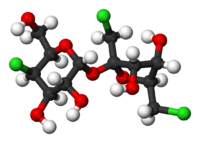
Sucralose (trichlorogalactosaccharose) is an intensive thermostable sweetener developed by the English company Tate & Lyle in 1976, which can be used in a wide range of food products - from drinks to bakery products. Sucralose is obtained from regular sugar and has taste characteristics similar to sugar.
| Sucralose | |
|---|---|
 | |
 | |
| Are common | |
| Systematic name | 1,6-dichloro-1,6-dideoxy-β- D- fructofuranosyl-4-chloro-4-deoxy-α- d- galactopyranoside |
| Traditional names | trichlorogalactosaccharose |
| Chem. formula | C 12 H 19 Cl 3 O 8 |
| Physical properties | |
| Molar mass | 397.64 g / mol |
| Thermal properties | |
| T. melt. | 125 ° C |
| Chemical properties | |
| Solubility in water | 28.3 g / 100 ml |
| Classification | |
| Reg. CAS number | 56038-13-2 |
| PubChem | |
| Reg. EINECS number | |
| Smiles | |
| Inchi | |
| Codex Alimentarius | |
| Chebi | |
| ChemSpider | |
Sucralose was discovered in 1976 by researchers Professor Leslie Hugh and his assistant Shashikant Phadnis at Queen Elizabeth College (now part of Queen's College London ). In researching how to use sucrose as an intermediate chemical in non-traditional areas, Pkhadnis was given the task of testing chlorinated sugar compounds. Phadnis, because of his imperfect English, understood that he was asked to taste ( English taste ), which he did. He found the mix exceptionally sweet.
Content
Properties
Sucralose ( food supplement E955) has a pleasant sweet taste, it is highly soluble in water, highly stable in a wide range of drinks and food products. Sucralose is completely stable during heat treatment - pasteurization and sterilization used in the manufacture of yoghurts and mashed potatoes, it retains its sweetness in products even after storage for a year. Sucralose is highly synergistic with fructose and invert syrups .
Instead of three hydroxyl groups, sucralose contains three chlorine atoms. Because of this, the body is not able to assimilate sucralose. Moreover, it is 600 times sweeter than sucrose; aspartame is 180-200 times sweeter than sucrose.
Melting point - 125 ° C (398 K).
Effect on the body
Sucralose was approved in Canada in 1991, and then in 1998 in the United States, where it was sold under the name Splenda. Before that, over 13 years Sucralose passed more than a hundred toxicity tests, which did not reveal any carcinogenic properties and side effects on reproductive function, nervous system and genetics.
Research sponsored by the manufacturer has determined an approximate daily intake of sucralose at 1.1 mg per kilogram of body weight. The optimal intake without negative side effects was 16 mg per kilogram of body weight, and the maximum allowable - 1500 mg [1] . In experiments that favored sucralose, animals received various doses of the sweetener over various time periods using a variety of administration methods — orally, via a catheter, and intravenously (2) [ clarify ] .
No adverse effects were detected in the experimental mice even at doses of 16,000 mg per kilogram of body weight; in rats, similar results were obtained with 10,000 mg (3) [ clarify ] . The latter is equivalent to consuming 75 grams of sucralose per day by a 75 kg person. However, against the background of consumption of sucralose in an amount of 5% of the total amount of food, the rats ate less, obviously because such a huge amount of sweetener made the food tasteless. A decrease in appetite, in turn, led to a decrease in the size of the thymus gland. Opponents of sucralose cite this evidence in support of the argument about the immunosuppressive effects of sucralose, because the immune T cells are produced in the thymus gland.
However, neither a decrease in appetite nor a decrease in the thymus gland occurs in humans. True, this did not stop some media. [ what? ] against warnings against the use of sucralose, which supposedly weakens the immune system and leads to the development of cancer. No evidence was given in favor of such statements, except for the incorrect results of experiments on animals in this case.
The human body removes about 85% of sucralose consumed, absorbing only 15%. What is absorbed is excreted from the body during the day - sucralose does not linger in the human body. It cannot enter the brain, cross the placental barrier in pregnant women and enter breast milk. Doses of sucralose do not interact with other nutrients and do not promote the release of insulin. Research [ what? ] showed its absolute safety for diabetics.
Opponents [ what? ] Sucralose states that not enough time has passed since the start of Sucralose use to reveal its effect on health. However, sucralose has been consumed in Canada since 1991 - any side effects would have manifested itself long ago, but nothing of the kind has been observed. In addition, the doses used in animal experiments were equivalent to human consumption of a sweetener for 13 years.
Study [ what? ] , the results of which were published several years ago [ when? ] , compared the effects of consumption of artificial sweeteners, including sucralose and sugar (3) [ clarify ] . The experiment lasted 10 weeks and was conducted on a group of overweight people who used either sugar or sugar substitutes. Participants in the experiment who consumed a large amount of sugar (28% of all energy) showed an increase in energy [ clarify ] body weight, fat mass and blood pressure, which was not observed among consumers of artificial sweeteners.
Notes
- ↑ Baird, IM; Shephard, NW; Merritt, RJ; Hildick-Smith, G. Repeated dose study of sucralose tolerance in human subjects (Eng.) // Food Chemical Toxicology. - 2000. - Vol. 38 (Supplement 2) . - P. S123 – S129 . - DOI : 10.1016 / S0278-6915 (00) 00035-1 . - PMID 10882825 .
Links
- Baird, I. M., et al. (2000). Repeated dose study of sucralose tolerance in human subjects. Food Chem. Toxicol. 38: S123 — S129.
- Grice, H. C., et al. (2000). Sucralose an overview of the toxicity data. Food Chem. Toxicol. 38: S1 — S6.
- John, B. A., et al. (2000). The pharmacokinetics and metabolism of sucralose in the mouse. Food Chem. Toxicol. 38: S107 — S110.
- Raben, A., et al. (2002). Sucrose compared with artificial sweeteners: different effects on an libitum food intake and bodyweight after 10 weeks of supplementation in overweight subjects. Am. J. Clin. Nutr. 76: 721-729.