French in Canada is one of Canada 's two official languages , along with English . The total number of French-speaking Canadians is about 7.2 million (20.6% of the population; as of 2016) [1] . French-speaking residents of Canada in censuses are counted as francophones (formerly French Canadians ), from which Quebeces , Franco-Ontarians , Acadians and other sub-ethnic groups are then distinguished. Over 90% of Canadian francophones live in the provinces of Quebec , Ontario, and Nuvo Brunswick / New Brunswick ( Acadia ).
Content
History
The first French appeared on the territory of modern Canada during the expeditions of 1534 . French settlement of Canada began after 1642 . By 1759 , when New France was captured by Britain, about 60 thousand francophones, including Canadian Métis, lived in Canada.
After the fall of New France, French was persecuted by the British authorities. Up to 75% of the French-speaking population of the Academy was deported or died during deportations . Nevertheless, the strong patriarchal-Catholic traditions of Quebec, coupled with the high birth rate of the French Canadians, allowed them to maintain a compact language area within the province despite administrative pressure from the Anglo-Quebec elite. Moreover, the French-Canadians continued to actively explore the Western regions of the country and the Canadian North, where at the beginning of the 19th century, before the massive influx of immigrants from Europe, the French language was very popular among the autochthonous population. On the basis of French, the French- Creole language of Canada was formed , as well as the special contact language of the Michif . Despite the gradualization of these groups, the French-speaking majority of Quebec did not submit and continued to struggle for their language rights. The silent revolution of the 1960s created favorable conditions for strengthening the position of the French language in Quebec itself. Soon the situation improved among the Francophone of Acadia, who received their French-speaking University of Moncton . The French Charter (Bill 101) made French the only official language of Quebec, although the Anglophons retained a number of privileges.
Status
In modern Canada, French is one of the two official languages throughout Canada only at the federal level. In fact, this means that French can be used throughout the country only in matters of a federal scale. In local office work and everyday life, his presence in most provinces of Canada is practically not felt, which is partly due to the long history of open hostility between the two main groups of the country. At the local level, French is the official language of the province of Quebec . The only officially bilingual province at the local level is New Brunswick , but even there, actual bilingualism boils down to the northern part of the country. In Ontario, French is not official, but it can be used in districts with more than 5 thousand francophones or less if their share is from 10% or more of the total population of the district. The only administrative unit in North America where the number of Francophones is increasing is Quebec .
Features
These phenomena are explained by several factors. Firstly, the colonization of Canada was mainly attended by immigrants from northwestern France, primarily residents of the Brittany and Normandy peninsulas. Secondly, the French language of pre-revolutionary France, when Quebec was colonized, was significantly different from modern, as the French revolutionaries began active post-revolutionary language construction , since they believed that royal courtiers set the fashion for French speech before the revolution. Royal French in France itself suddenly began to be perceived as artsy and pompous. A number of linguistic norms, including phonetic ones, were revised. For example, the combination -oi, before the revolution at the court pronounced -we, was changed to -wa, which was previously considered colloquial . A number of Old French tokens are finally gone. However, since these changes occurred in France after 1789 , the French language in Canada, which was captured by the British in 1759 , has not undergone language revision and to this day, to a greater or lesser extent, retains the features of royal French, which gradually began to disappear only in the last 20-30 years. The authority of the French crown, as well as the Catholic Church in Quebec, has been maintained for decades, and therefore the French speech of the French Canadians has preserved many historical features of that era. It can also be noted in the preservation of a number of archaic forms such as “nous-autres” (we) and “vous-autres” (you), the preservation of which, apparently, was influenced by the corresponding Spanish “nosotros” and “vosotros”, since the New France previously had common borders with Spain. As in Spanish, the verb espérer (wait, not just hope, as in modern French) has retained its old meaning. Used historicism " piastres " to refer to the Canadian dollar [2] . A feature is also the preservation of ungraded sound "r" in several regions of Quebec. A characteristic feature of Canadian French is the presence of extensive layers of obscene language related to Catholic subjects.
Anglicisms
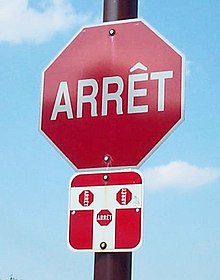
After 1759, the share of francophones in Canada steadily declined during the mass immigration of Anglophones and allophones, gravitating towards the English language. Between 1840 and 1860, the English-speaking population of Canada exceeded the French-speaking. Subsequently, this gap continued to widen. At the first stage, the influence of the French language on Canadian English was significant, however, from the second half of the 19th century, borrowings passed from English to French. Given the uncertain status of the French language in Canada, where the British administration did everything possible to eradicate it, the number of direct Anglo-American borrowings in it was significant until the middle of the 20th century . The vocabulary was especially actively borrowed by francophone, since English was the working language of the industry, and no attention was paid to French-speaking education. After the Quiet Revolution and the establishment of the official status of the French language, the active linguistic purism of the French-Quebec led to a sharp reduction in the number of direct borrowings. So, even instead of internationalism STOP / STOP, ARRÊT began to be used. French in Canada breaks down into a number of regional options, the largest of which are:
- Quebec French with western and eastern dialects; also a sociolect of Montreal - Zhual .
- The Franco-Acadian dialect (the most archaic), also Moncton's sociolect - a masterpiece .
- Ontar French , close to Quebec.
- Manitoba French .
- The French-Creole language of Canada and the special blended Michif language.
French in schools
Many English-language schools in Canada (primarily in Ontario) have a “ French immersion ” program where all or part of the subjects are taught in French.
Links
- ↑ Government of Canada, Statistics Canada. Census Profile, 2016 Census - Canada [Country and Canada [Country]] . www12.statcan.gc.ca. Date accessed August 27, 2018.
- ↑ Le français au Canada (unavailable link) . Date of treatment February 14, 2010. Archived March 10, 2010.