Canada became independent in 1867 when the three provinces of British North America were united into dominion . During the creation of the dominion, the French-speaking province of Canada was divided into two ( Quebec and Ontario ), and two more English-speaking provinces ( Nova Scotia and New Brunswick ) were added to them. In addition, Britain ceded Canada its possessions in North America. [one]
The external borders of Canada have changed seven times, and during the development the number of regions has grown from four provinces to ten provinces and three territories.
Content
- 1 Timeline
- 1.1 July 1, 1867
- 1.2 July 15, 1870
- 1.3 July 20, 1871
- 1.4 July 1, 1873
- 1.5 July 26, 1874
- 1.6 April 12, 1876
- 1.7 September 1, 1880
- 1.8 July 1, 1881
- 1.9 May 7, 1886
- 1.10 August 12, 1889
- 1.11 October 2, 1895
- December 1, 1897
- 1.13 June 13, 1898
- 1.14 May 23, 1901
- 1.15 October 20, 1903
- 1.16 September 1, 1905
- 1.17 1906
- 1.18 May 15, 1912
- 1.19 1925
- 1.20 March 11, 1927
- 1.21 November 11, 1930
- 1.22 March 31, 1949
- 1.23 April 1, 1999
- 1.24 December 6, 2001
- 1.25 April 1, 2003
- 2 See also
- 3 notes
Timeline
July 1, 1867
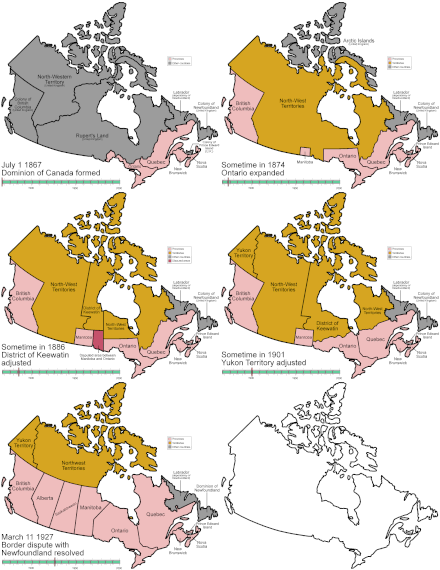
Dominion Canada was formed from three provinces of British North America : the province of Canada , which was divided into two provinces of Ontario and Quebec , and the colonies of New Brunswick and Nova Scotia .
July 15, 1870
Britain ceded most of its possessions to North America Canada: Rupert Land and Northwest Territory , which became Northwest Territories . The Rupert Land Treaty of 1868 transferred these lands to Canada in 1869, but in reality it was only implemented in 1870, when £ 300,000 was paid to the Hudson's Bay Company . The Manitoba Act came into force, according to which a small part of Ruprecht’s Land - the Red River colony surrounding the city of Winnipeg , was made the province of Manitoba .
July 20, 1871
British Columbia joined Canada as the sixth province .
July 1, 1873
The British colony of Prince Edward Island joined Canada as the seventh province .
July 26, 1874
The borders of Ontario have been expanded north and west. [2]
April 12, 1876
On April 12, 1876, Kivatin County was separated from the Northwest Territories, which divided the Northwest Territories. [3]
September 1, 1880
Great Britain ceded its Arctic islands to Canada, and they are made part of the Northwest Territories.
July 1, 1881
The borders of Manitoba have been expanded from the Kivatin County to the western borders of Ontario. But part of these territories was disputed by Ontario.
May 7, 1886
The southwestern border of Kivatin County has been modified to fit the boundaries of the new provisional districts of the Northwest Territories created in 1882, returning some land to the Northwest Territories. [four]
August 12, 1889
The dispute between Manitoba and Ontario ended with the Ontario borders extending westward to Lake of the Woods and the Albany River under the Canada Act (Ontario Frontiers) of 1889 .
October 2, 1895
Kivatin County annexed part of the Northwest Territories north of Manitoba on the mainland, and all the islands on the Hudson Bay , as well as James and Ungawa Bay . Part of the land between Kivatin County, Ontario, and the Hudson Bay was not included in Kivatin County. Four additional temporary districts were formed in the Northwest Territories: Yukon County, Ungawa County, Mackenzie County and Franklin County .
1897
The boundaries of Kivatin County have been changed. It included Southampton Island, Cotes Island, Akimiski Island and other islands.
June 13, 1898
The Yukon Territory was created from the Yukon County (in the northwestern part of the Northwest Territories), and the Quebec Border Expansion Act of 1898 moved the borders of Quebec north to the Eastmain River.
May 23, 1901
The eastern border of the Yukon Territory passed along the Pelly River.
October 20, 1903
The border dispute over Alaska was resolved in favor of the United States .
September 1, 1905
The provinces of Alberta and Saskatchewan were identified from the Northwest Territories. The western border of Saskatchewan and the eastern border of Alberta are 110 ° west longitude. The southern and northern borders of Alberta and Saskatchewan: in the south it is the border of Canada and the USA or the 49th parallel, in the north the 60th parallel. The western borders of Alberta along the peaks of the Rocky Mountains to the 60th parallel. Kivatin County has been eliminated.
1906
The Northwest Territories were renamed (the hyphen was removed in the name until 1912)
May 15, 1912
Manitoba, Ontario and Quebec have expanded their territory north to modern borders. This year, the Northwest territories began to include land north of the 60th parallel (except for the islands of the Hudson Bay and James Bay). They were divided into three districts: Kivatin, Mackenzie and Franklin.
1925
The boundaries of the Northwest Territories have been expanded to the North Pole .
March 11, 1927
In 1927, the British Privy Council resolved the Labrador border dispute between Labrador and Quebec, transferring part of the lands of the dominion of Canada to the dominion of Newfoundland .
November 11, 1930
Norway ceded Canada to the island of Sverdrup in exchange for British recognition of Norwegian sovereignty over the island of Jan Mayen .
March 31, 1949
The Dominion of Newfoundland and its possession Labrador become the tenth province of Newfoundland.
April 1, 1999
From the North-Western territories, the territory of Nunavut was allocated [5] . Temporary districts as administrative areas in the Northwest Territories were abolished.
December 6, 2001
Newfoundland Province was renamed Newfoundland and Labrador
April 1, 2003
The Yukon Territory was renamed the Yukon .
See also
- Division of Canada
- Provinces and territories of Canada
- Canadian Confederation
Notes
- ↑ Many Canadian lands before becoming part of British North America were part of the colonies of Canada and Acadia in New France . French influence was strong, and the creation of the dominion of Canada from the Anglo-French colonies allowed it to weaken.
- ↑ When a Canadian province existed was formed, its borders were not completely clear, and Ontario claimed to stretch to the Rocky Mountains and the Arctic Ocean. With the acquisition of Canada's Land, Rupert Ontario was interested in clearly defining its boundaries. By agreement with the federal government, the Ontario border was moved north to the 51st parallel.
- ↑ It was located north of Manitoba and west of Ontario.
- ↑ The temporary districts were: Alberta County, Athabasca County, Assiniboia County and Saskatchewan County , administratively subordinated to the Northwest Territories, unlike Kivatin County.
- ↑ including all of Kivatin County and most of Mackenzie and Franklin counties