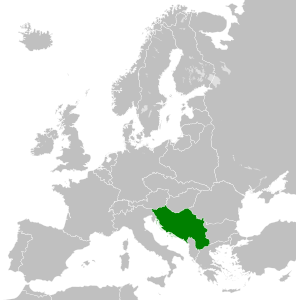
The Kingdom of Yugoslavia ( Serbian. Kragevin Kugoslavia , Croatian. Kraljevina Jugoslavija ) [1] - the official name of the state in the northwestern part of the Balkan Peninsula in 1929-1941 (formally until 1945) on the territory of modern Slovenia , Croatia , Serbia , Montenegro , Bosnia and Herzegovina and Macedonia .
| Independent kingdom | |||||
| Kingdom of Yugoslavia | |||||
|---|---|---|---|---|---|
| serbohorv. Kraљevina Јugoslavia / Kraljevina jugoslavija Slovene. Kraljevina jugoslavija Maced. The Kingdom of Yugoslavia | |||||
| |||||
| Motto : “ Serbohorv. Cyrus. Јedan people, јedan kraљ, јedna dzhava serbohorv. lat Jedan narod, jedan kralj, jedna država ( Slovenian. En narod, en kralj, ena država ) ( Maced . One nation, one king, one dzhava ) ( Rus. One people, one king, one power ) " | |||||
| Anthem : " Khimna Kraљevine Ugoslavia " Anthem of the Kingdom of Yugoslavia | |||||
 | |||||
←   → → → → → → → → → →1929 - 1941 | |||||
| Capital | Belgrade | ||||
| Languages) | Serbo-Croatian [1] | ||||
| Religion | Secular state | ||||
| Currency unit | |||||
| Ruling party | Yugoslav Radical Peasant Democracy (Yugoslav National Party) | ||||
| Form of government | dualistic monarchy absolute monarchy (de jure in 1929-1931, de facto in 1929-1935 ) | ||||
| Dynasty | Karageorgievichi | ||||
| Currency | Yugoslav Krona (until 1920) Yugoslav dinar (after 1920) | ||||
| Government structure | Unitary | ||||
| Heads of state | |||||
| King of Yugoslavia | |||||
| • 1929-1934 | Alexander I | ||||
| • 1934-1945 [K 1] | Peter II | ||||
| Regent of Yugoslavia | |||||
| • 1934-1941 | Pavel Karageorgievich | ||||
| • January 6, 1929 - September 3, 1931 | Dictatorship January 6 | ||||
| • | Axis Invasion of Yugoslavia | ||||
| • | Nedichev Serbia | ||||
| • July 4, 1941 - May 15, 1945 | The People's Liberation War of Yugoslavia | ||||
| • November 29, 1945 | Federal Republic of Yugoslavia Proclaimed | ||||


The name "Yugoslavia" was adopted on January 6, 1929 , after the coup d'etat of King Alexander I. Prior to this, from December 1, 1918, the country was called the Kingdom of Serbs, Croats and Slovenes , abbreviated as KSKhS ( Serb. Krajevina Srba, Khrvat and Slovenac ).
Content
- 1 History
- 2 Government structure
- 2.1 Political parties
- 3 Administrative divisions
- 4 Economics
- 4.1 Agriculture
- 4.2 Production
- 4.3 Debt
- 4.4 Money
- 5 Ethnic groups
- 6 Education
- 7 Religion
- 8 Foreign policy
- 8.1 Agreement with Greece
- 8.2 Pro-Allied Government
- 8.2.1 Little Entente
- 8.2.2 Balkan Alliances
- 8.2.3 Italian coalition
- 8.2.3.1 Friendship Agreement
- 8.3 1935–1941
- 8.4 1941–1945
- 8.5 Soviet-Yugoslav relations
- 9 Demographics
- 9.1 Ethnic groups
- 10 Comments
- 11 Notes
History
The reign of the king during this period was characterized by authoritarian and conservative tendencies. The Kingdom of Yugoslavia, in order to avoid interethnic conflicts and the danger of collapse, was divided into provinces ( banovans ) that did not correspond to the settlement territory of any of the main South Slavic peoples. This corresponded to the ideology of erasing ethnic differences and assimilation.
On January 6, 1929, King Alexander I Karageorgievich published a manifesto, which in fact established his dictatorship , banning all political parties and appointing a new head of government. It was not until September 3, 1931 that the king granted the country a new constitution and allowed parliamentary elections. However, in the 1931 elections, because of the stringent requirements for collecting signatures for registration, only one government list was put up. The deputies elected by it formed the only authorized party - the Yugoslav Radical Peasant Democracy (on July 20, 1933 it was renamed the Yugoslav National Party) [2] .
On November 7, 1932, the Peasant-Democratic Coalition adopted “Punctations,” which referred to multinationality and the federalization of Yugoslavia [3] . In response, coalition leader Vladko Machek , the first to sign this document, was arrested in 1933 and sentenced to three years of high security.
Before the assassination of King Alexander in 1934 by the Croatian Ustash , Yugoslavia was oriented toward an alliance with the democratic powers of Western Europe (part of the so-called Little Entente ). After the death of the king and the coming to power of the Prince-Viceroy Paul, the state, despite the sympathy Paul to Britain, went on rapprochement with Germany and Italy .
In addition, the national policy was changed - Croatian leader Maciek was released in 1934. And on August 26, 1939, on the basis of the Tsvetkovich – Macchek agreement, Croatia received autonomy within the kingdom as a separate banovina .
In March 1941, the government of Yugoslavia ( Tsvetkovich’s cabinet) signed the Vienna Protocol on accession to the German-led Berlin Pact , which caused a widespread protest movement in the country. On March 27, the government was overthrown.
On April 6, 1941, troops of Germany and its allies attacked Yugoslavia, occupying and dismembering the country's territory during the Yugoslav operation . An independent Croatian state was created (also controlled Bosnia), led by the Ustashi; part of the country went to Germany and Italy, the Serb genocide began. In Yugoslavia, a national liberation struggle unfolded. It was headed, on the one hand, by the Communists Tito ( Communist Party of Yugoslavia , founded in 1919), on the other hand, by the monarchists- chetniks headed by D. Mikhailovich ; these parties were either tactically blocked or fought with each other. The north-eastern part of the country was liberated in 1944 during the joint actions of the Soviet troops and the NOAA ( People's Liberation Army of Yugoslavia ). By May 15, 1945, the Yugoslav army completed the liberation of Yugoslavia. On November 29, 1945, the Federal People's Republic of Yugoslavia was proclaimed.
Government structure
The supreme body of state power - the National Assembly ( Narodna Skupshtina ), was elected by the people for a term of 4 years, the head of state is the King ( Kraљ ), the executive body is the Council of Ministers ( Ministerski Savet ), consisting of the chairman of the Council of Ministers and Ministers, was appointed by the king.
Political Parties
- The Yugoslav popular movement Zbor (the Zoługlosni folk band “Zbor” ) is an ultra-right, Serbian fascist
- The Yugoslav Radical Union ( ЈUgoslosenka Radical Asset ) - ultra-right, fascist
- Yugoslav National Party ( ословugoslosenka national stranka ) - conservative, monarchist
- People's Radical Party ( People's Radical Stranger ) - Conservative, Serbian Nationalist
- Slovenian People's Party ( Slovenska ljudska stranka ) - Christian Democratic, Autonomous
- Montenegrin Federalist Party ( Crnogorska federalistička stranka ) - agrarian, autonomist
- Democratic Party ( Democrat stranka ) - liberal, centrist
- Independent Democratic Party ( Self-Democratic Democratic Stranger ) - Social Liberal
- Croatian peasant party ( Hrvatska seljačka stranka ) - center-left, agrarian, autonomist
- Socialist Party of Yugoslavia ( Socialist Party ј Ugoslavia ) - Social Democratic
- Communist Party of Yugoslavia ( Communist Party of Ugoslavia ) (legal wing - Independent Labor Party of Yugoslavia) - Marxist-Leninist
- German party ( Nemačka Stranka , Deutsche Partei ) - enjoyed some influence in Vojvodina
Administrative Division
The territory of Yugoslavia was divided into bans . Representative bodies of regions - regional meetings (oblast skupshtina ), regional committees. ( over the edge ).
The state included:
- Dravian banovina
- Seaside Banovina
- Zeta Banova
- Savskaya banovina
- Moravian Banovina
- Vrbava banovina
- Drinsky banovina
- Vardar banovina
- Danube Banovina
- Croatian banovina - autonomy (since 1939 ).
The city of Belgrade , together with the cities of Zemun and Pancevo , constituted a separate administrative-territorial unit, independent of banovins.
Economics
The level of development in the regions of Yugoslavia varied sharply. The northern banovans ( Drava , Seaside and Danube ), located mainly in the territories of modern Slovenia , Croatia and Vojvodina, were characterized by a higher level of economic development. The birth rate there was much lower, and the railway network was denser than in southern Bosnia, Macedonia, Montenegro and Kosovo [4] . The royal authorities tried to unify all regions and even out their level of development. For this, in 1938, a special fund was created for subsidizing underdeveloped regions [5] . In addition, the state financially supported the resettlement of residents of the northern regions to the south [5] .
Agriculture
Three quarters of the Yugoslav workers were employed in agriculture. There were few commercial farmers, most of whom were subsistence farmers. In the south, peasants were especially poor, living in a hilly, barren region. There were no large estates except in the north, and all of them belonged to foreigners. One of the first actions undertaken by the new Yugoslav state in 1919 was the destruction of the possessions of foreigners, in particular Hungarians, landowners. Almost 40% of the rural population was in abundance (i.e., extra people did not need to maintain the current level of production), and despite the warm climate, Yugoslavia was relatively dry. Internal communications were poor, the damage from World War I was significant, but with few exceptions, agriculture was deprived of machinery or other modern agricultural technologies.
Production
Production was limited to Belgrade and other large settlements, and consisted mainly of small, relatively primitive, enterprises that conducted production exclusively for the domestic market. The commercial potential of the Yugoslav ports of the Adriatic Sea was wasted because the country did not have the technical knowledge to manage the shipping industry. On the other hand, the mining industry was well developed due to the abundance of mineral resources in the country, but since it was mainly owned and operated by foreigners, most of the products were exported. Yugoslavia was the third, least developed country in Eastern Europe after Bulgaria and Albania .
Debt
Yugoslavia was a typical country in Eastern Europe in the sense that it borrowed large sums of money from the West during the 1920s. During the Great Depression , starting in 1929, Western lenders collected their debts from Yugoslavia, which the Yugoslavs could not repay. Part of the money was lost during bribery, although most were used by farmers to improve production and export potential. However, agricultural exports have always been an unstable prospect, as their export earnings are largely dependent on volatile world market prices. The Great Depression caused the market for peasants to collapse as global demand shrank dramatically, and the situation for export-oriented farmers got even worse when countries everywhere started to set up trade barriers. Italy was the main trading partner of Yugoslavia in the first years after the First World War, but due to the fact that Benito Mussolini came to power in 1922, supplies ceased. The difficult economic situation of the 30s Yugoslavia followed the example of its neighbors, allowing itself to become dependent on Nazi Germany .
Money
Currency - dinar, was introduced:
- 50 nickel-copper coins, 1 and 2 dinars [6]
- banknotes in 5, 10, 20, 50, 100, and 1.000 dinars [7] [8]
The operator of postal and telephone communications is PTT, the operator of rail transportation is the Yugoslav State Railways ( ословugoslosensk dzhavnice zheleznitsa ).
Ethnic groups
The small middle class was in large settlements, and almost all the rest were peasants engaged in agriculture. The largest ethnic group were Serbs , followed by Croats , Slovenes , Bosnian Muslims , Macedonians and Albanians . Religion followed the same pattern: half of the population followed Orthodox Christianity , about 40% were Catholics , and the rest were Muslims . In such a multilingual country, tensions were frequent, but especially between Serbs and Croats. Other quarrels were between Serbs and Macedonians, since the official position of the Yugoslav government was that the latter were ethnic Serbs. At the beginning of the 20th century, the international community regarded the Macedonians primarily as a regional variety of Bulgarians , right up to the 1919 Paris Peace Conference.
Slovenes were closer to the Croats in terms of religion and culture. In particular, they knew that there were too few of them to form their own nation, and there was no reason to believe that in Yugoslavia, in which Croats predominate, it will be better or worse than in Serbia. For the most part, they went along with the general political flow and were not a significant source of problems.
Mostly Muslims, Bosnians used some concessions from Belgrade , but they always felt strong hostility from their neighbors, especially Serbs, and were known as “ Turks ”, regardless of their Slavic nationality. Albanians lived worse because they do not speak Serbo-Croatian and all Muslims were the subject of widespread persecution in Yugoslavia. In some regions of the country, it was allowed to exist as enclaves of Islamic law in relation to personal status, which was a concession to the Muslim population of Yugoslavia.
Other ethnic minorities included Italians , Romanians , Germans , Hungarians and Greeks . In addition to the Romanians, the Yugoslav government did not provide them with a special regime regarding respect for their language, culture or political autonomy, which is not surprising given that all their home countries had territorial disputes with Yugoslavia. Several thousand Jews lived mainly in large cities; they were well assimilated, and there were no significant problems with anti-Semitism.
Education
A significant part of the population of Yugoslavia was illiterate. According to the 1931 census, the share of illiterate people in Yugoslavia as a whole amounted to 44.6% (in 1921 it was even higher - 51.5%) [9] . The proportion of illiterate people varied greatly depending on the banovina. It was the lowest in Slovenian lands ( Drava Banovina ), where in 1931 only 5.5% of the population were illiterate, which was almost half that in Belgrade (10.9% of the population were illiterate in 1931) [10] . The highest illiteracy rate among the entire population was in 1931 in the predominantly Macedonian Vardar (70.9%) and Bosnian Vrbass (72.6%) banovans [11] . At first, there were serious regional differences in school education. In 1929, a law on public schools was passed, which prescribed that they conduct instruction in the “Serbo-Croatian-Slovenian” language and teach 14 school subjects in a program uniform for the whole country [5] .
Religion
- The Serbian Orthodox Church united mainly Serbs-Orthodox Serbia, Montenegrins-Orthodox and Macedonians-Orthodox.
- The Yugoslav Conference of Catholic Bishops brought together mainly Slovenian Catholics, Croat Catholics, Slovenia and Croatia, Hungarian Catholics, German Catholics and Catholic Slovaks of Vojvodina and Prekmurje (mostly Magyarized)
- The Evangelical Church of the Augsburg Confession in the Kingdom of Serbs, Croats and Slovenes ( Evangelička crkva Augsburškog ispovedanja u Krajevini SHS ) - mainly united Lutheran Hungarians, Lutheran Germans Vojvodina and Prekmurje (mainly Magyarized Lutherans, Slovenes, Slovenes Croatia and Slovenia [12]
- The Slovak Evangelical Church of the Augsburg Confession in the Kingdom of Serbs, Croats and Slovenes - mainly united the Lutherans of Vojvodina (mostly Magyarized) [13]
- The Christian Reformed Church in the Kingdom of Yugoslavia - mainly brought together Calvinist Hungarians, Calvinist Germans and Calvinist Slovaks (mostly Magyarized) Vojvodina and Prekmurje [14]
- The Supreme Muftiate of Yugoslavia mainly united Muslim Bosnians and Muslim Albanians.
- Federation of Jewish Communities of Yugoslavia ( Savez jevrejskih opština Jugoslavije ) - mainly united the Judaists of Vojvodina (mostly Magyarized), the Judaists of Bosnia, Serbia and Macedonia of the Sephardic canon
- Seventh-day Adventist Union of South Europe (Northern Diocese, Southern Diocese and Croatian Diocese) - united the Seventh-day Adventists
Foreign Policy
Agreement with Greece
In 1923, the Greek- Yugoslav Convention transferred Belgrade a free zone in the Aegean port of Thessaloniki for 50 years, which gave Yugoslavia access to the Mediterranean Sea , bypassing the Adriatic controlled by unfriendly Italy [15] . A railway from Yugoslavia was brought to this zone.
Pro-Allied Government
The kingdom had friendly relations with the allies of the First World War . This was especially the case between 1920 and 1934 with respect to the traditional supporters of Yugoslavia, Great Britain and France .
Little Entente
Since 1920, the Kingdom of Yugoslavia formed the Little Entente with Czechoslovakia and Romania with the support of France . The primary goal of the alliance was to prevent Hungary from returning to the territories it had lost after the First World War. The alliance lost its significance in 1937, when Yugoslavia and Romania refused to support Czechoslovakia, which was then threatened by Germany.
Balkan Alliances
In 1924, the Kingdom of Yugoslavia formed the Balkan block with Greece , Romania and Turkey , which intended to maintain equilibrium on the Balkan Peninsula . The Alliance was officially consolidated on February 9, 1934, then it became the "Balkan Entente." In 1934, after the assassination of King Alexander I Vlado of Chernozemsky in Marseille and the change of Yugoslav foreign policy, the alliance broke up.
Italian Coalition
The Kingdom of Italy had territorial ambitions against the Kingdom of Yugoslavia. Relations between Italy and the predecessors of the kingdom, the Kingdom of Serbia and the state of Slovenes, Croats and Serbs became hostile during the First World War, as Italian and Yugoslav politicians argued over Dalmatia , which Italy demanded. This hostile relationship was demonstrated on November 1, 1918, when Italian troops sank the recently captured Austro-Hungarian battleship SMS Viribus Unitis , which was used by the state of Slovenes, Croats and Serbs. Italy formed a coalition against it with states that had similar state structures under the strong influence of Italy and / or fascism: Albania , Hungary , Romania and Bulgaria , which lasted from 1924 to 1927.
The 1927 cooperation of Yugoslavia with Britain and France forced Italy to withdraw from its anti-Yugoslav union. The Italian fascist dictator Benito Mussolini took the extreme, namely, called on the Croatian nationalist figure Ustasha Ante Pavelic to live in Italy and use training grounds in Italy to prepare for the war with Yugoslavia. Hungary also allowed such training camps for Ustasha. Mussolini allowed Pavelich to reside in Rome.
Friendship Agreement
In 1927, in response to growing Italian expansionism, the royal government of Yugoslavia signed a friendship and cooperation agreement with Great Britain and France.
1935–1941
Officially, the last words of King Alexandar were "Save Yugoslavia and friendship with France." His successors were well aware of the need to try to do the first, but the second, to maintain close ties with France, was becoming increasingly difficult. There were several reasons for this. By the mid-1930s, France, internally divided, could no longer play an important role in Eastern Europe and support its allies, many of whom were hit hard by the economic crisis of that period. On the contrary, Germany more and more wanted to conclude barter agreements with the countries of Southeast Europe. In the process, these countries felt that it was against their interests, namely to follow France. An additional motive for improving relations with Italy and Germany was Italy's support for the Ustashe movement. Since Machek said that Italy would support the separation of Croatia from Yugoslavia, the first regent, Prince Paul, decided that more friendly relations with Italy were inevitable. In an attempt to strip HSS of potential Italian support, a friendship agreement was signed between the two countries in 1937. This somewhat reduced the threat of the Ustash, as Mussolini imprisoned some of their leaders and temporarily withdrew financial support. In 1938, Germany, annexing Austria, became a neighbor of Yugoslavia. The weak reaction of France and Great Britain at the end of that year during the Sudeten crisis convinced Belgrade that a European war was inevitable and that it would be unreasonable to support France and Great Britain. Instead, Yugoslavia tried to stay away, despite Paul’s personal sympathies for Britain and the Serbian establishment’s addiction to France. Meanwhile, Germany and Italy tried to use the internal problems of Yugoslavia, as did Macchek. As a result, the regency agreed to the formation of Banovina in August 1939. This did not put an end to pressure from Germany and Italy, and the strategic situation of Yugoslavia worsened every day. It increasingly depended on the German market, about 90% of its exports went to Germany, and in April 1939, Italy invaded and annexed Albania. In October 1940, Italy attacked Greece, when France was already eliminated from the scene, and Britain became the only potential ally of Yugoslavia, given that Belgrade did not recognize the Soviet Union. London, however, wanted to drag Yugoslavia into the war, which he rejected.
From the end of 1940, Hitler wanted Belgrade to definitely choose a side. The pressure intensified, culminating in the signing of the Trilateral Pact on March 25, 1941. Two days later, Prince Pavel was overthrown as a result of a coup, and his nephew Peter II was declared an adult, but the new government, led by General Simovich, assured Germany that it would adhere to the Pact. Hitler nevertheless ordered an invasion of Yugoslavia. On April 6, 1941, Belgrade was bombed; On April 10, the independent state of Croatia was proclaimed; and on April 17 the weak Yugoslav army capitulated.
1941–1945
After the invasion, the Yugoslav royal government went into exile and the local Yugoslav forces rose up to resist the occupying Axis powers. Initially, the monarchy preferred the Drazh Mikhailovich and its dominant Serbs the resistance of Chetnikov . However, in 1944, in the Tito - Shubasic agreement, Democratic Federated Yugoslavia was recognized by the interim government , and the status of the monarchy will be determined later. Three regents - Srjan Budisavlevich , Serb; Ante Mandic , croatian; and Dusan Cernek , Slovenian, were sworn in Belgrade on March 3, 1945. They appointed a new government led by Tito as prime minister and war minister, and Shubasic as foreign minister.
On November 29, 1945, while in exile, King Peter II was overthrown by the constituent assembly . The Federal People's Republic of Yugoslavia gained international recognition as Yugoslavia, and Peter II became a contender.
Soviet-Yugoslav relations
The foreign policy of Yugoslavia was anti-Soviet in nature . The kingdom housed a significant part of the white emigration , which had its cadet corps in Yugoslavia. The Communist Party of Yugoslavia was banned. Yugoslavia recognized the USSR only in 1940.
Demographics
Ethnic groups
| Ethnic group | Number in thousand people | Percentage of the total in% |
|---|---|---|
| Serbs | 4,665,851 | 38.83 |
| Croats | 2,856,551 | 23.77 |
| Slovenes | 1,024,761 | 8.53 |
| Bosnian Muslims | 727,650 | 6.05 |
| Macedonians | 585,558 | 4.87 |
| Other Slavs | 174,466 | 1.45 |
| Germans | 513,472 | 4.27 |
| Hungarians | 472,409 | 3.93 |
| Albanians | 441,740 | 3.68 |
| Romanians | 229,398 | 1.91 |
| Turks | 168,404 | 1.40 |
| Jews | 64,159 | 0.53 |
| Italians | 12,825 | 0.11 |
| Other | 80,079 | 0.67 |
| Total | 12,017,323 | 100.00 |
Comments
- ↑ De jure . De facto ruled the country for only 2 weeks.
Notes
- ↑ 1 2 Tomasz Kamusella. The Politics of Language and Nationalism in Modern Central Europe. Palgrave Macmillan, 2008, pp. 228, 297.
- ↑ Yugoslavia in the XX century: essays on political history / K.V. Nikiforov (ed.), A.I. Filimonova, A.L. Shemyakin, etc. - M .: Indrik, 2011. - P. 267, 272 Access mode: http://www.inslav.ru/resursy/elektronnaya-biblioteka/2372-2011-jugoslavija-v-xx-veke
- ↑ Kharitonova N.A. Foreign policy of Yugoslavia before the assassination of King Alexander in 1934 // Historical, philosophical, political and legal sciences, cultural studies and art history. Questions of theory and practice. - 2011. - No. 7-1. - S. 185
- ↑ Biro L. Regionalism and Centralism between the two wars (on the example of Yugoslavia). A look from Hungary // Slavic world in the third millennium. - 2013. - No. 8-1. - S. 222.
- ↑ 1 2 3 Biro L. Regionalism and centralism between two wars (on the example of Yugoslavia). A look from Hungary // Slavic world in the third millennium. - 2013. - No. 8-1. - S. 225.
- ↑ Kingdom of Serbs, Croats and Slovenes
- ↑ Kingdom of Serbs, Croats and Slovenes
- ↑ Kingdom of Yugoslavia
- ↑ Biro L. Regionalism and Centralism between the two wars (on the example of Yugoslavia). A look from Hungary // Slavic world in the third millennium. - 2013. - No. 8-1. - S. 223.
- ↑ Biro L. Regionalism and Centralism between the two wars (on the example of Yugoslavia). A look from Hungary // Slavic world in the third millennium. - 2013. - No. 8-1. - S. 224.
- ↑ Biro L. Regionalism and Centralism between the two wars (on the example of Yugoslavia). A look from Hungary // Slavic world in the third millennium. - 2013. - No. 8-1. - S. 223-224.
- ↑ Evangelical Christian Church of the Augsburg Confession (Serbia)
- ↑ Slovak Evangelical Church of the Augsburg Confession in Serbia and Montenegro
- ↑ Christian Reformed Church in Serbia
- ↑ Gibian L.Ya. Yugoslavia in Balkan and European politics at the beginning of World War II: the policy of maneuvering and its collapse // Vestnik MGIMO University. - 2009. - No. 4. - S. 19
- ↑ Banac, Ivo. The National Question in Yugoslavia: Origins, History, Politics . Cornell University Press, 1988. pp. 49–53, 58. ISBN 9780801494932