Gambusia ( lat. Gambusia ) is a genus of bead-feathered fish of the family Pecilius . Small live-bearing fish from North , Central and South America . Most species are freshwater, some can live in brackish or salt water.
| Gambusia |
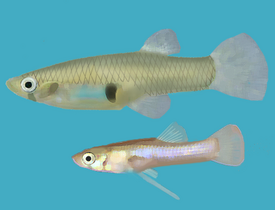
Holbrook Gambusia
( Gambusia holbrooki )
above is a female, below is a male |
| Scientific classification |
|---|
| No rank : | Bilateral symmetrical |
| Infraseries : | Ateriomorphs |
|
| International scientific name |
|---|
Gambusia Poey , 1854 |
|
A number of species have been acclimatized in various regions ( Europe , Australia , China , Japan , Hawaiian and Philippine Islands , Central Asia , the Caucasus ) to combat malaria and other infectious diseases - fish actively eat mosquito larvae.
The Russian sanitary legislation considers larval carnivores as the best larvifag (for warm regions of the country) [1] . Holbrook gambusia populations were recorded in the Krasnodar Territory (the Kuban basin) and in the warm waters of Central Russia (for example, in cooling ponds of thermal power plants) [2] .
Some species are bred in aquariums . The conditions of keeping, feeding and breeding are the same as for other pecilides, but the aquariums cannot be covered with glass, since the fish soon die. Fish are quite unpretentious, survive in various bodies of water, although they prefer warm, stagnant waters. In open water bodies of the gambusia, they can withstand the temperature drop to 5 ° and lower; wintering of fish was observed under an ice layer of 2-3 cm and a water temperature of about 0 °.
For joint maintenance in aquariums with other species of fish, gambusia are unsuitable, as they break off their fins. Producers very actively eat their young, if conditions for shelter are not created for them. It has been noted that in fish ponds, gambusia eats eggs and fry of commercial fish, and during primary settlement, due to the same feature, gambusia can affect the biodiversity of natural reservoirs [1] .
The enemies of gambusia: ducks and other birds eating small fish, aquatic turtles , predatory fish.
Gambusia monuments were erected in the Adler district of Sochi , Corsica and Israel for their help in the fight against malaria . Gambusia eats the larvae of malaria mosquitoes , thereby drastically reducing their number and, as a result, reducing the number of cases of malaria.
In the play “ Walpurgis Night ” by Venedikt Erofeev , one of the characters has a cherished dream - to breed a gambusia in the pond: “This fish - gambusia - eats all mosquito larvae in its pond, and at the same time all lamblia . She can pick up seventy-five at a time. And the most important thing is that the gambusia is good - it’s not a single mosquito in the air from it ” [4] .
