The American Barnum Museum is a museum in the USA , located on the corner of Broadway and Ann Street ( Eng. Ann Street ) in 1841-1865 (burned down in a fire on July 13, 1865 [1] ). The owner of the museum was the famous showman F. T. Barnum and his partner and co-owner John Skudder. Before their collaboration began, the museum existed under the name Scudder's American Museum . The museum offers its own educational programs. On musical Broadway, this place is often referred to simply as Barnum. In July 2000, the museum appeared on the Internet version.
| American Barnum Museum | |
|---|---|
| Barnum's american museum | |
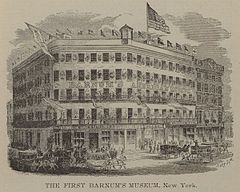 Museum Art Image | |
| Established | 1842 year |
| closing date | |
| Address |  USA : Manhattan , New York USA : Manhattan , New York |
| Site | Internet version |
Content
History
In 1841, Barnum bought the American Skudder Museum, located along St. Paul's on the southeast corner of Broadway and Ann Street. He reconstructed a five-story building into a gigantic, tasteless self-promotion with painted animals, luminous panels, banners and flags, with lemon-colored illumination, a very recent invention. He hired the worst musicians he could find to play on the balcony directly above the entrance, apparently expecting these terrible sounds to attract visitors [2] .
Barnum opened his museum on January 1, 1842 , trying to create a place where families could come to relax, but he did not succeed, if only because he could not attract an audience. Its many attractions turned the center into a cross between a zoo, a museum, a reading room, a wax exhibition, a theater and a show, but it bore the proud name - the central place for the development of American folk culture. Barnum filled the American Museum with panoramas, “cosmoramas”, scientific instruments, modern devices and arranged a flea circus, somewhere he searched for a carriage with a dog, and with a trunk made of wood, under which Jesus preached Christian truths to his disciples, a hat that once belonged to Ulysses Grant , arranged an oyster bar, a spiral staircase, exhibited drawings of fleas, glass blowers, phrenologists, organized competitions between young children, an aquarium, a menagerie with exotic animals, including a meeting such as beluga, found the Siamese twins Chang and Eng and periodically promoted performances: from the performances of magicians, ventrilocists, storytellers to productions based on biblical tales and " Uncle Tom's Cabin ". In its heyday, the museum worked fifteen hours a day, receiving about 15,000 visitors during this time.
In July 2000, a virtual version of the museum appeared on the Internet thanks to a grant from the National Endowment for the Humanities . The CUNY Center ( The CUNY Graduate Center ) reconstructed the museum on the Internet to tell and show contemporaries the true and complete history of the museum and related 19th-century objects.
Attractions
The museum's collection included items collected around the world over the past 25 years. The museum arranged many attractions that led to its great fame. One of the most famous is the dwarf General Tom-Tam . There was not the only exhibit with physiological abnormalities, except for it you could also admire the Fijian mermaid and Josephine Boydesdeshen, who had a long beard. In addition to Tom Tam, another fun pastime was William Henry Johnson, who earned a reputation as one of Barnum's most popular and long-running attractions. The most controversial and popular exhibit were Chang and Eng, two Siamese twins that caused a lot of scandals.
The five-story building also had great educational value. In addition to various entertainments, the museum also tried to achieve educational goals, telling about the natural history of animals, an aquarium and at exhibitions; about the history of paintings and wax figures (including the figure of Jesus Christ); about moderate reforms.
See also
- Do-ham-mi
Notes
- ↑ Barnum Museum Fire: July 13, 1865 Archived April 2, 2015. (eng.)
- ↑ Robert Green. 48 laws of power = The 48 laws of power / per. from English E. Ya. Migunova. - Moscow: Ripol-Classic, 2014 .-- S. 109-110. - 768 p. - (PRO power). - ISBN 978-5-386-06017-6 .