Gennady Kostroma and Lyubimogradsky ( Gennady Mogilevsky - Belorussian; Genadziy Magileўskі ; in the world Grigory Ivanovich ; the beginning of the 16th century, Mogilev - January 23 [ February 2 ] 1565 - founder of the Spaso-Gennadiev monastery , now in the Yaroslavl diocese .
| Gennady Kostroma and Lyubimogradsky | |
|---|---|
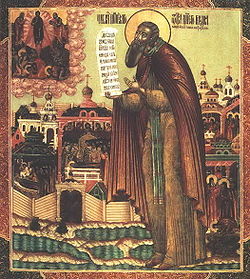 Rev. Gennady of Kostroma and Lyubimogradsky with a monastery. Icon of the beginning of the XVIII century. | |
| Name in the world | Grigory Ivanovich |
| Birth | Mogilev |
| Death | |
| Is revered | in orthodoxy |
| Canonized | November 23 ( December 3 ) 1646 |
| In the face | reverend |
| Day of Remembrance | January 23 ( February 5 ) |
| Proceedings | “The instruction to the original monk”, “Teaching to the brethren and to all people” |
Biography
Gennady is narrated by his life (1584-1586) and the Tale of gaining relics (the end of the 1640s); he is also mentioned in the Life of the Monk Kornil Komelsky (1589).
Gregory was born at the beginning of the XVI century in Mogilev (then the territory of the Grand Duchy of Lithuania ) in a wealthy family of boyar Ivan and his wife Elena. He was thoughtful and prone to solitude. The strong religiosity manifested in him, the desire to often visit the monasteries caused discontent of his parents.
Then Gregory, having changed into poor clothes, left his parents' house and headed for Moscow . Having visited her shrines, he went to Novgorod land together with a certain Theodore, also striving for monastic feats. Friends wanted to settle in the monastery of Alexander Svirsky , but he bluntly announced that he had "no way to live in the desert as a young lad", and blessed them to go to the Vologda forests in the Komelsky desert to the Monk Cornelius [1] . Soon Theodore returned to Moscow, after he had a large family, he lived to a very old age; Gregory, on the contrary, having stayed there “in art for quite some time”, was tonsured with the name of Gennady . Soon he became an exemplary monk and beloved student of Cornelius. The brotherhood envied Gennady; among them appeared "murmur and disobedience" to Cornelius himself.
According to the life of Gennady, avoiding the “storm of slander, slander and whispering,” or, according to the life of Cornelius, wishing to be “alone in silence,” Cornelius and Gennady retired to Lake Sursk, 25 km from Lyubim , which was in the old Kostroma suburbs (now it is the city of Yaroslavl areas ). With the help of the sovereign flight attendants who lived there , the monks built a cell and spent time in labor, "the forest is cut and the land is yelling"; to drain the swamps, they dug four ponds with their own hands. At the insistence of the Grand Duke Vasily Ivanovich, Cornelius returned to his Komelsky monastery in 1529, and he “blessed” Gennady with the “waste desert,” that is, the newly-built Lyubimsky monastery. This desert was subsequently known as the Spaso-Gennadievsky monastery , its rector Gennady was until the end of his days.
For a small, six-member brotherhood, a church was built in the name of the Transfiguration of the Lord. With the help of the Grand Duke, Gennady decorated the church with "every kind of church mockery"; The Grand Duke granted a bread rug . With the increase in the number of monks, Gennady built another church in the name of St. Sergius of Radonezh. The abbot was for the brethren “an image of humility and patience”: he chopped and smashed firewood, worked in a cookery and a bakery, washed haircloths ; for relaxation, he was lovingly engaged in icon painting. To "pacify the flesh," he wore iron chains and crosses. In the manuscript life of Pachomius Nerekhtsky, a verbal portrait of St. Gennady is given: “the summers are average, with Russian hair, black hair, ako hair from Cosma and Damian beserebererenniki, saints’ shrimp’s robes, prayer ruins ” [2]
Gennady became famous for his insight and healing. The reverend sometimes went from Sura to Moscow. It was said that on one of his visits, he visited the house of the boyar Yuliania Fyodorovna, the wife of Roman Yuryevich Zakharyev , and, blessing her children, predicted to her that her daughter Anastasia would be queen - she really became the wife of Tsar Ivan the Terrible . The Zakharyins, in gratitude, helped Gennady build a second church in his monastery - in the name of St. Sergius of Radonezh. He healed Boyar Boris Paletsky from a serious illness, then he donated a valuable bell to the monastery; and the Vologda bishop Cyprian. Gennady was the confessor of Ivan the Terrible and baptized his daughter Anna .
Gennady, according to the testimony of his student, "unable to read and write" (that is, did not know how to write), but left two literary works of an ascetic-edifying character, "A Manual for a Newcomer Monk" and the dying "Teaching of Brotherhood and of All People." In them, Gennady remained faithful to the covenant of his mentor Rev. Cornelius: “receive the ancient saints, father intelligence, patience, love and humility, moreover, prayer for the cathedral and cell, and work hard in the midst of the impersonal.” According to Gennady, a monk should know only the church, his meal and his cell, “fix the monastery’s affairs unhurriedly, lazily and serenely”, protect the monastery’s property, not be “rival creator and disobedient”. Gennady exhorted his successors and “do not abuse peasants with violence”. The church for the monk must be "earthly heaven." “Do not attend a church council,” Gennady exhorted his disciples, “the first abomination by a monk is not a hedgehog to a hedgehog in a church ... Is it possible that a monk will not take communion for six weeks, have a monk”. Illiterate Gennady advised the monks to purchase books. “It is fitting for you, my child,” he wrote, “to embrace them and the mind to take note of the mind.”
January 23 [ February 2 ] 1565 the reverend peacefully died and was buried in the monastery he created.
Honor
The life of the Monk Gennady, containing a description of 19 lifetime and posthumous miracles, and the canon was written to him by his student and second successor, hegumen Alexy between 1584-1587, placing him with a spiritual testament dictated by Gennady himself. Presumably in the same years a service was made to the saint. Alexy then initiated a case of his canonization, which did not receive a move. However, local veneration began immediately after the repose: in the monastery and in Kostroma churches were consecrated in the name of St. Gennady.
The relics were acquired on August 19 (29), 1644 during the laying of the stone Transfiguration Cathedral on the site of the wooden church built by Gennady: when they opened the coffin of Gennady, not only his body, but also his clothes were “intact and indestructible and indulging in corruption”. The relics set up for a time in the monastery church of Alexy the Man of God, November 23 ( December 3 ) 1646 were solemnly transferred to the newly blessed Transfiguration Church and placed at the autopsy at the right choir of the Annunciation chapel. Then, with the blessing of Patriarch Joseph , a church celebration was established for the Monk Gennady. In 1861, a service was printed with an akathist to the Monk Gennady, composed by G. Kartsev and "rewritten" by the Archbishop of Yaroslavl Nile .
The relics were stored at first openly, and then "for unknown reasons and it is not known when they were hidden under the cover." In the early 1920s, the monastery was closed, and the relics were opened on September 28, 1920 and, together with what was believed to be Gennady’s belonged, they were taken to the Yaroslavl Provincial Museum with a bucket for collecting money and an ax, where the fate of the relics remained until the mid-1930s unknown. Since 1995, the Spaso-Gennadiev Monastery has been revived.
Memory January 23 ( February 5 ) - this day was chosen in 1983 as the date of the Cathedral of Kostroma Saints [3] , May 23 ( June 5 ) to the Cathedral of Rostov-Yaroslavl Saints and in the third week of Pentecost to the Cathedral of Belarusian Saints .
To celebrate the 350th anniversary of the acquisition of the relics and the 435th anniversary of the repose of St. Gennady, the Kostroma diocese award was established - the badge "Rev. Gennady of Kostroma and Lyubimogradsky" of I and II degrees, to which clergy and laity are given for their zeal and special contribution to the spiritual revival of the Kostroma region. [2]
Literature
- Life and miracles of St. Gennady, Kostroma and Lyubimograd miracle worker. Edition of the Gennadiev Monastery. - M., 1895. - 46 p.
- Dobrovolsky G.F. Spaso-Gennadiev Monastery and Rev. Gennady, Kostroma and Lyubimograd miracle worker. - M., 2004 .-- 50 p.
Notes
- ↑ Gennady, Rev. Kostroma // Brockhaus and Efron Encyclopedic Dictionary : in 86 volumes (82 volumes and 4 additional). - SPb. , 1890-1907.
- ↑ 1 2 Commemorative and award medals dedicated to Kostroma saints . Church Historical and Archaeological Museum of the Kostroma Diocese
- ↑ Cathedral of Kostroma saints . Russian saints
Sources
- Umbrellas N.A., Polushkina L.L. Gennady, St. Kostroma and Lyubimogradsky // Orthodox Encyclopedia
- Gennady Kostroma and Lyubimogradsky, reverend . Russian saints
- Sheremetevsky V.V. Gennady (Rev. Kostroma) // Russian Biographical Dictionary : in 25 volumes. - SPb. - M. , 1896-1918.
Links
- Akathist to St. Martyr Gennady, Kostroma and Lyubimograd miracle worker // Akathists to Russian saints. - Title, 1995.