Joseph Suam ( fr. Joseph Souham ; 1760-1837) - Earl, French division general, participant in the Napoleonic Wars.
| Joseph Suam | ||||
|---|---|---|---|---|
| fr. Joseph Souham | ||||
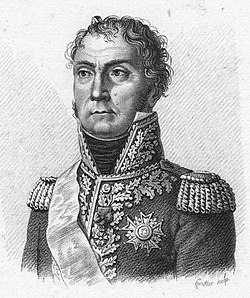 general swam | ||||
| Date of Birth | May 30, 1760 | |||
| Place of Birth | Ludersak | |||
| Date of death | April 28, 1837 (76 years old) | |||
| Place of death | Versailles | |||
| Affiliation |  France France | |||
| Type of army | Infantry | |||
| Rank | Division General | |||
| Commanded | 9th division of the 7th corps, 3rd Army Corps (1813) | |||
| Battles / wars |
| |||
| Awards and prizes |
| |||


Biography
Born May 30, 1760 in Lyubertsak . He entered the military service on March 17, 1782 as an ordinary in the royal cuirassier regiment.
In 1792, Suam enters the 2nd Correz volunteer battalion of the revolutionary army and fights in the first coalition war . In the battle of Gemappe, he commanded a battalion, then was in business under Dunkirk . On July 30, 1793 he was promoted to brigadier general , and on August 30 he became a division general in the army of Jourdan .
In September of the same year, in an effort to divide the forces of the allies located on the Sambra River, Suam launched a sabotage into Flanders , took possession of Menen and Marsienny and gained success in his enterprise, although it suffered significant damage during the retreat.
In 1794, he served in the same theater of war under the command of Pishegru ; led various divisions and at the end of April, having seized the fortified heights under the Church attack, overthrew the enemy with the loss of several guns and many prisoners in Tournai . On April 29, he defeated the Austrians near Curtre . At the Battle of Turkuen , on May 18, Suam and Moreau , in the absence of Pishegru, controlled the army; in June, he covered the siege of Ypres , conquered Herzogenbusch, and in November Nimwegen saved the Dutch garrison from the danger of drowning during a flood, and this was done under the fire of English batteries.
In 1795, he took part in the conquest of Holland . In 1796 he was in Germany in the army of Jourdan, who, however, reproached him for the lack of energy in the battle of Stockach and, consequently, the defeat of the French.
In 1800, Suam commanded a division in the Rhine Army of General Moreau, and, on the left wing under the command of Saint-Cyr , had several stubborn affairs in May and June in the vicinity of Ulm . On the day of the Hohenlinden victory , he acted on the left bank of the Danube against General Klenau and occupied Regensburg . Because of his close friendship with Moreau and Pishegru and their zealous defense against Bonaparte's accusations, Suam incurred the wrath of the First Consul, was imprisoned for several months and then dismissed from service.
In 1807, he was again appointed the head of the 9th division in the 7th Corps of Saint-Cyr in Catalonia . In 1808, Suam covered the siege of Rozas and defeated the Spanish General Alvarez on the River Fluvia on November 24. Equally different were his actions in the battle of Llobregat (December 21) and in the victory won by General Reading at Waltz (February 25, 1809), where Suam withheld the onslaught of superior enemy forces, and, receiving reinforcements from the Pino division, threw the Spaniards back to Tarragona having recaptured from them all artillery, convoys and several thousand prisoners.
In the autumn of that year, covering the siege of Girona, he successfully repelled all attempts by General Black to free this fortress, but barely managed to escape from captivity when General O'Donnell , with a sudden sortie, made his way through the besieging French corps with part of the garrison.
Following the capture of Gironna, he was sent with a division to Upper Catalonia: there, in the course of 1810, surrounded by the guerillas and constantly alarmed by them and General O'Donnell, Suam and his troops showed courage and activity, especially in the battle of Wij, in which 4000 the French defended themselves for several hours against 10,000 Spaniards and forced them to retreat.
The severe wound received in this battle forced Swam to retire to France , but in 1812 he returned to Spain , where he commanded the General Dorsen’s Northern Army division. Armed with reinforcements to the Portuguese army, which was defeated during Salamanca , Suam joined her in September near Briviesco, accepted as senior senior commanders from General Klozel, and in October moved to liberate Burgos , besieged by Wellington . But this venture failed, and Suam retreated, pursued by the Allies.
In November, the Portuguese, Northern and Central French armies joined under the command of Marshal Soult and again pushed the Anglo-Spaniards to Portugal . At this time, Suam left the army because of a quarrel with King Joseph .
In the spring of 1813, Suam formed a new division in Mainz and entered the 3rd Corps of Marshal Ney . In the battle of Lutzen, Suam was the first to withstand the onslaught of the allied forces in the villages of Gross-Gerschen and Klein-Gerschen and Rana, and lost almost half of his division. Napoleon , giving full justice to the brave general, granted him a gentleman of the Legion of Honor , but even here he did not agree to the request of the noble Suam - to release his friend, General Dupont , who was arrested for surrender under Bailen, from the castle of Gam. Under Bautzen, Suam acted on the left wing of the French against Blucher and Barclay de Tolly , and after the Poyshvitsky truce and the appointment of Ney as army commander instead of Marshal Udino , he took command of the 3rd Corps. After an unsuccessful battle at Katzbach, Suam covered, along with Sebastiani's cavalry, MacDonald's retreat.
In the battle of Leipzig, Suam, with two divisions of the Ney corps, located against the Austrian Silesian army, was sent to reinforce Napoleon in Wachau. Before he reached this village, he received an order to return to help Marmont with Mekern, but he arrived there after the French were defeated. In October, Suam fought on the Parte River, defended the Schönfeld village and was again injured.
In the campaign of 1814, he was in the corps of Marmont, commanding a division composed of a mobile national guard; he participated in the battle of Fer-Champenoise and in repelling the assault by the allies of Montmartre Heights , and after the surrender of Paris , retreated, together with the corps, to Esson, where he was present during the negotiations of Marmont with Prince Schwarzenberg , with the aim of separating the 6th Corps from Napoleon’s army in Fontainebleau and position him behind the Allied forces. When Marmont, Ney and MacDonald went to Paris to persuade the Allied monarchs to recognize Napoleon's son as the successor to the throne, and the emperor received an order from Emperor to go to Fontneblo, then Swam, fearing the discovery of the secret of the condition with Schwarzenberg, spoke immediately to Versailles , not informing the troops of the real purpose of the campaign.
This movement of Marmont's corps completely changed the situation. Allied monarchs demanded immediately unconditional abdication of Napoleon from the throne. When the troops at Versailles learned the details of the case, they rebelled, and Suam was forced to hide.
From Louis XVIII he received command over the 20th Military District, remained inactive during Napoleon’s hundred-day reign , was appointed Inspector General of the entire infantry in 1816, in 1818 - Military Governor of the 3rd Military District, and May 1, 1821 He was awarded the title of Knight of the Grand Cross of the Legion of Honor.
Upon accession to the throne of Louis Philippe, Suam was dismissed from active duty and retired to his estates.
Suam died on April 28, 1837 at Versailles. Subsequently, his name was embossed on the Arc de Triomphe in Paris .
Literature
- Military encyclopedic lexicon . 2nd ed. - T. XII. - SPb. , 1857.
- Encyclopedia of military and naval sciences . - T. VII. - SPb. , 1895.