Chrysanthemum and Sword: Models of Japanese Culture - Ruth Benedict's book devoted to the study of Japanese culture, and one of the most famous works on cultural anthropology ; first published in 1946 in the USA. translated into Japanese in 1948 and became a bestseller in the PRC . [one]
| Chrysanthemum and the Sword: Models of Japanese Culture | |
|---|---|
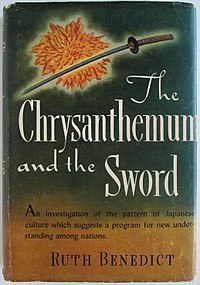 Cover of the first edition of the book | |
| general information | |
| Author | Ruth Benedict |
| Type of | and |
| Original version | |
| Title | English The Chrysanthemum and the Sword: Patterns of Japanese Culture |
| Language | English |
| Place of publication | Boston |
| Publishing house | Houghton Mifflin Harcourt |
| The year of publishing | 1946 |
| Pages | 324 |
| ISBN | 978-0-395-50075-0 |
| Russian version | |
| Translator | N. M. Seliverstov, ed. A.V. Govorunova |
| Place of publication | SPb. |
| Publishing house | The science |
| The year of publishing | |
| Pages | 359 |
| Carrier | paper |
| ISBN | 5-02-026868-2, 0-395-50075-3 |
Content
- 1 History of creation
- 2 research Methodology
- 3 Key Ideas
- 4 Some information from the book
- 5 Criticism
- 6 Publications in other languages
- 6.1 In Russian
- 7 notes
Creation History
The study was launched in June 1944 on behalf of the US government, as America faced the need "to find answers to many questions about our enemy - Japan" [2] .
Research Methods
Since the United States and Japan were at war , Benedict could not resort to the usual method of field research in such cases. Therefore, she collected material for the book using the following methods:
- interviewing Japanese living in the USA;
- acquaintance with literature about Japan and the Japanese - both Western and Japanese authors;
- watching films - propaganda, historical, artistic.
Key ideas
The book examines the system-forming concepts for Japanese society: [3]
- debt;
- hierarchy;
- shame;
- sincerity;
- self esteem
and others.
“ Duty ” ( it ), which determines (and subjugates to itself) the life of every Japanese, is divided into two categories:
- bad debt ( gime )
- debt to the emperor (as well as the country as a whole) ( ty )
- parents (and therefore ancestors and descendants) ( co )
- duty to work ( nimmu )
- debt that can be paid ( weights )
- debts to the world
- to the prince
- to relatives
- to other people for what he received from them
- duty to honor the honor of the name.
- debts to the world
The hierarchy is considered by Benedict through the concept of "due place" - that position in society and the family that a member of Japanese society should occupy according to
- social status of the family
- the floor
- age.
Some information from the book
- the child is taught reverence from infancy, bowing his head when his mother bows;
- ordinary Japanese did not have a family name until the middle of the 19th century: it was not needed, since loyalty to the prince, and not the family, was considered the main virtue;
- using one of the most popular expressions of gratitude, sumimasen , the Japanese mean something like this: thank you for doing me a favor, and I'm sorry for not doing this for you first.
Criticism
Douglas Lummis noted that “ After a while I realized that I could never live in decent relations with the people of this country, if I didn’t get rid of this book, and its politely-arrogant view of the world, from my head ” [4] .
Lummis, who visited the archives of Vassar College to check the links with Benedict, wrote that some of the important things in the book are based on an interview with Robert Hashima, a native of the United States of Japanese origin who was brought to Japan by a child, studied here, and then returned to the United States before the outbreak of World War II. Lummis, who interviewed Hashima, notes that this circumstance helps to reveal bias in the study of Benedict [4] :
For him, who had come to Japan for the first time as a teenager in the middle of the militarist period and had no memory of the country before, what he studied at school was not “ideological”, such was Japan for him.
Original textFor him, coming to Japan for the first time as a teenager smack in the middle of the militaristic period and having no memory of the country before then, what he was taught in school was not "an ideology", it was Japan itself.
Lummis believes that Benedict too trusted in Hashima, who told a deeply alien experience of life in Japan [4] :
It seems he has become a kind of touchstone, the authority on which she checked information from other sources.
Original textseems that he became a kind of touchstone, the authority against which she would test information from other sources
Other language
In Russian
- Benedict R. Chrysanthemum and the sword. Models of Japanese culture. / per. from English N. M. Seliverstova, ed. A.V. Govorunova . - SPb. : Science , 2004 .-- 359 p. ISBN 5-02-026868-2
- Benedict R. Chrysanthemum and the sword. Models of Japanese culture. - M.: Russian Political Encyclopedia , 2004. - 256 p.
- Benedict R. Chrysanthemum and the sword. Models of Japanese culture. - M .: Nauka , 2007 .-- 360 p.
Notes
- ↑ Fujino, Akira, Tribune News Service, 'Book on Japanese culture proves a bestseller in China ", The Advocate of Stamford , Connecticut, January 8, 2006
- ↑ Ruth Benedict. Chrysanthemum and sword. Models of Japanese culture. Publisher: Russian Political Encyclopedia, 2004, p. 7
- ↑ Kent, Pauline, "Japanese Perceptions of the Chrysanthemum and the Sword," Dialectical Anthropology 24.2 (1999): 181.
- ↑ 1 2 3 Lummis, C. Douglas Ruth Benedict's Obituary for Japanese Culture // The Asia-Pacific Journal: Japan Focus