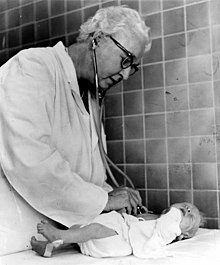
Apgar , Scale Apgar - a system for quick assessment of the condition of the newborn .
At the 27th annual congress of anesthesiologists ( 1952 ), the American anesthetist Virginia Apgar first officially presented her developed system for assessing the condition of the newborn in the first minutes of life. This is a simple method for the initial assessment of the condition of the child in order to identify the need for resuscitation procedures.
The scale assumes a total analysis of five criteria, each of which is evaluated integrally in points from 0 to 2 inclusive. The result of the assessment can be in the range from 0 to 10.
The Apgar scale is one of three parameters, along with the weight and height that are reported to the parents of the newborn.
Content
Criteria
Five criteria for Apgar grading:
| 0 points | 1 point | 2 points | |
|---|---|---|---|
| Coloring the skin | Generalized pallor or generalized cyanosis | Pink body color and cyanotic limb color (acrocyanosis) | Pink color of the whole body and limbs |
| Heart rate | Missing | <100 | > 100 |
| Reflex excitability | Does not react | The reaction is mild (grimace, movement) | Reaction in the form of movement, coughing, sneezing, screaming loudly |
| Muscle tone | Missing, limbs hanging down | Decreased, some limb flexion | Active movements |
| Breath | Missing | Irregular, weak scream (hypoventilation) | Normal, scream loud |
Interpretation of results
This assessment is usually carried out in the first to fifth minute after birth and can be repeated later if the results were low. A score of less than 3 means a critical condition of the newborn, more than 7 is considered a good condition (normal).
The Apgar scale was designed for medical staff to determine which children require more careful monitoring. A child who received 5 points needs closer monitoring than a child who received from 7 to 10 points. A child who receives 5-6 points a minute after birth, but five minutes later increases his score to 7-10, goes into the category of children you can not worry about. A child who begins life with five Apgar points and remains at the same 5 points 5 minutes after birth needs more careful observation. Ideal 10 points are rare.
A mnemonic rule for English-speaking specialists (it was introduced by pediatrician Joseph Butterfield in 1963):
- A ppearance - appearance (color of the skin);
- P ulse (Heart Rate) - the pulse of the child (heart rate);
- G rimace (Response to Stimulation) - a grimace that occurs in response to irritation;
- A ctivity (Muscle Tone) - activity of movements, muscle tone;
- R espiration - breathing movements.
The following acronym is common in German-speaking countries: Atmung, Puls, Grundtonus, Aussehen, Reflexe . Alternative: Aussehen, Puls, Gesichtsbewegungen, Aktivität, Respiration (Atmung).
The following neologisms are also used: American Pediatric Gross Assessment Record .
Spanish acronym: Apariencia, Pulso, Gesticulación, Actividad, Respiración .
In English, the following mnemonic rule is also in use: How Ready Is This Child (literally - how ready is this child), where:
- H eart rate - heart rate,
- R espiratory effort - breathing,
- I rritability - reflexes and irritability,
- T one - muscle tone,
- C olor - skin color.
Monitoring of all indicators is carried out in the first minute after birth, then in the fifth minute of life.
In some cases, especially at low rates, the Apgar score is also given in the 10th minute of life.
Mom and relatives, as a rule, are given two numbers, for example, 8-9 points on the Apgar scale indicate that the baby's condition immediately after birth is good.
See also
- Ballard Scale
Notes
Literature
- Sears W., Sears M. Your baby from birth to two years. - M .: Eksmo, 2006.