
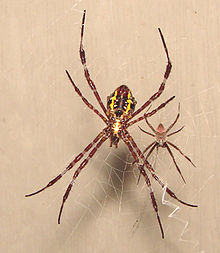
Sexual dimorphism (from ancient Greek δι- - two, μορφή - form) - anatomical differences between males and females of the same biological species . Sexual dimorphism can manifest itself in various physical signs [1] .
- Size In most mammals and chicken birds, males are larger and heavier than females. In many birds (especially predatory ) , amphibians and arthropods, females are usually larger than males. In turtles and snakes, females are larger than males; in lizards, on the contrary, as a rule, males are larger than females; The exception is geckos, in which a large value is also characteristic of females.
- Hairline Beard in men, a mane in lions or baboons .
- Coloring . The color of feathers in birds, especially in ducks .
- Skin Characteristic growths or additional formations, such as deer antlers , scallops in roosters .
- Teeth . The tusks of the males of the Indian elephant , the larger canines of the males of walrus and boars .
Some animals, especially fish , show sexual dimorphism only during mating. According to one theory, sexual dimorphism is more pronounced, the more different the contributions of both sexes to the care of offspring. It is also an indicator of the level of polygamy .
Content
What is sexual dimorphism?
Sexual dimorphism is a general biological phenomenon widespread among dioecious forms of animals and plants . In some cases, sexual dimorphism is manifested in the development of such signs that are clearly harmful to their owners and reduce their viability. Such, for example, are the decorations and the bright coloring of males in many birds, the long tail feathers of the male peacock , the bird of paradise , the lira bird , which interfere with flight. Loud shouts and singing, sharp odors of males or females can also attract the attention of predators and put them in a dangerous position. The development of such signs seemed inexplicable from the standpoint of natural selection. For their explanation in 1871, Darwin proposed the theory of sexual selection [2] . She caused controversy in the days of Darwin. The view was repeatedly expressed that this was the weakest point of Darwinian teaching [3] . Sexual dimorphism in humans includes gender differences .
Sexual dimorphism and reproductive population structure
Sexual dimorphism must be associated with the reproductive structure of the population : it is minimal in strict monogamies, because monogams use specialization of the sex only at the level of the organism, not the population, and in panmict species and polygamies , they use the advantages of differentiation more fully, as the degree of polygamy increases.
Reversal of sexual dimorphism with polyandry
Polyandry , in which the female mates with several males, is found in invertebrates , fish , birds , mammals . At the same time, reversal of sexual dimorphism is often observed (females are larger than males, brighter colored, males build a nest, hatch eggs and take care of brood, there is no struggle for a female). Such a phenomenon is present in the emu , three - fusilli , color snipe , water bugs Phoreticovelia disparata .
Handicap Principle
The principle of the handicap is the proposed evolutionary force that causes the development of signs in some species, which, at first glance, lead to a deterioration in the fitness of the organism. For example, bright plumage in males of birds makes them more visible and attracts predators , while less bright females mask well.
However, at the level of the species, the reproductive success of the organism, that is, the number of its descendants, is more important than the duration of its life. This is clearly seen in the example of a pheasant , the females of which live twice as many males. But the ability of the male pheasant to reproduce does not depend on the length of its life, but on its attractiveness to females.
A male with brightly colored plumage and a large tuft demonstrates to the female a high fitness , that is, that he survived, despite the "odds" that the less visible males had, and therefore the female, who would pass on his genes , especially to his daughters, who will have camouflage, provides them with increased fitness.
It is also possible to suggest a different explanation for the presence of “Handicap” in some species. The handicap can be explained as a consequence of the “arms race”: the larger tail initially played the role of an awesome tool that gave one of the rivals a better chance of winning the fight for the right to mate with a female, a visually large tail created the illusion of advantage in strength, the winner’s genes spread faster in the population and with each new mutation to increase the size of the tail, the chances of its owner increased. Over time, fights between males due to the inconvenience of a tail delivered by the tail took on the character of the evolutionary stable strategy of the “Dove” behavior. For females, the size of the tail was thus familiar not with the fact that the male was successful, because he survived, despite the “handicap”, but as a symbol of a stronger and more capable of protecting. Despite the fact that in the present state of affairs, tail size does not in any way affect the degree of protection of the female, in this case there are two factors: 1 - the effect of time lag, that is, the genetically acquired installation did not manage to evolve when choosing a partner; 2 - such sexual game conditions adopted by all members of the species give females the confidence that the genes of the male with the best handicap will ensure her descendants success with the other females.
See also
- Sexual selection
- Dimorphism
- Polymorphism
- Hermaphroditism
- Gender Differences
Notes
- ↑ Shimkevich V. M. Sexual differences // Encyclopedic dictionary of Brockhaus and Efron : in 86 tons (82 tons and 4 extras). - SPb. , 1890-1907.
- ↑ Darwin C. (1953) The origin of man and sexual selection. Cit., 5, M.-L.
- ↑ Wallace L. (1911) Darwinism. M.