(65) Cybele ( Latin Cybele ) is an asteroid of the outer part of the main belt , which belongs to the spectral class P and heads the asteroid group of the same name — the Cybele family [4] . It was discovered on March 8, 1861 by the German astronomer Ernst Tempel in the Marseille Observatory and named after the ancient Greek goddess Cybele [5] .
| (65) Cybele | |
|---|---|
| Asteroid | |
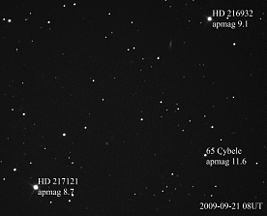 Cyber asteroid against the background of stars | |
| Opening | |
| Discoverer | Ernst Tempel |
| Detection point | Marseilles |
| Date of discovery | March 8, 1861 |
| Eponym | Cybele |
| Alternative designations | 1949 YQ |
| Category | Main ring ( Cybele Family ) |
| Orbital characteristics | |
| The Age of March 14, 2012 JD 2456000.5 | |
| Eccentricity ( e ) | 0.1098151 |
| Semi-axis ( a ) | 512.455 million km (3.4255502 a. E.) |
| Perihelion ( q ) | 456.18 million km (3.0493731 a. E.) |
| Afhelia ( Q ) | 568.73 million km (3,8017273 a. E.) |
| Period of circulation ( P ) | 2315,762 days (6.34 g ) |
| Average orbital speed | 16.044 km / s |
| Inclination ( i ) | 3.56290 ° |
| Ascending node longitude (Ω) | 155.65186 ° |
| Perihelion Argument (ω) | 102.67635 ° |
| Mean Anomaly ( M ) | 217,12214 ° |
| Physical characteristics [3] | |
| Diameter | 237.26 km ( IRAS ) 302 × 290 × 232 km [1] |
| Weight | 1.78⋅10 19 kg |
| Density | 1.70 ± 0.52 [2] 2,550 ± 0,220 |
| Acceleration of gravity on the surface | 0.0663 m / s² |
| 2nd cosmic speed | 0.1255 km / s |
| Rotation period | 6.082 h |
| Spectral class | P (Xc) |
| Apparent magnitude | 10.67 - 13.64 m |
| Absolute magnitude | 6.62 m |
| Albedo | 0.0706 |
| Average surface temperature | 150 K (−123 ° C ) |
| Current distance from the Sun | 3,425 a. e. |
| Current distance from Earth | 4.316 a. e. |
Content
Title
In the process of assigning the name to an asteroid, a small dispute arose. Ernst Tempel transferred his right to choose the name of the asteroid to the German scientist Karl Steinheil in recognition of his contribution to the telescope construction business. Karl Steingale also proposed to give the newly discovered asteroid the name of the then King of Bavaria Maximilian II and call it the word "Maximiliana". However, according to the rules of that time, the names of asteroids were given strictly only from ancient Greek mythology, besides a number of other astronomers spoke out strongly against such a name. As a result, the asteroid was named after the Phrygian goddess of the earth Cybele [5] .
Orbital characteristics
The Cybele family, as well as Cybele's asteroid itself, is located in the outer part of the asteroid belt and is one of the largest groups of asteroids in the main belt. A characteristic feature of this asteroid is their belonging to the dark carbon-rich spectral classes and the movement around the Sun in orbital resonance with Jupiter 1: 2 .
Physical characteristics
For the first time, an attempt to estimate the diameter of the Cybele asteroid was made in the Soviet Union , according to the results of observation of a star covering an asteroid on October 17, 1979 . These observations led to the conclusion that the asteroid was irregularly shaped with a maximum diameter of 245 km, which almost coincides with the diameter determined by the IRAS orbital observatory (237 km). During the same coverage, signs of the presence of a satellite with a diameter of 11 km were found, but it has not yet been possible to confirm its presence [6] . According to estimates, made 6 years later in 1985, the Cybele's diameter was about 330 km and was greatly overestimated. In 2004, Muller made another estimate of the size of Cybele, this time using thermophysical modeling (TPM), which gave a result of 302 × 290 × 232 km [1] .
The latest star coverage by this asteroid was observed on August 24, 2008 — the star 2UCAC 24389317 was eclipsed to 12.7 m magnitude [7] , and on October 11, 2009 — the star was eclipsed in the constellation of Aquarius 13.4m magnitude [8] .
The latest infrared spectra of the asteroid, obtained on October 7, 2010 , show an interesting picture of the absorption lines, similar to the spectrum of another large asteroid - (24) Themis . This may indicate the presence of water ice on the surface of Cybele [9] . The surface of an asteroid can be covered with a thin layer of silicate dust mixed with a small amount of water ice and solid organic substances [10] . The Japanese infrared satellite Akari revealed the presence of hydrated minerals on Kibela [11] .
See also
- List of asteroids ( 1—100 )
- Small Planet Classifications
- Asteroid family
Notes
- ↑ 1 2 Müller, T. G; Blommaert, JADL 65 Cybele in the thermal infrared: Multiple observations and thermophysical analysis (Eng.) // Astronomy and Astrophysics : journal. - EDP Sciences , 2004. - Vol. 418 . - P. 347-356 . - DOI : 10.1051 / 0004-6361: 20040025 . - . - arXiv : astro-ph / 0401458 .
- ↑ Carry, B. (December 2012), Density of asteroids , vol. 73, p. 98-118 , DOI 10.1016 / j.pss.2012.03,009
- ↑ Asteroid Data Sets (English)
- ↑ Linda T. Elkins-Tanton. Asteroids, Meteorites, and Comets : [ eng ] . - 2010. - P. 96.
- ↑ 1 2 Schmadel, Lutz D. Dictionary of Minor Planet Names . - Fifth Revised and Enlarged Edition. - B. , Heidelberg, N. Y .: Springer, 2003. - P. 21. - ISBN 3-540-00238-3 .
- ↑ IAUC 3439: 1979l; Occn OF AGK3 +19 599 BY (65) (inaccessible link is history ) . MPC (Circular No. 3439) (January 4, 1980). The appeal date is June 18, 2004.
- ↑ IOTA. (65) Cybele 2008 Aug 24 profile . Circulation date December 2, 2010. Archived June 17, 2012.
- ↑ Steve Preston. (65) Cybele / 2UCAC 28838190 event on 2009 Oct 11, 01:30 UT (unavailable link - history ) . The appeal date is September 21, 2009.
- ↑ Detected a second asteroid with water (rus.)
- ↑ Landsman, Zoe; Licandro, J .; Campins, H .; Kelley, M .; Hargrove, K .; Pinilla-Alonso, N .; Cruikshank, D .; Rivkin, AS; Emery, J .; Licandro; Campins; Kelley; Hargrove; Pinilla-Alonso; Cruikshank; Rivkin; Emery. Asteroid 65 Cybele: Detection Of Small Silicate Grains, Water-Ice And Organics (Eng.) // Bulletin of The American Astronomical Society : journal. - American Astronomical Society , 2010. - October ( vol. 42 ). - P. 1035 . - .
- ↑ Fumihiko Usui et al. AKARI / IRC near-infrared asteroid spectroscopic survey: AcuA-spec , December 17, 2018
