Jose di Anchieta or José Anchieta Llarena , ( port. José de Anchieta , isp. José de Anchieta Llarena ; March 19, 1534 , San Cristobal de la Laguna , Canary Islands - June 9, 1597 , Ansieta , Brazil ) - Jesuit a missionary from the Canary Islands , one of the largest figures in the history and culture of colonial Brazil during the first century after its discovery by the Portuguese . Member of the founding of the cities of Sao Paulo ( January 25, 1554 ) and Rio de Janeiro ( March 1, 1565 ). A writer and poet , the recognized founder of Brazilian literature . Compiled the first grammar of the Tupi language . For an enormous contribution to the cause of the enlightenment and Christianization of Brazilian Indians, he received the nickname Apostle of Brazil ; Catholic Church canonized saints ( 2014 ). Anchieta's Day ( June 9 ) since 1965 is celebrated in Brazil as a national holiday .
| Jose di Anchieta | |
|---|---|
| port. José de anchieta | |
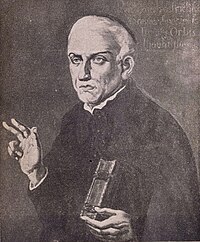 | |
| Date of Birth | March 19, 1534 |
| Place of Birth | San Cristobal de la Laguna |
| Date of death | June 9, 1597 (63 years) |
| Place of death | Anchieta , Brazil |
| A country | |
| Scientific field | history , geography , ethnography , religion |
| Place of work | Brazil |
| Alma mater | Coimbra University |
| Known as | missionary , historian , writer , poet , playwright , linguist , naturalist , doctor . Considered the founder of Brazilian literature . Member of the founding of the cities of Sao Paulo ( January 25, 1554 ) and Rio de Janeiro ( March 1, 1565 ). |
| Signature | |
Two Brazilian cities are named after him - one in the state of Espiritu Santo (formerly Reritiba), the other in the state of Santa Catarina .
Biography
Family and Childhood
Born on the island of Tenerife (Canary Islands) in a wealthy family.
His father, Juan Lopez de Anchieta, a landowner from Urrestilla ( Basque Country ), fled to Tenerife because of his participation in the unsuccessful rebellion of the Comuneros against the Spanish king Carlos I (Emperor of the Holy Roman Empire, Charles V ). A cousin of Juan Lopez de Anchieta was Beltran Yañez de Onias-i-Loyola - the father of Ignatius de Loyola .
The mother, Mencia Díaz de Clavijo y Llarena, belonged to a rich family of Jewish descent [1] (her father Sebastien de Llarena was a “ new Christian ” from Castile , as well as the nephew of Captain Fernando de Llerena — one of the first Spanish conquerors of Tenerife). By the time of marriage with Juan Lopez de Anchieta, she was the widow of Bachelor Noyano Nuñez de Villavicencio, the “ new Christian, ” and the mother of two children.
In this marriage were born ten children, among whom Jose was the third in a row.
Jose received his primary education from Dominican monks. In his childhood, for the first time, he felt his religious vocation.
In addition to José, his half-brother, Pedro Núñez, and his brother, Cristobal, also subsequently took holy orders.
Youth
Jewish origin was the main reason for sending Jose, a 14-year-old student, not to Spain, but to Portugal, because the Inquisition in this country was not as severe as in Spain. In 1548, Ancieta moved to Coimbra , where he began studying philosophy at the Jesuit College of Arts at the University of Coimbra . In accordance with the spirit of the time, he received a Renaissance education at this school, mainly philological and literary.
In 1551, Ancieta took a vow of chastity in front of the statue of the Blessed Virgin in the Cathedral of Coimbra and, deciding to devote himself to the service of God, joined the novice of the Society of Jesus at the University of Coimbra. Showing extraordinary religious fervor, he spent time in many hours of prayers, vigils and self-flagellation, which further weakened the young man’s already weak body. In addition, he survived the accident: a stepladder fell on his back. As a result of the subsequent spinal injury, he remained hunched for the rest of his life and never got rid of bouts of back pain.
Activities in Brazil
At this time, Brazil began to receive requests for the urgent dispatch of new missionaries for the evangelization of the Indian population. As the father superior of the Jesuit mission in Brazil, Father Manuel da Nobrega , stressed, he needed any staff, “ even those who are weak in the mind and sick with the body ” [2] . Young Anshieta, to whom the doctors also recommended the climate of the New World to restore health after suffering an injury, gladly set off on a mission overseas.
The second group of Jesuits on their way to Brazil, in which Anchieta found himself, set sail with a squadron of the new Portuguese Governor-General of Brazil, Duarte da Costa May 8, 1553 and July 13, arrived in Bahia . At this time, Nobreg's father was in the captain of San Vicente , and his acquaintance with Ancieta (later developed into a personal friendship) took place later.
During the acclimatization of Anshieta, he taught Latin to the children of immigrants and plunged into the study of the Tupi language . In October 1553, a group of 13 missionaries, among whom were Nobrega and Ansieta, went to San Vicente. After a dangerous two-month trip, during which they survived a shipwreck, the Jesuits reached San Vicente ( December 24 ). From there they went to the Piratining Plateau , where on January 24, 1554 the group settled in a small poor hut built for them by the Guayanas Indians on the orders of their cacique Tibiris between the small Tamanduatei and Anyangabau rivers, tributaries of the Tiete River . The next day, January 25 , on the feast of the Rev. Pavla, the first mass was celebrated in Piratin, and a new dwelling is dedicated to the Apostle of the Gentiles . At the Mass , in addition to the Jesuits and the Indians, there was also a Portuguese bandeirant, João Ramalhoy and his wife Bartira, daughter of cacique Tibiris.
Together with his Jesuit comrades, Anchiet has been engaged in Christianization, catechization and education of Indians there for ten years. The Collegium of São Paulo di Piratinga soon became the center of a prosperous settlement, in the first year of its existence with 130 inhabitants, 36 of whom were baptized.
In 1563, Manuel da Nobrega chose Ancietu as his assistant for an extremely difficult peacekeeping mission. No longer able to demolish the cruelty of the Portuguese colonialists, the Indians who inhabited the coast of the modern states of São Paulo , Rio de Janeiro and Espiritu Santo formed the so-called “ Tamoyos confederation ”, which soon formed an alliance with the French colonists who proclaimed the Antarctic colonies. founded Fort Coligny in Guanabara Bay, under the leadership of Vice Admiral Nicolas Duran de Villeganyon . Since 1562, the Tamoyos attacks have threatened the very existence of the captain of San Vicente .
Nobrega and Anshyet took a trip to the village of Iperoig (the modern city of Ubatuba , the state of São Paulo) and entered into peace negotiations with the Tupinambas Indians (who dominated the Confederation) to prevent their further attacks on San Vicente. A key role in these negotiations was played by Anshieta's excellent knowledge of the Tupi-Guarani language. For five months, Ansieta remained a voluntary hostage of Tamoios, while Nobrega returned to San Vicente, accompanied by Kunyambébe, son of Cacique Tupina Nambas, to complete the negotiations. During his stay in Iperoeig, Anchiete was hardly able to escape death at the hands of cannibal Indians several times. The negotiation process ended with the conclusion of the Iperoiga peace — the first peace treaty between the Indians of the New World and the Europeans, which actually laid the end of the tamoyos confederation and eliminated the French-Indian threat to the Portuguese colonies at that stage.
Being in Indian captivity, Anshieta folded his famous poem De Beata Virgine Dei Matre Maria , better known as the Poem Deva . Having no paper, he, according to the legend, wrote down couplets on the coastal sand every morning and memorized them, and only much later was able to transfer more than 4,000 stanzas to paper. Also, according to legend, in captivity of Ansieta, he did a levitation session in front of the Indians, who, horrified, considered him a sorcerer .
In 1564, Estasiu di Sa , nephew of the new Governor General Mema di Sa , arrived in Brazil at the head of the navy , with orders to finally oust the French colonists. During the stay of the fleet in San Vicente, Nobrega actively assisted in supplying the expedition, which went to war against the French in January 1565 . Together with Estasiu di Sa, Anchieta also went, who took part in the laying of the fortress of San Sebastián (future Rio de Janeiro) at the foot of the Pan de Azúcar mountain in March 1565 . In the future, Ansieta was a participant in the hostilities between the Portuguese and the French and the Indian allies who were on both sides; he acted as a surgeon and translator . In 1566, he went to Bahia with a report to the Governor-General about the course of the war against the French and asking for reinforcements to be sent to Rio de Janeiro. During his stay in Bahia, the 32-year-old Anshieta was ordained a priest.
In 1567, he participated in the final, victorious battles against the French and was present at the last minutes of Estasiu di Ca, who was fatally wounded in battle.
An undocumented story of Nobreghi and Ancieta’s decisive participation in the arrest of a Huguenot refugee, tailor Jacques Le Bayeux, by order of Governor-General Mena di Sa in 1559 and the imposition of the death penalty for preaching Protestant heresies. In 1567 Le Bayeux was transferred to Rio for execution. However, the executioner refused to execute the sentence and then, eager to end the heresy, Anshieta allegedly strangled Le Bayeux with his own hands. The largest biographer of Anshitya, Jesuit father Elihu Abranchis Viotti, based on a number of documents contradicting this story, calls this episode apocryphal .
In 1567 he returned to Rio, and later that same year he was appointed rector of Jesuit houses in São Vicente and São Paulo. In 1569, he founded the settlement of Roritiba ( Iritiba ) - the modern city of Anshieta in the state of Espirito Santo. For three years ( 1570 - 1573 ) Anciethe was rector of the Jesuit College of Rio de Janeiro, succeeding Manuel da Nobregu, who died in 1570, in this position. On April 8, 1577, the General of the Society of Jesus Everardo Mercuriano appointed him a provincial of the Society of Jesus in Brazil. Anshieta held this position for 10 years.
Since 1570 , despite his poor health and long journey over land and sea, Ancieta traveled a lot, overcoming vast distances within the territory of the modern states of Rio de Janeiro, Bahia, Espiritu Santo and São Paulo, visiting each from the Jesuit missions. Despite snakes and wild animals, he embarked on numerous expeditions to uncharted forests in search of Indian tribes not yet embraced by Christian preaching.
In 1587 he was dismissed at his own request, but then he also headed the College in Vitoria (Espírito Santo) until 1595 .
Death
In 1595, due to deteriorating health, Anshieta was finally able to retire to Réritibu, where he died two years later. He was mourned by 3,000 Indians, who appreciated his efforts to protect their lives and human dignity. Buried in Vitoria. Two Brazilian cities are named after him - one in the state of Espiritu Santo (formerly Reritiba), the other in the state of Santa Catarina, as well as many other places, roads, institutions, hospitals and schools.
Attitude to Indians
An enlightener and apostle of the Indians, Anshieta invariably acted (often to the detriment of himself) as their protector against the atrocities of the Portuguese colonialists, sharply condemning the latter for the fact that they did not consider the indigenous population as people. His activities in Brazil, in his own mind, should have been directed to the benefit of simple and defenseless indigenous peoples. He studied their language, customs and worldview, tried his best to get close to them and take part in their lives and, ultimately, made a great contribution to the development of their material and spiritual culture, as well as ensuring their personal and public safety. At the same time, he was far from idealizing the Indians and in his works pointed out their shortcomings that had to be eradicated: laziness and idleness, drunkenness and debauchery , cruelty and cannibalism , etc. However, he noted that the worst Behavior is different from those of Indian tribes who more than others communicate with Europeans - the Portuguese and the French. During his life and after the death of Anshiet remained for the Indians almost supernatural being. There are many legends around him, such as the legend of how he was able to stop an attacking jaguar with the Word of God. According to popular belief up to our days, the prayer of Anshiete helps against the attacks of wild animals.
Beatification
Despite the fact that the campaign for the beatification of Jose di Ancieta began in 1617 in the captain of Bahia, it was carried out only in June 1980 by Pope John Paul II . It appears that the expulsion of the Jesuits from Brazil and Portugal, carried out by the Marquis di Pombalom in 1759 , prevented this process, which had begun in the 17th century.
Canonization
Anshieta was canonized on April 3, 2014 by Pope Francis [3] . He became the second saint born from the Canary Islands after Pedro Betancourt .
The Path of Anchieta
At one time, Ansieta was known among the Indians as abarebebe , which means the holy fast walker (or holy flyer father ). As a result of his regular travels, he twice a month traveled along the coast from Reritiba to Vitoria Island, making brief stops for prayer and rest in the villages of Guarapari, Sétibes, Ponta da Frut and Barra do Zhuku. Today, this distance, which is approximately 105 kilometers, is covered on foot by pilgrims and tourists along the lines of the Santiago Way in Spain.
Literary Activity
The volume and versatility of the literary heritage of the Apostle of Brazil, considered the first Brazilian writer, is amazing. He was a grammar, poet , playwright and historian and wrote in four languages: Portuguese, Spanish, Latin and Tupi.
He was also an astute naturalist who described several new species of plants and animals, as well as an excellent doctor and surgeon .
Poetry
His poem De gestis Meni de Saa ( On the Acts of Mena di Sa ) (c. 1560 ), preceding the Lusiads of Camoes , narrates the struggle of the Portuguese and the French Huguenots in Brazil; She became the first work in the genre of epic poetry in the New World .
His famous poem De Beata Virgine Dei Matre Maria , better known as the Poem Deva , composed by him in Indian captivity and numbering 4,172 stanzas .
Dramaturgy
Anshieta created religious hymns and dramas to teach Indians the basics of morality through music and theater . His most famous dramatic work is Auto about Saint Lawrence or On the feast of Saint Lawrence ( Auto de São Lourenço or Na Festa de S. Lourenço ) - a trilingual piece in Latin, Portuguese and Tupi-Guarani. The plot of the play is rich in characters and dramatic situations, the theme of the martyrdom of the saint is revealed in song, struggle and dance.
Tupi grammar
The grammar art of the most used language on the coast of Brazil ( Arte da gramática da língua mais usada na costa do Brasil ) is the first work containing the basics of the Tupi language. Upon arriving in Brazil, Anchieta received an assignment from Manuel da Nobregi to master the language of the indigenous population; he completed his study after six months, and a year later already mastered him fully and subsequently wrote many of his works on it. The art of grammar was published in 1595 in Coimbra by Antonio di Mariz. Currently, two copies of this edition have been preserved (two of them are in the National Library of Rio de Janeiro). This is the second of the published works of Anshieta and the second work on Indian languages (after the appearance in Mexico in 1571 of the Art of the Mexican and Castilian language of brother Alonso de Molina ).
Historiography
The most important historical works of Jose di Anchieta are his Letters , as well as a number of Messages . These documents describe the events that Anshieta witnessed and participated in during his 30-year missionary activity in Brazil. Clear and detailed descriptions of Anchieta today are of great importance for understanding the way of life, level of knowledge and customs of contemporary Indians and Europeans, as well as discoveries in the field of wildlife and geography of Brazil .
Report on Brazil and its capitals, 1584
Jose di Ancieta's first translation into Russian, 2010
In 2010, O. Dyakonov made the first translation into Russian of the work of Jose di Anchieta - Reports on Brazil and its captains - 1584 .
The document belongs to several historical reports ( Report on Brazil and its capitals - 1584 , Reports on the province of Brazil for Our Father and Historical fragments ), first discovered in the library of the Portuguese city of Evora by Brazilian historian and diplomat Francisco Adolf di Varnhagen , Viscount of Porto Seguro ( 1816 - 1878 ), who transferred them to the Brazilian Historical and Geographical Institute ( IHGB ).
The manuscript, written in Portuguese language of the XVI century , was published in the Journal of the Brazilian Historical and Geographical Institute ( RIHGB ), Vol. VI, No. 24, 1844 . Later, one of the largest Brazilian historians, João Capistrano Honorio de Abreu ( 1853 - 1927 ), who found a more accurate copy of the Message in the same library of Évora, quite confidently established the authorship of Anchieta (first proposed by Varnhagen). This is evidenced, in particular, by the author’s detailed account of the events related to the founding of São Paulo, and in general, his increased attention to and awareness of the affairs of the southern coast, and, on the contrary, a rather superficial description of events in the north.
From a copy of Kapistrana di Abreu, published in 1933 in the fundamental collection of works by Ancietus. Letters, messages, historical fragments and sermons of the father Joseph di Anchieta, O. I. ( 1554 - 1594 ) ( Cartas, Informações, Fragmentos Historicos e Sermões do Padre Joseph de Anchieta, SJ ) O.Dyakonov translated into Russian. At the same time, the translator also tried to indicate all the main semantic differences, as well as differences in the spelling of names and titles, contained in the Varnhagen manuscript of the RIHGB of 1844, since it often contains some additional words and fragments that are absent in the version of Capistrana di Abreu, or represents an alternative sometimes a clearer reading of certain places in the text.
Indigenous Brazil Marriage Report, 1560s
A copy of the marriage of the Indians of Brazil , owned by Jose de Ancieta, was first presented to the Brazilian Historical and Geographical Institute ( IHGB ) in 1844 by historian and diplomat Francisco Adolf de Varnhagen, who found this document in the Évora Library, cod.CXVI / 1-33 , f.130v (Portugal). In his cover letter to the Institute, he pointed to the newly found document as being directly related to a study published shortly before this study by Colonel J. J. Mashadu de Oliveira. What was the social position of a woman among Brazilian aborigines? ( Qual era a condição social do sexo femenino entre os indigenas do Brasil? In the Journal of the Brazilian Historical and Geographical Institute ( RIHGB ), No. 14, Vol. IV, 1842). Arguing with Mashadu de Oliveira, Varnhagen emphasized that the facts in the Marriage Report of the Indians of Brazil “will contradict the views of Mr Mashadu de Oliveira” and “darken some iridescent paintings with prose paints” that paint “beautiful and comforting theory "of this author.
Varnhagen described his find as follows: “One valuable book with 215 sheets, bound in parchment and now owned by the Library of Évora, contains papers related to the Jesuits of Brazil at the end of the 16th century and written in the handwriting of that time; on page 130 we find a report on the subject (that is, the position of a woman among Brazilian Indians), which takes six pages, and there is a mark made in the same handwriting that Joseph Anchieta wrote it in the margin. This report is of paramount importance in the light of the facts contained in it ... ”
According to the description of the original, given by Varnhagen, there is only the name of the author, but there is no date. However, the Message most likely belongs to the 1560s, since the historical persons mentioned are directly connected with Piratinga and the conclusion of peace in Iperoiga. Considering that Anshieta is well aware of the details of the “personal life” of such cacique as Kunyambeb and Aimbir, he may have written it after his 5-month captivity in Iperoiga (when he knew them all well), therefore, after 1563 , but hardly a lot of time later, since the memories of these leaders were still fresh in his memory.
Works
In Latin and Portuguese
- José de ANCHIETA, De Gestis Mendi de Saa. Poema epicum. Introdução, versão e notas pelo Pe. A. Cardoso, SI. São Paulo, Ed. Loyola, em convênio com and vice-postulação da causa de canonização do Beato José Anchieta, 4ª ed., 1986. 344 p. (Obras Completas, Vol. 1º).
- Joseph de ANCHIETA, Poemas Eucarísticos e outros (De Eucaristia et aliis). Introd., Versão e notas do Pe. A. Cardoso, SJ. SP, Ed. Loyola, 1975, 246p. (Obras Completas, v.2).
- Joseph de ANCHIETA, Teatro de Anchieta. Originais acompanhados de trad. versificada, Introd. e notas pelo Pe. A. Cardoso, SJ. SP., Ed. Loyola, 1977,374p. (Obras Completas, Vol.3).
- Joseph de ANCHIETA, Poema da Bem-Aventurada Virgem Maria, Mãe de Deus. Vols. I — II. Originais latinos, acompanhados de trad. em verso alesandrino, Introd. e Anotações ao texto pelo Pe. A. Cardoso, SJ. SP, Ed.Loyola, em convênio com o Instituto Nacional do Livro, MEC, 1980, 312 e 420 p. (Obras Completas, Vol. 4, Tomos 1-2). Exoste nova edição, mais popular, sem original latino: José de ANCHIETA, O Poema da Virgem. Trad. port. em ritmos de A. Cardoso, SJ. 5th ed., SP, Paulinas 1996.
- Joseph de ANCHIETA, Lírica Portuguesa e Tupi. Originais em port. e em tupi, acompanhado de trad. versificada, Introd. e Anotações ao texto pelo Pe. A.Cardoso, SJ. SP, Ed. Loyola / Vice-Postulação da causa de canonização do Beato José de Anchieta, 1984, 232p. (Obras Completas, Vol. 5º, Tomo 1).
- Joseph de ANCHIETA, Lírica Espanhola. Original em espanhol, acompanhado de trad. versificada, Introd. e anotações ao texto pelo Pe. A.Cardoso, SJ. SP, Ed.Loyola / Vice-Postulação da causa de canonização do Beato José de Anchieta, 1984, 168p. (Obras Completas, Vol. 5º, Tomo 2).
- Joseph de ANCHIETA, Cartas: Correspondência ativa e passiva. Pesquisa, Introd. e Notas do Pe. Hélio Abranches Viotti, SJ. SP, Ed. Loyola / VicePostulação da causa de canonização do Beato José de Anchieta, 1984, 504 p. (Obras Completas, Vol. 6º).
- Joseph de ANCHIETA, Sermões. Pesquisa, Introd. e Notas do Pe. Hélio Abranches Viotti, SJ. SP, Ed. Loyola / Vice-Postulação da causa de canonização do Beato José de Anchieta, 1987, 184 p. (Obras Completas, Vol. 7º).
- Joseph de ANCHIETA, Diálogo da Fé. Introd. histórico-literária e Notas do Pe. A. Cardoso, SJ. SP, Ed. Loyola / Vice-Postulação da Causa de Canonização do Beato José de Anchieta, 1988, 240p. (Obras Completas, Vol. 8º).
- Joseph de ANCHIETA, Textos históricos. Pesquisa, Introd. e Notas do Pe. Hélio Abranches Viotti, SJ. SP, Ed. Loyola / Vice-Postulação da Causa de Canonização do Beato José de Anchieta, 1989, 198 p. (Obras Completas, Vol. 9º).
- Joseph de ANCHIETA, Doutrina Cristã: Tomo 1: Catecismo Brasílico; Tomo 2: Doutrina Autógrafa e Confessionário. Edição fac-similar. Introd. histórico-literária, Trad. e Notas do Pe. Armando Cardoso, SJ. SP, Ed. Loyola / Vice-Postulação da Causa de Canonização do Beato José de Anchieta, 1993, 148p. (Obras Completas, Vol. 10º).
- Joseph de ANCHIETA, Arte de Gramática da Língua mais usada na costa do Brasil. Edição fac-similar. Apresentação Prof. Dr. Carlos Drumond. Aditamentos Pe. A.Cardoso, SJ. SP, Ed. Loyola / Vice-Postulação da Caisa de Canonização do Beato José de Anchieta, 1990, 232p. (Obras Completas, Vol. 11).
Translated into Russian.
- Jose di Anchieta. The message about Brazil and its Captains - 1584. (inaccessible link - history ) . Terra Brasilis AD 1500: documentary sources on the history of Brazil (August 26, 2010). - Translation from Portuguese and notes - O. I. Dyakonov, 2010, Russia, Moscow. The appeal date is August 26, 2010.
- Jose di Anchieta. Report on Marriages with the Indians of Brazil. (inaccessible link - history ) . Terra Brasilis AD 1500: documentary sources on the history of Brazil (August 30, 2010). - Translation from Portuguese and notes - O. I. Dyakonov, 2010, Russia, Moscow. The appeal date is August 30, 2010.
Notes
- ↑ Center for Cultural Judaism - Articles (not available link)
- ↑ port. mesmo os fracos de engenho e os doentes do corpo
- ↑ El padre jesuita Anchieta ya es santo
Literature
- Simão de VASCONCELOS, Vida do Venerável José de Anchieta ... Editor: Serafim Leite, SJ. Rio de Janeiro, 1943. (Publicada pela 1a vez em 1672).
- Primeiras Biografias de Anchieta. SP, Ed. Loyola, 1988, 200p. (Nova edição, a cargo do Pe. HAViotti, SJ., Das obras de Quirício CAIXA, Pero RODRIGUES).
- Jorge de LIMA, Anchieta. Rio de Janeiro, Civilização Brasileira, 1934.
- Hélio A. VIOTTI, SJ, Anchieta, o Apóstolo do Brasil. SP, Ed. Loyola, 21980.
- Armando CARDOSO, O Bem-aventurado Anchieta. São Paulo, Ed. Loyola, 1980, 21991.
- Roque SCHNEIDER, José de Anchieta: Seu perfil e sua vida. 3ª ed., SP, Ed. Loyola, 1994
- André KISIL, Anchieta, Doutor dos Índios. Um missionário curando almas e corpos. SP, RG Editores, 1996. 152 p. (149–151 Bibliografia)
- Charles SAINTE-FOY, Anchieta, o Santo do Brasil. Edição comemorativa do IV centenário de falecimento do Padre José de Anchieta (1597–1997). São Paulo, Artpress, 1997. 210 p. (Nova tradução da obra de 1858).
- Armando CARDOSO, Um carismático que fez história: Vida do Pe. José de Anchieta. São Paulo, Paulus, 1997, 320p.
- Monumenta Anchietana. Obras completas do Pe. José de Anchieta, 11 Bde., São Paulo 1975-1993.
- Michael Sievernich: José de Anchieta, Kirchenvater Brasiliens, in the book: Johannes Arnold ua (Hg.), Väter der Kirche. Ekklesiales Denken von den Anfängen bis in die Neuzeit (FS Hermann Josef Sieben, Paderborn 2004, 967-992.
- Carlos Cezar Damaglio Misja José de Anchiety - apostoła Brazylii , wyd. Łośgraf 2002 ISBN 83-87572-94-2
- Balthazar Anchieta, Compendio de la Vida de el Apóstol de Brazil, VPJ de Anchieta (Xeres de la Fr., 1677)
- Simon de Vasconcelos, Vida do vener. padre J. de Anchieta (Lizbona, 1673);
- Jacques Cretino-Joly , Life of Anchieta in Oratorian Series (Londyn, 1849); Hist. of S, J., II, 119 (Paryż, 1851).
- Helen Dominian, Apostle of Brazil: The Biography of Padre José Achieta, SJ (1534–1597) (NY: Exposition Press, 1958)
- Jorge de Lima, Anchieta (Rio de Janeiro: Civilisaçao Brisiliera, 1934)
Links
- Anshieta / MF Nadjarnykh // Ankylosis - Bank. - M .: The Great Russian Encyclopedia, 2005. - P. 98. - (The Great Russian Encyclopedia : [in 35 t.] / Ed. Yu. S. Osipov ; 2004–2017, t. 2). - ISBN 5-85270-330-3 .
- Associação Pró-canonização de Anchieta (inaccessible link)
- Catálogo das Obras de Pe. José de Anchieta - Biblioteca Nacional (PDF)
- Cartas, Informações, Fragmentos Históricos e Sermões (fac-símiles) (PDF)
- Fac-símiles de alguns poemas de Anchieta no códice MS ARSI OPP N 24 O arquivo contém ainda fac-símiles de canções e romances ibéricos usados como base para os contrafacta de Anchieta (PDF)
- O Cancioneiro Ibérico em José de Anchieta: Estudo sobre a música na poesia de Anchieta Dissertação de Mestrado - ECA / USP, 1996
- Thomas Joseph Campbell, Catholic Encyclopedia, 1913
- Articles about Anshyet and his works.