| ||||
| Sant Ignazio in Italy, Santa Prisca (Mexico) , Saint Gervais in France, Smolny Convent in St. Petersburg (Russia) |
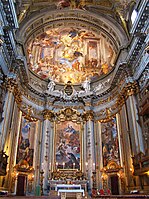


Baroque architecture is a period in the development of architecture of the countries of Europe and America (especially in Central and South ), covering about 150-200 years. The period began at the end of the XVI century and ended at the end of the XVIII. Baroque (as a style) encompassed all forms of art, but was most vividly reflected in painting , theater (and related literature, music), and architecture.
The origins of baroque architecture

The roots of Baroque go back to the architecture of the Renaissance . The first, really large and majestic ensemble was created in the Vatican Bramante . This is the 300-meter Belvedere courtyard, which was built in the same style while preserving the various functions of the buildings (Belvedere with antique sculptures, a regular garden, Vatican Library and an open-air theater). But all forms of architecture are rather calm, balanced. This is not baroque.
The idea of Bramante to create an ensemble of several buildings was picked up by Vignola (1507-1573). He did not have such opportunities as Bramante in the use of many building materials and space. Therefore, his ensemble of the villa Julia for Pope Julius III (pontiff in the years 1550-1555) was of small size. The villa already has all the baroque features - a single ensemble with pavilions , a garden , a fountain , steps of various types, connecting terraces of different levels. The villa is still strongly separated from the environment, closed to itself, like most Renaissance buildings, and its architecture is also balanced, like most Renaissance buildings.
The tension, gigantic dimensions and emotional richness of the architecture will inspire Michelangelo . It is in the works of Vignola and the late Michelangelo that researchers see the origins of Baroque architecture.
Mannerism and Baroque
Mannerism made its contribution to Baroque architecture. Despite all the flaws and whims, the masters of Mannerism picked up the baton of intellectual pursuits, high erudition, virtuoso craftsmanship, science and handed it to the architects of the early Baroque ( Giacomo Della Port , Domenico Fontana , Carlo Madern ).
It was at this time (according to the needs of society) that the types of the magnificent city palace, the baroque monastery, the country villa with the palace and the baroque garden arise. The facade of the church Il Gesзу in Rome (architect Giacomo della Porta ) became a model for the construction of many churches both in Italy and far beyond its borders ( Paris , Grodno , Lviv , etc.)
From Mannerism, the Baroque also inherited an attraction to the unusual, amazing, amazing. This was especially reflected in the landscape architecture, baroque gardens and parks (giant sculpture or giant grotesque mask, open-air theater, unusual building with exotic details, etc.). Even more attracted to the unusual collections - engravings, minerals, foreign plants. (and greenhouses for them), the creation of offices with the first museum collections.
In Italy
The next generation of Baroque architects will educate the great Italian architect Francesco Borromini .
It Borromini boldly departed from the classical canons, authoritative decisions, the old rules, designed the premises of unprecedented complexity. This Borromini is the real heir to Michelangelo Buonarroti’s emotionally charged architecture, bigger than Lorenzo Bernini or Pietro da Cortona .
Borromini. Oratorio of Filipino Monks, Rome
Borromini, section of the church of Sant Ivo at the University of Rome
The Cathedral of Santa Maria della Salute (1630–1631) in Venice. The work of Baldassare Longena
Basilica of the Superga (1717-1731), Turin . Job Filippo Yuvarra
An interesting way as a baroque architect was Yuvara . He began as a stage designer and assistant in the restructuring of theater buildings. Not all of his projects were embodied. But from building to building, he gained experience. If Domenico Fontana (1543-1607) or Francesco Caratti (? –1675) used the type of an elongated palace-block without playing with volumes, Yuvara enhances the expressiveness of his palaces with diagonal constructions, rizalits, and playing various volumes. The decor is becoming more restrained, does not avoid rust , pilasters and columns, so familiar to classicism . But buildings do not become examples of classicism, while preserving the greatness, diversity and beauty of baroque. An important distinction of the architectural style of Yuvara was the extremely expressive silhouettes of the buildings (the castle of Stupinigi, the Royal Palace of Madrid, especially the Superga Basilica).
Palazzo Carignano (arch. Guarino Guarini )
Royal palace in madrid
Stupinigi near Turin
Mafra Palace in Portugal
Many masters of Italy did not find in their homeland either orders or their knowledge. The participation of Italian masters in the construction of Gothic cathedrals in France is well known. In the 17th century, Italian architects delivered new architectural ideas throughout Western Europe.
In France
Cathedral House for the Disabled (1708) Jules Arduen-Mansart
Luxembourg Palace (1615-1645) by Solomon Debros
College of the Four Nations (1662-1688) Louis Levo
The Chapels of Versailles (1643-1715) by Robert de Cota
Mirror Gallery (1678-1686) in Versailles Arduen-Mansart
Hall in the Hotel Subiz (1735–1740) by Bofran
In the Holy Roman Empire
Baroque in translation means: a pearl of irregular shape. In the 17th century, the Holy Roman Empire as a state had a short rise period. It is associated with both positive and negative factors. The victory over Turkey and the liberation of European territories from non-European culture had a positive impact, since Turkey and its culture were not then perceived as part of Europe. Negative was the accession of industrial areas [ unknown term ] to Austria and the formation of the Austrian Empire. She had previously been a conglomeration of various cultural and historical regions. Now there are more areas. This process will last until the end of the 18th century. It began with the annexation of the violence of Hungary in 1686. It ended with the annexation of northern Italy, which provoked the National Liberation War, first in Hungary in the beginning of the XVIII century, in the XIX century - in Italy.
The victory was won by the secular and church authorities of Austria. It was these powerful and rich circles that became the customers and the main consumers of the achievements of the Baroque era. For strategic reasons, in 1683 the Austrians burned all the suburbs of Vienna, so that the Turks could not get anything. Approximately in 1690, the “construction boom” began - in the burned areas there are luxurious country estates, Baroque monasteries, Baroque churches in different cities.
Baroque construction began long before the 1690s. One of the first examples of the baroque cathedral in the city of Salzburg was established in 1611–1628. Even then, the projects and work of Italian architects were widely used, because the baroque of Austria developed under the powerful influence of the baroque of Italy. So, the cathedral in Salzburg was built by the Italian Santino Solari . And in Prague, captured and conquered by Austria, commissioned by the winning Austrians, an entire army of architects, decorators and artists of Italy worked (from architect Karatti to gardener Sebregondi ).
The student period ended after about 70 years. Already the most baroque structure of Vienna - the Schonbrunn Palace - is being built by Austrians Johann Bernhard Fischer von Erlach and his son Joseph Emmanuel. At the same time Schönbrunn is not like any of the palaces of Italy. Baroque buildings are being built in Vienna - the palace of Prince Eugene, the Bohemian Chancellery , the Court Library, the Church of St. Charles Borromeo ( Karlskirche ), the palaces of aristocrats. The Austrian province is proud of this masterpiece - a baroque monastery in the town of Melk (architect J. Prandtauer, I. Mungenast).
The most talented among the first generation of Baroque masters in Prague was Francesco Caratti , who designed the colossal Cherninsky Palace . The length of the Gothic St. Vitus Cathedral in Prague was 124 meters. The Chernin Palace was already 150 meters long.
Frauenkirche (Dresden)
Karlskirche (Vienna)
Pilgrimage church in vis
Monastery in Melk
In the Commonwealth
The first monument in the Polish-Lithuanian Commonwealth with elements of the pre-baroque - Farny Catholic church in Nesvizh - was erected in the 1580s by the Italian master Giovanni Bernardoni after the model of Il-Gesu . In imitation of this Roman church, countless churches were subsequently built. In Lviv, the parish of baroque is associated with the construction of the Sretensky church of barefoot Carmelites (1642–1644) in the image and likeness of the Roman church of Santa Susanna (arch. Carlo Maderna , 1603). However, during the 17th century, Polish gentry valued the heavy, simplified architectural forms, which were called Sarmatian style , which were not typical for Baroque. This to some extent hindered the further development of the Baroque architectural dictionary and its distribution in the Polish-Lithuanian provinces.
Gradually, the erudition and talents of architects quickly made it possible to move away from copying Italian designs and create original structures (a church and a monastery of barefoot Carmelites, Berdichev ). The largest orders — churches, monasteries, chapels — came from the Catholic Church. Only at the very end of the 18th century, the construction of large-scale palace residences, such as the Wilanow Palace in Warsaw, began under Western European influence. At that time, many temples of Krakow and Vilnius were rebuilt in the Baroque spirit, and the Xavieri Church richly decorated with sculpture was built in Grodno . The late monuments of secular baroque include the Branicki Palace in Bialystok , the Sangushek Palace in Izyaslav , the palace of Greek Catholic metropolitans in the complex of the Cathedral of St. George in Lviv , the country residence of Metropolitans in Obroshin .
In the Vilna diocese, the architecture of the churches valued the slimness of the silhouette, the delicacy of the decor, the rush up. The largest master of late baroque in the lands of the Grand Duchy of Lithuania - Jan Christoph Glaubitz - created a special type of two-tower baroque church, called Vilnius . The architecture of Left-Bank Ukraine , which separated from the Polish-Lithuanian Commonwealth after the Khmelnytsky Uprising , went its own way. Local architects creatively reworked the structure of the Orthodox churches of the pre-Mongol era in the wake of folk wooden architecture, enriching it with baroque decoration. Widespread are multi-pipe temples with pear-shaped heads. The local architectural school is known as the Ukrainian Baroque .
Baroque in Russia
In Russia, the development of baroque art, reflecting the growth and strengthening of the noble absolute monarchy, falls on the first half of the 18th century [1] . Baroque style in Russia possessed a number of national features. Russian mature baroque differed from the Western, in particular, the most pronounced - Italian, structural clarity and simplicity of planned constructions, the close connection of the structural base and the elements decorating it. Another distinctive feature of Russian baroque was its major character, the active use of bright colors in coloring, bold coloristic contrasts, including gilding [2] .
Nikolai Sultanov, a researcher of ancient Russian architecture, coined the term “ Russian baroque ”, denoting to them the pre-Petrine architecture of Russia of the 17th century . In fact, this term was understood as the “ Moscow pattern ”, which took shape in the 1640s. Contemporary art critics see the pattern rather as an analogue of Mannerism , while the history of Russian baroque leads to the spread in the Moscow construction practice of octagonos on a quadrangle (the Church of Tsarevich Joasaph , 1678). In the evolution of Russian baroque, the stages of “ Moscow Baroque ” of the end of the 17th century are distinguished ( Naryshkin , Stroganov , Golitsyn styles are distinguished), “ Petrovsky baroque ” of the first quarter of the 18th century, “ mature Russian baroque ” of Elizabethan time [3] .
Russian baroque architecture, which reached a magnificent span in the urban and manor ensembles of St. Petersburg , Peterhof , Tsarskoye Selo and others, is notable for its solemn clarity and integrity of the composition of buildings and architectural complexes (architect MG Zemtsov, F. B. Rastrelli, D. V. Ukhtomsky). A relatively little-known page in the history of Baroque is the temple architecture of the Ural factories and Siberia; in relation to it there are such terms as “ Ural baroque ” and “ Siberian baroque ”.
See also
- Edwardian Baroque
Notes
- ↑ Baroque // Great Soviet Encyclopedia : [in 30 t.] / Ch. ed. A. M. Prokhorov . - 3rd ed. - M .: Soviet Encyclopedia, 1969-1978.
- ↑ Russian mature baroque / Baroque in Russia / History of architecture / www.Arhitekto.ru
- Russian Baroque: Information about Russian Baroque
Literature
- collection "Baroque in Russia", M., 1926
- collection "Baroque in Slavic countries", M., "Science", 1982
- Vipper B. R. “The Architecture of Russian Baroque”, M., “Science”, 1978
- "History of Russian Art", vol. 5, M., ed. USSR Academy of Sciences, 1960
- “Decorative Art of the USSR”, No. 3, 1986 (article by V. Loktev “On the Second Calling of Architecture”)
- “ Architecture of the USSR ”, No. 9, 1982 (article by V. Loktev “This Incomprehensible Father of Baroque”)