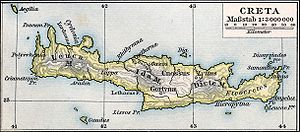
Quidons (Mycenaean Greek: ku-do-ni-jo / Kudōnios , ancient Greek. Κύδωνες / Κυδωνιάτας ) [1] is the name of the people who lived in the Bronze Age in the north-west of Crete . Their name is associated with the name of the mythical king Kidon (Mycenaean Greek: ku-do / Kudōn ), who founded the city of Cydonia ( Linear letter A : ka-u-do-ni / ku-do-ni [2] ; Mycenaean Greek : ku- do-ni-ja / Kudōniā ; Drevg . Κυδωνία ).
Along with the Etheocrits (Minoans) were considered the most ancient inhabitants of the island of Crete . [3] Practically nothing is known about their origin and language.
Content
Archeology
An indirect evidence of the existence of kidons is the difference between the material culture of the west of Crete during the Minoan civilization. In the early kingdom period, the Cretan hieroglyphs spread in the center and in the east of the island, while in the west they were absent. Although the city of Kydonia was supposedly founded by the Minoans and culturally did not differ from the rest of the island, but its subordinate territories in the west of the island remained culturally backward; there are no monuments of Linear A. in the southwest of the island.
From the point of view of the material culture, the Kidons look like continuers of the Neolithic traditions of Crete, whereas the Minoans are like carriers of the Eneolithic traditions that came from mainland Greece or Anatolia.
Language
Among the Cretan glosses, C. Vitchak singled out 6 belonging only to Kidona territory [4] .
Historical references
Classical Greece
For the first time, Kidon mentions Homer 's Odyssey as an independent people of Crete (Mycenaean era), along with the Achaeans , Dorians , Pelasgas and " authentic Cretans " (Song 19, lines 172-179):
Κρήτη τις γαῖ 'ἔστι μέσῳ ἐνὶ οἴνοπι πόντῳ, | There is such a country in the middle of a wine-colored sea, |
Already in the 3 songs of Odyssey, which describes the return of Menelaus from Troy after the end of the Trojan War , the kidons are mentioned in line 292 as inhabitants of the coast of Yardan (the current Adriatic):
ἔνθα διατμήξας τὰς μὲν Κρήτῃ ἐπέλασσεν, | There, dividing the ships, one of them drove to Crete, he |
Roman period
Virgil in the epic " Aeneid ", which tells the prehistory of Rome on the basis of earlier legends, quidons are briefly mentioned in the 12th book, line 858 (lines 856-860 are given below):
non secus ac nervo per nubem impulsa sagitta, | So the arrow in the clouds, with a bowstring broken with a whistle, |
Also, Kidons are briefly mentioned in a letter from an anonymous author to Emperor Constantine the Great in 310 AD. e: [10]
“After all, not a single spear of Persians or Kidons hit the target with such a confident throw, as you came to the aid at the right time to your father, who was preparing to leave this world, and all his worries, which he considered in his anticipating and silent heart, made it easier your present. "
The ancient Greek historian and geographer Strabo in his “Geography” refers to the retelling of Stafil of the House of Navcratic poem Homer and places the still-existing Kidons to the west of the island of Crete. He calls them, along with Etheo- Cretans ("authentic Cretans", Greek Ἐτεόϰρητες ) in the south of the island, as "probably the indigenous inhabitants of the island", while the Dorians in the east - as late migrants. At the same time, Strabo mentions that the small town of Pres with the sanctuary of Zeus Dikteysky in the east of the island belonged to the Etheo Oryans. [11] Strabo’s data on the settlements of the island contradicted the generally accepted thesis that the Dorians, after the conquest of the island of Crete, settled it in the west and in the center, and the Ethe Oritians were driven out to the east. Perhaps the confusion in the text of Strabo arose because in the description of Crete he relied not on contemporary sources, but on earlier sources, and placed Dorians he knew in places that were not mentioned in these sources.
Kydonia
Often, the designation “Kidons” was not used as the name of a people, but as the name of the inhabitants of the city of Kydonia on the northwestern coast of Crete, where the city of Chania is now located. During the excavations of Knossos, the plates of Linear A and Linear B were found , mentioning the name of the city of Cydonia, which indicates its existence already in the Middle Minor’s period . In Linear A (about 2000–1400 BC) [12] the name of the city was designated as KU.DO.NI , and in Linear B, which transmitted the Greek language (about 1440–1180 BC. .) [12] it was transmitted as ku-do-ni-ja . [13] From these original forms arose the ancient Greek name Kydonia , which in Latin was referred to as Cydonia (see Peitinger table ). [14]
Archeology
Since 1964, excavations have been carried out on the Castelli Hill in Chania. Artifacts covering the era from the late Neolithic to the geometrical epoch of ancient Greece were discovered here. On some fragments of blood vessels the inscriptions were inscribed with Linear Letter B of the Late Minnoy (last) era: one of these inscriptions was the first find of the inscription by Linear Letter B outside Knossos.
Two interior rooms of the house in the form of a Minoan megaron with a floor covered with plaster and walls fastened with cement mortar indicate that Kydonia was settled in the Late Caribbean (Mycenaean) period. [15]
Mycenaean era ended in 1100 BC. e. as a result of the invasion of the Dorians, after which writing disappeared and the dark ages of Greece came. From this time on, the Kidons dissolve in the Greek population, although their name is still preserved in legends for some time.
Notes
- ↑ Fritz Gschnitzer. Frühes Griechentum: Historische und sprachwissenschaftliche Beiträge // Kleine Schriften zum griechischen und römischen Altertum, Band 1 . Franz Steiner Verlag. Stuttgart. 2001. Seiten = 142/143. ISBN = 3-515-07805-3
- ↑ Packard DW (1974). Minoan Linear A.
- ↑ Geschichte des Altertums, Erster Band
- ↑ Polyrrhenian (or Cydonian) language | Krzysztof Witczak - Academia.edu
- ↑ http://www.gott.in/Grie/hom/od19gr.php ΟΔΥΣΣΕΙΑΣ - Ὀδυσσέως κα Πηνελόπ ςμιλία. τὰ νίπτρα
- ↑ 1 2 Homer. Odyssey
- ↑ http://www.gottinin.de/Grie/hom/od03gr.php ΟΔΥΣΣΕΙΑΣ - τὰ ἐν Πύλῳ
- ↑ http://www.gottwein.de/Lat/verg/aen12la.php Aeneis - LIBER XII
- ↑ Aeneid. Virgil (Inaccessible link) . The appeal date is May 15, 2012. Archived July 19, 2012.
- ↑ http://agiw.fak1.tu-berlin.de/Auditorium/RhMusAnt/SO_7/AAdConst.htm Der Panegyricus des Jahres 310 auf Konstantin den Großen - Übersetzung historisch-philologischer Kommentar (Kapitel 8)
- ↑ Geographika, Band 3
- 2 1 2 https://web.archive.org/web/20120710070853/http://www.uibk.ac.at/sprachen-literaturen/sprawi/pdf/Hajnal/mykgr1.pdf
- ↑ Molchanov A. A., Neroznak V. P., Sharypkin S. Ya. Monuments of the most ancient Greek literature. Introduction to mycology. M. 1987.
- Tab The Tabula Peutingeriana, Section 7: Thrace - Thrace Province and Cyrene-Crete Provinces
- ↑ Jannis G. Tzedakis. Zeugnisse der Linearschrift B aus Chania (inaccessible link) // Kadmos, Band 6, Heft 1. Januar 1967. S. 106